
Introduction: Why a Full Closet Still Feels Like Nothing to Wear

You impulse-buy the trending item you saw on social media at midnight. The high of opening the package when it arrives. Then, after wearing it twice, the next new release has already taken over, and the thing you bought sits unworn. Standing in front of a closet full of clothes with tags still attached, you feel something that is both self-disgust and, strangely, the urge for more — at the same time.
This is not a spending problem. It is the structure of a dependency that the modern consumption system has deliberately built by exploiting the brain’s own circuitry.
Session 1: The Dependency Loop — The Illusion of the “New Me”
The pull of fast fashion is driven by the fusing of clothes, self-image, and happiness into a single equation.
At the center is the fantasy of transformation through purchase. If I wear this, I can become the kind of person I saw on that feed. The attributes of an object — its newness, its trendiness — merge with the sense of self. Buying becomes a kind of magic: the imperfect present self converted, instantly, into the ideal. The magic, of course, does not persist past the delivery.
Layered onto this is the acceleration of habituation. The brain responds strongly to novelty — but the easier and cheaper the acquisition, the faster that novelty fades. The craving for something newer resurfaces quickly, and the frequency and volume of purchasing increases. The loop sustains itself.
Then there is the pattern of compensatory consumption: reaching for a purchase in response to stress, loneliness, or a drop in self-esteem. In these moments, the item being bought is not a garment — it is a stand-in for a feeling. Since the garment cannot deliver the feeling, the emptiness and self-recrimination that follow the purchase become the trigger for the next one.
Session 2: Practice — Interrupting the Automatic Craving
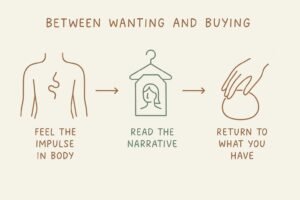
This practice is about pausing the automatic response to the “I want it” signal — observing the movement of mind behind the impulse, and recovering the space of choice.
STEP 1: Feel the impulse in the body
When a strong urge arises — I need that — stop before opening the app, and bring attention to where and how the desire is registering in the body.
“Right now, there is a ‘wanting’ sensation happening in my body.”
The heat in the chest, the tightening in the stomach, the specific itch in the fingers to click — receive these as objects of observation. The fusion between the action of buying and the sensation of wanting begins to loosen. The impulse can be seen as a passing phenomenon rather than a command.
STEP 2: Read the story the clothes are selling
Look at what you want to buy and examine what is arising in the mind.
“If I get this, what story am I expecting to become the protagonist of?”
The version of me who gets noticed. The version who isn’t left behind by the trend. The version who escapes the ordinary. The question is not about the garment — it is about recognizing that what is being purchased is a self-narrative. The act of buying is an attempt to replace the actual self with a performed one. Seeing this clearly changes the quality of the wanting.
STEP 3: Return to what you already have
Before buying something new, sit in front of your closet and pick up the clothes already there, one by one. Feel the texture of the fabric, the weight and color. Recall the circumstances of buying it, the times you wore it.
This practice deliberately redirects attention from what is absent to what is present — from the story of insufficiency to the reality of what already exists. It is the most direct interruption of the new-purchase impulse: not through suppression, but through returning to what is already here.
Session 3: The Wanting Was Designed
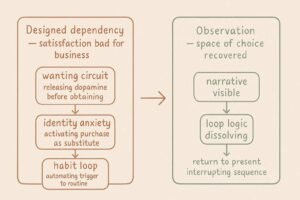
Not being satisfied is the intended outcome
Neuroscience shows that dopamine — the neurotransmitter most associated with reward — is released most strongly not when something is obtained, but when something might be obtained. Not a satisfaction circuit. A wanting circuit. Fast fashion’s rapid new-release cycles, perpetual sales, and limited-edition framing are all deliberate designs that exploit this mechanism by maintaining the condition of uncertain reward. The high of opening the package is structurally designed to be overtaken by the anticipation of the next purchase before the current one has lost its novelty.
The reason buying doesn’t satisfy is not that you want too much. It is that the system is engineered so that satisfaction would be bad for business.
Why clothes become a substitute for identity
Alongside the dopamine mechanism, a second force is operating. Social media creates conditions for continuous social comparison — and research consistently shows that social comparison destabilizes self-evaluation, generating a chronic background sense of I am not yet enough. This instability activates an identity substitution pattern: new clothes as a temporary self. The act of purchasing stops being about acquiring a garment and becomes a temporary resolution of identity anxiety. But since the clothes do not change the self-image at a deeper level, the anxiety returns quickly — and the next purchase is called for.
Why the loop is so hard to interrupt
Behavioral scientist Charles Duhigg described the structure of automatic behavior as a habit loop: trigger → routine → reward. In fast fashion dependency, the loop runs as: seeing a trend on social media → purchasing → the high of newness. Once this loop is sufficiently automated, the trigger initiates the purchase behavior with something close to reflex.
The only exit is between the trigger and the routine — a moment of observation before the sequence completes. When the narrative being purchased becomes visible, the loop’s logic partially dissolves.
The craving was designed
Fast fashion is not selling clothes. It is selling the message that you are not yet enough, and a temporary reprieve from that feeling. What sociologists call the commodification of the self — the condition in which maintaining a marketable, current self-image becomes a kind of ongoing obligation — is the deepest business logic of the fast fashion model. The anxiety of becoming out of date, of falling behind a trend that is replaced before it has been absorbed: this anxiety is not naturally occurring. It is continuously manufactured.
The dependency and the self-disgust that follow are not evidence of personal weakness. They are evidence that the system is working as intended.
Conclusion: The Clothes Already There
The wanting will keep arriving. The system will keep manufacturing the sense of not-enough. The loop will run tomorrow the same as today.
But before the next purchase, there is always the closet. The clothes already there — their weight, their texture, the memory of where you were when you wore them. That is what the system cannot manufacture: the specific, already-existing reality of what is yours.
The wanting is designed. The noticing is yours.
KEY TERMS
Anticipatory Reward and Dopamine
The neuroscientific finding that dopamine is released most strongly not when something is obtained but when it might be obtained. A wanting circuit, not a satisfaction circuit. Fast fashion’s new-release cycles, perpetual sales, and limited-edition framing deliberately exploit this mechanism by maintaining the condition of uncertain reward. The reason purchasing doesn’t satisfy is not a failure of willpower — it is the designed outcome of a system that requires ongoing wanting.
Social Comparison and Identity Instability
The psychological mechanism by which continuous social comparison — intensified by social media — chronically destabilizes self-evaluation, generating the background sense of I am not yet enough. This instability activates an identity substitution pattern: new clothes as a temporary self. Since the garment cannot resolve the underlying instability, the anxiety returns and the next purchase is triggered.
Habit Loop
A concept from behavioral scientist Charles Duhigg describing the three-part structure of automatic behavior: trigger, routine, reward. In fast fashion dependency: seeing a trend → purchasing → the high of newness. Once automated, the trigger initiates the purchase behavior with something close to reflex. The only exit is the gap between trigger and routine — a moment of observation before the sequence completes.
Commodification of the Self
The social condition in which maintaining a marketable, current self-image becomes an ongoing obligation. The deepest business logic of the fast fashion model: not selling garments but selling the anxiety of being out of date, and a temporary resolution of that anxiety. The dependency and self-disgust that follow purchases are not personal failings — they are the intended outputs of a system designed around manufactured insufficiency.
Defusion
The capacity to notice the fusion between a thought — buying this will make me the person I want to be — and one’s sense of reality, and to create a moment of distance from it. The common thread running through all three steps of Session 2: observing the impulse, reading the narrative, returning to what already exists. Each is an act of defusion — loosening the identification of clothes with identity.