
Introduction: By the Time You Feel “Itchy,” the Moment Has Already Been Processed

You’re sitting at a desk, or on a train, or waiting for something to begin. Something happens at the skin. A signal travels. And almost instantly — so fast it feels simultaneous — a word arrives: itchy. Then an impulse: scratch.
The word and the impulse feel like the sensation itself. They aren’t. There’s a step between the raw signal and the label, and that step is where the brain does a great deal of quiet work.
This practice is about spending a few minutes in that step — before the label, with the sensation itself.
Session 1: Why Removing the Label Matters

Sensation processing happens in two stages, and most people only ever experience the second one.
The first stage: the somatosensory cortex receives signals from the skin and muscles — pressure, temperature, vibration, position. Raw data. No evaluation yet, no meaning attached.
The second stage: the insular cortex and prefrontal cortex take that data and convert it into something usable — itchy, painful, pleasant, tense. A category. A response recommendation. A word.
What most people experience as “feeling something” is already the output of this second stage. Not the raw signal, but the processed, labeled, evaluated version of it. The sensation has been interpreted before it reaches awareness.
The brain doesn’t wait for signals to arrive before forming an opinion. Past experience with similar inputs produces a template — this pattern means itchy — and that template shapes the experience before it’s fully registered. Removing the label isn’t just a linguistic exercise. It’s an interruption of this predictive system, a brief return to the data before the interpretation runs.
Session 2: Three Steps
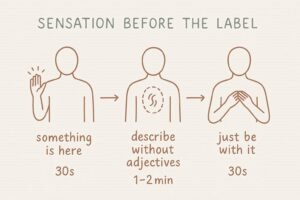
Starting with a neutral area — the palm, the sole of the foot — is easier than beginning with something already labeled as uncomfortable.
STEP 1: Choose a sensation without naming it (30 seconds)
Close the eyes and direct attention to one area of the body. Find whatever is most present there. Don’t name it yet. Just register: something is here. That’s the starting point.
STEP 2: Describe without adjectives (1–2 minutes)
Try to describe the sensation using location, movement, and change — without using evaluative words like warm, itchy, heavy, tight.
Location and extent — where exactly, and how large an area
Movement — expanding, pulsing, steady, shifting
Intensity pattern — constant, building, fading, irregular
Edge quality — does it have a clear boundary or does it blur into the surrounding area?
This step resists the instinct to summarize. The search for non-evaluative language keeps the mind in contact with the sensation rather than replacing it with a concept.
STEP 3: Stop describing and just be with it (30 seconds)
Let the description go. What remains is the sensation and the awareness of it — nothing added. If it changes, stay with the change. If it fades, stay with the fading. No action required.
Session 3: Why the Brain Has Already Decided What You’re Feeling
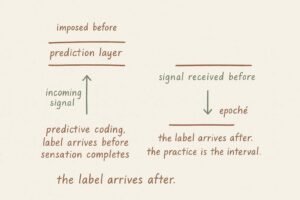
What we experience as sensation feels like direct contact with the world. The neuroscience suggests a more complicated picture.
The predictive coding framework — developed by Karl Friston and others as a unifying account of brain function — proposes that the brain is fundamentally a prediction engine. Rather than passively receiving sensory input and then interpreting it, the brain continuously generates predictions about incoming signals based on prior experience, and processes the incoming data primarily as a source of prediction errors: the difference between what was expected and what arrived. Signals that match the prediction are suppressed from conscious awareness — they’re treated as redundant confirmation of what was already known. Only the unexpected reaches full conscious processing. What this means for everyday sensation is that much of what feels like direct experience is actually the brain’s prediction, updated by incoming data rather than constructed from it.
The word itchy is not a neutral description of a signal. It is a predictive category — a template built from thousands of previous experiences with similar signals — that the brain imposes on the incoming data, shaping the experience before it is fully formed. The urgency of itching, the near-compulsive pull toward scratching, is not in the signal itself. It is part of the predictive package the brain attaches to that category of input. Describing without adjectives is an attempt to approach the signal before the predictive category fully activates — to stay with the data rather than the interpretation the data triggers.
This attempt has a philosophical parallel in what Edmund Husserl called epoché — the methodological suspension of assumptions, interpretations, and everyday categories to return to experience as it presents itself, prior to theoretical overlay. Husserl called this the phenomenological reduction: not a denial of the conceptual world, but a deliberate bracketing of it, in order to examine the structure of experience itself. The instruction to describe location, movement, and change rather than itchy or warm is a practical version of this bracketing — using language to approach experience rather than to replace it.
What both the neuroscience and the phenomenology point toward is the same gap: between signal and interpretation, between sensation and label, there is a step. It happens quickly — fast enough that the two feel simultaneous. But they are not simultaneous. The label arrives after the sensation. The practice is learning to stay in the interval, however brief, before the label closes it.
This is where Vedanā, in the Theravada Buddhist analysis, locates its most fundamental observation. Before sensation becomes pleasant or unpleasant — before the evaluation that drives craving or aversion — there is the bare reception of contact. Earlier in this series, Vedanā was approached through the passive sensory environment of a commute, and through the acute arousal of a stress response. This guide approaches it as the underlying structure of all sensory experience — the layer that was always there, beneath every label.
Conclusion: The Sensation Was There Before the Word
The label will arrive. It always does — quickly, automatically, with a response recommendation already attached. That’s the system working as it was built to work. The practice doesn’t ask it to stop.
What the practice asks for is the moment before. The sensation was always there before the word. The interval is where the practice lives.
KEY TERMS
Predictive Coding
The neuroscientific framework proposing that the brain processes sensory input primarily as prediction error — the difference between what was expected and what arrived. Familiar sensations are largely experienced as the brain’s prediction, updated by incoming data. The label itchy is a predictive category imposed on a signal pattern, shaping the experience before it is fully formed. Describing without adjectives is an attempt to approach the signal before the predictive category activates.
Two-Stage Sensory Processing
The somatosensory cortex performs primary processing of raw signals — pressure, temperature, vibration, position. The insular cortex and prefrontal cortex then perform secondary processing — evaluation, classification, labeling. Most of what is experienced as sensation has already passed through the second stage. The raw signal and the labeled experience are not the same thing.
Epoché (Phenomenological Reduction)
Edmund Husserl’s method of bracketing assumptions, interpretations, and conceptual categories to return to experience as it presents itself prior to theoretical overlay. The instruction to describe sensation using location, movement, and change rather than evaluative adjectives is a practical version of this bracketing — using language to approach experience rather than substitute for it.
Vedanā — The Universal Layer
In Theravada analysis, Vedanā is the bare reception of contact before sensation is evaluated as pleasant, unpleasant, or neutral — the layer prior to the craving or aversion that evaluation produces. This guide approaches it as the underlying structure of all sensory experience: not a specific context or stress state, but the gap between signal and label that is present in every moment of sensation. Phenomenological reduction and Vedanā approach this gap from different directions. The territory is the same.
Defusion
A core skill in Acceptance and Commitment Therapy (ACT): the capacity to observe thoughts as passing mental events rather than facts requiring immediate response. When itchy → scratch runs as an automatic sequence, pausing before the response — staying with the sensation rather than acting on the label — is defusion applied at the most fundamental level of sensory experience.