
Introduction: “This Will Never Change” Is Rarely Accurate

Somewhere in the middle of a hard week, or a difficult conversation that keeps returning — this stress is going to last forever. That person will never change. I’m stuck like this.
When these thoughts arrive, something is being experienced as fixed. Permanent. Settled.
But direct attention to the hand tells a different story. Right now, in the palm, there is sensation. In thirty seconds, it will not be exactly the same sensation. What appears fixed is, at the level of direct experience, continuously moving.
This practice is about confirming that — in the most immediate way available.
Session 1: Why the Palm

The nervous system responds more strongly to change than to stable conditions.
This is sensory adaptation: receptors reduce their response to a stimulus that remains constant, and sharpen their response when something changes. The moment of change carries the most information. Stable conditions, by contrast, tend to fade from awareness — which is part of why chronic situations feel permanent. It’s not that they aren’t changing. It’s that the changes are happening below the threshold where adaptation has suppressed the signal.
The palm is well-suited for this observation. It contains a high density of sensory receptors reporting continuously on temperature, pressure, vibration, and blood flow. Most of this reporting runs in the background. Directed attention brings it forward.
What makes the practice more than a sensory exercise is the temporal dimension. Every sensation has a structure in time — a beginning, a period of change, an ending. This structure is always present. It is rarely noticed.
Session 2: Three Steps

Curiosity rather than judgment is the only requirement.
STEP 1: Map what’s present (1 minute)
Direct attention to the non-dominant palm. Eyes closed, not touching anything. Explore whatever sensations are present — not to name them, but to locate them.
Something faint near the base of the little finger
A kind of emptiness in the center
A pulse in the thumb
Presence or absence, movement or stillness — simple observations only.
STEP 2: Follow one sensation through its full arc (2–3 minutes)
Select the most distinct sensation and stay with it through its complete temporal structure. Most people lose it within seconds — the attention slides off the sensation and onto something else. That sliding is part of the practice.
Emergence — how did it enter awareness? Gradually or suddenly?
Change — what is shifting? Intensity, quality, location?
Dissolution — how does it leave? Abruptly, gradually, or by becoming something else?
Not chasing it — staying with it as it moves.
STEP 3: Receive the whole as a flow (1 minute)
Widen attention to the entire palm. Rather than tracking individual sensations, receive the whole field — sensations arising, changing, dissolving — as a continuous process rather than a static state.
Session 3: Why the Nervous System Mistakes Persistence for Permanence
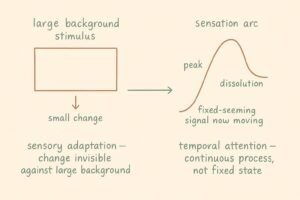
The feeling that a difficult situation will last forever is not simply pessimism. It reflects something specific about how the nervous system processes persistent conditions.
Sensory adaptation — the reduction in receptor response to a constant, unchanging stimulus — operates not only at the level of physical sensation but as a general feature of neural processing. A chronic stressor, experienced continuously, begins to be registered as background: the baseline against which other things are measured rather than a change that requires response. The variations within it — the small improvements, the momentary reliefs — fall below the threshold of detection that adaptation has set. The situation isn’t static. The nervous system is treating it as if it were. This is one mechanism behind the subjective experience of being stuck.
The Weber-Fechner law formalizes the relationship between stimulus change and perception: the smallest detectable change in a stimulus is proportional to the magnitude of the background stimulus. Against a large background, small changes are imperceptible. Against a small background, the same changes register clearly. This is why chronic stress makes recovery hard to feel — the recovery is real, but it’s occurring against a background large enough to suppress its detection. Directing explicit attention to present sensation is an attempt to re-engage with the background itself, bringing the suppressed signal forward rather than assuming the background is all there is.
The temporal structure of sensation — the finding that every sensory experience has a beginning, a period of change, and an ending, even when it’s experienced as a static state — points to a different mode of engagement with the same input. When a sensation is followed through its arc of emergence, change, and dissolution, the processing that would otherwise classify it as a fixed background condition is interrupted. The same signal, attended to differently, produces a different relationship to it.
The more general implication is direct: what appears fixed, at the level of experience, is a continuous process of change. This is not a philosophical position to be adopted but an observation to be confirmed directly. Contemplative traditions that have worked closely with sustained sensory observation have arrived at the same place — not as doctrine but as something practitioners found when they looked carefully enough and long enough.
Conclusion: It Was Always Moving

The sense of being stuck is real — not as a misreading of the situation, but as an accurate report of what the nervous system is doing. Adaptation suppresses the signal of change. The background becomes the whole picture. The system is working exactly as it was built to work.
The change never stopped. The attention did.
KEY TERMS
Sensory Adaptation and Change Detection
The nervous system reduces its response to constant, unchanging stimuli and sharpens its response to change. The most information-rich moment in any sensory sequence is the moment of change, not the stable plateau. Chronic conditions feel permanent partly because adaptation has suppressed the signal of their variation. Directing explicit attention to present sensation is an attempt to re-engage with what adaptation has moved to background.
Weber-Fechner Law
The perceptual principle that the smallest detectable change in a stimulus is proportional to the background stimulus magnitude. Small recoveries within chronic stress are harder to feel not because they aren’t happening, but because the background is large enough to suppress their detection. The quantitative basis for why directing attention to present sensation — rather than assuming the background — can shift what is perceived.
Temporal Structure of Sensation
Every sensory experience has a beginning, a period of change, and an ending — a structure in time that is present whether or not it is noticed. Attending to this structure shifts the experience from state to process. The same input, engaged with differently, produces a different relationship to it.
Psychological Flexibility
The capacity to hold experience — sensation, emotion, thought — as a changing process rather than a fixed fact. Correlates with stress tolerance, emotional regulation, and resilience. Develops through repeated sensory observation rather than conceptual understanding. The practical implication of everything the previous three terms describe.
Anicca
The observation, arrived at through sustained attention to direct experience, that sensations, emotions, and mental events arise, change, and pass — without exception. Not a belief to hold but something practitioners found when they looked carefully and consistently. The temporal structure described in this guide’s neuroscience — emergence, change, dissolution — is what this observation points at. The language differs. The territory is the same.
Defusion
A core skill in Acceptance and Commitment Therapy (ACT): the capacity to observe thoughts as passing mental events rather than facts requiring immediate response. When *this feeling will never end* arrives as a certainty, recognizing it as a thought — and returning attention to the sensation that is, right now, already changing — is defusion applied to the specific distortion of permanence.