
Introduction: The Moment Sitting Ends, a Different Practice Begins

A quiet room, the breath, the movement of thought observed and released — formal practice is real. Something is genuinely developed there.
But the attention trained in that room has not yet been tested. There is no emotional charge, no interpersonal friction, no unpredictable event. Formal practice is where the skill is built. Whether it actually functions is something only daily life can answer.
This is not a moral instruction to stay mindful throughout the day. It is a learning science question: what conditions are required for a skill to generalize beyond the context in which it was acquired?
Session 1: Why Daily Practice Is Not Optional

Learning psychology has a well-documented phenomenon called context-dependent learning: skills and memories are stored in association with the conditions in which they were acquired, and do not automatically transfer to different conditions. The attentional control developed in the low-stimulation, low-arousal environment of formal sitting practice is stored in association with that context. In the high-stimulation, high-arousal environment of a difficult conversation or a stressful commute, it is not automatically available — not because the practitioner has failed, but because the learning structure requires more.
The related phenomenon of state-dependent learning adds a further dimension. Skills acquired in one internal state — calm, low emotional arousal, undisturbed — are less readily accessed in a significantly different internal state: anxious, frustrated, pressured. The gap between the state of formal practice and the state of daily difficulty is real, and it is a gap that only practice in the more demanding state can close.
This is why daily practice is not the application of formal practice. It is the completion of it. The range of conditions in which attentional control functions expands only through practice across that range.
Session 2: Five Approaches
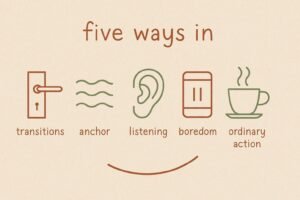
APPROACH 1: Mark transitions deliberately
The boundaries between activities — entering a room, sitting down, opening a device — are natural switching points from automatic to intentional attention.
When passing through a door: at the moment the hand touches the handle, take one breath
When sitting down: receive the sensation of the body meeting the chair for three seconds
Before opening a laptop: one breath, confirm the intention to begin
The transition itself is the practice — not a performance of mindfulness, just a moment of deliberate noticing.
APPROACH 2: Return to a sensory anchor
When emotional arousal rises — tension, irritation, urgency — return attention to a specific physical sensation rather than trying to manage the emotion directly.
In a tense meeting: three seconds of attention to the contact of feet with the floor
When irritation builds: simply notice the sensation of breath at the nostrils
When concentration scatters: extend attention to the detail of a distant sound
This is not suppression. It is practicing attentional control precisely in the conditions where it is most needed.
APPROACH 3: Make listening the practice
In conversation, stop preparing what to say next, and make listening itself the object of attention.
Receive the tone, the pace, the pauses, the quality of the other person’s voice
Notice internal reactions — agreement, discomfort, judgment — while continuing to listen
The noticing and the listening at the same time: this is the practice
Interpersonal situations are among the highest-arousal contexts available — and unavailable in formal sitting.
APPROACH 4: Observe boredom directly
Waiting for a signal, standing in a queue — before reaching for the phone, observe the sensation of boredom itself.
Where in the body does boredom reside, and what is its actual texture?
Is it changing?
What does the impulse to relieve it feel like before it is acted on?
The one-beat pause before the automatic response is the intervention.
APPROACH 5: Direct attention to ordinary actions
Making coffee, washing dishes, walking between rooms — bring deliberate attention to the action as it is happening: smell, temperature, texture, sound.
Not doing it carefully, but noticing that attention is there
The confirmation that attention is present is the whole point.
Session 3: State-Dependent Learning, the Yerkes-Dodson Law, and Why the Cushion Is Only the Beginning
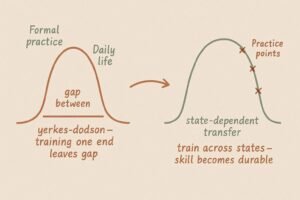
State-dependent learning has been documented across memory research since the 1970s. The finding is consistent: recall and skill performance are influenced by the match between the internal state at acquisition and the internal state at retrieval. Information learned while calm is less accessible under significant emotional arousal. Skills trained in low-arousal conditions show reduced transfer to high-arousal conditions. The gap between the internal state of formal sitting practice and the internal state of a genuinely difficult moment in daily life is not a failure of commitment — it is the learning structure predicting exactly this outcome. The only way to close that gap is to practice attentional control in the higher-arousal state. Daily life provides the conditions that formal practice cannot.
The Yerkes-Dodson law, established by psychologists Robert Yerkes and John Dodson in 1908, describes the relationship between arousal level and task performance as an inverted U-curve: too little arousal and performance declines through inattention; too much and it declines through interference. Formal sitting practice operates at the low end of this curve — reducing stimulation, quieting the arousal system, allowing fine-grained attentional work. Daily emotional situations operate toward the upper range. The combination of both is what develops attentional control across a wide range of conditions. Either alone leaves the range incomplete. The most durable attentional skill is the one trained at multiple points along the curve — not only at the quiet end.
What contemplative practice has long called sustained awareness through ordinary action — knowing what one is doing, why, and to what end, maintained through the movements of a daily life — is what the learning science here describes as transfer across states and contexts. The map was drawn long before the mechanism was understood. What the research confirms is this: formal practice and daily practice are not the same practice at different scales. They develop different things, and both are required.
Sociologist Erving Goffman’s work on impression management describes how people shift roles, presentations, and behavioral registers across different social contexts — workplace, family, public space, intimate relationship. Each context carries different cognitive and emotional demands. The attention trained in one context does not automatically operate in another. The formal practice context — quiet, private, role-free — is perhaps the most contextually distinct environment available. Generalizing from it requires, by the logic of context-dependent learning, deliberate practice in each of the other contexts that matter. The commute, the difficult conversation, the tedious task — each is a context with its own demands. The skill that functions across all of them is not the one trained only where it is easiest.
Conclusion: The Day Is the Other Half of the Practice
Today, choose one approach. Any of the five. Find a moment when emotional arousal rises — tension, irritation, urgency — and pause for one beat before the automatic response fires.
Whether it works or not, that experience is the data. The formal practice built the capacity. The day is where the range gets tested — and extended.
The cushion is where attention learns what it is. Daily life is where it finds out what it can do.
KEY TERMS
State-Dependent Learning
The finding, consistent across memory research since the 1970s, that recall and skill performance are influenced by the match between internal state at acquisition and internal state at retrieval. Skills trained in low-arousal conditions show reduced transfer to high-arousal conditions. The gap between formal sitting practice and daily emotional situations is a predictable consequence of this structure — and the only way to close it is practice in the more demanding state. Daily life is not the application of formal practice. It is where the skill completes its formation.
Context-Dependent Learning
The principle that memories and skills are stored in association with the conditions of acquisition and do not automatically transfer to different conditions. Formal sitting practice is a highly specific context — quiet, low-stimulation, role-free. Skills acquired there are stored in association with those conditions. Generalizing them across the multiple contexts of daily life requires practice in each. Transfer is not automatic; it is built through repeated exposure across varied conditions.
Yerkes-Dodson Law
Robert Yerkes and John Dodson’s 1908 description of the inverted U-curve relationship between arousal level and task performance. Formal practice operates at the low-arousal end; daily emotional situations operate toward the higher end. Developing attentional control that functions across a wide range of conditions requires practice at multiple points along the curve. The most durable skill is the one trained at both ends — not only where it is easiest.
Impression Management and Context Switching
Erving Goffman’s observation that people shift roles, presentations, and behavioral registers across different social contexts — each carrying distinct cognitive and emotional demands. By the logic of context-dependent learning, attentional skills developed in one context do not automatically generalize to others. Each context — the commute, the difficult conversation, the workplace, the family — requires its own version of the same practice.
Defusion
When I’m completely failing at this in daily life or the practice doesn’t work when it actually matters arrives as a verdict, recognizing it as a thought rather than an accurate assessment — and returning attention to whatever is present in this specific moment — is defusion applied to the discouragement that the gap between formal practice and daily life reliably generates.