
Introduction: Willpower Isn’t the Problem. It Was Never Meant to Be the Engine.

How many days did the meditation streak last after the decision to start — most people have a slightly uncomfortable answer to that question.
The reason it didn’t continue isn’t weak willpower. It’s that the design relied on willpower in the first place.
Behavioral science has consistently found that habits are not built by resolve — they are triggered by context. Intention alone is an unreliable activator. What makes behavior stable is a prior design: when this situation arises, I do this. The decision is made once, in advance, so it doesn’t have to be made again in the moment.
A personal rule is that design, built by you, for your own life.
Session 1: The “If X, Then Y” Structure

Psychologist Peter Gollwitzer has spent decades studying what he calls implementation intentions — the simple structure of if situation X arises, I will do Y. The finding, replicated across domains from health behavior to study habits, is consistent: people who form implementation intentions follow through at significantly higher rates than those who set goals alone.
The reason isn’t motivational. It’s architectural. A goal gives direction. A trigger initiates movement. Implementation intentions work not by strengthening willpower but by creating an activation pathway that doesn’t require willpower to fire. The decision has already been made. When the trigger arrives, the action follows.
When I reach for the coffee cup, I take three seconds to notice the smell first — this is not a goal. It is a design. The coffee cup is the trigger. The noticing is what the trigger releases.
Session 2: Three Steps
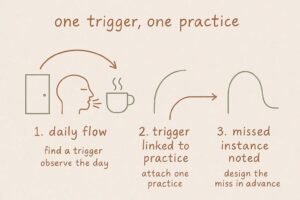
STEP 1: Find a trigger (one day to a few days)
Observe the flow of your ordinary day without evaluation. Look for things that happen reliably — movements, transitions, physical sensations.
Spatial thresholds: passing through a door, sitting down, boarding a train
The start of an action: reaching for a cup, opening a laptop, beginning a conversation
Body signals: noticing the breath has become shallow, noticing tension in the shoulders
No trigger is better than another. The only criterion is that it happens every day without fail.
STEP 2: Attach a practice
Connect the trigger you’ve found to one practice from this series — whichever felt most natural.
Every time I pass through a door, I pause and feel one breath
When I reach for the coffee cup, I notice the smell for three seconds first
When I look at the time, I check in briefly with the body
When I sit down, I notice where the shoulders are
One trigger, one practice. Keep it simple enough to actually happen.
STEP 3: Design the miss in advance
Decide now what happens when the rule doesn’t fire. When you notice later that you walked through the door without pausing — receive that noticing as the practice. Don’t make it mean anything about the rule or about you. Note it, adjust if needed, continue.
Session 3: How Habit Becomes Character — and Why the Environment Does the Work
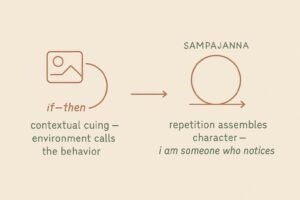
Cognitive psychology has documented a phenomenon called contextual cuing: specific locations, times, and actions unconsciously activate associated memories and behavioral patterns. For someone who drinks coffee at the same desk every morning, the cup — the physical object in that context — calls up the behavioral sequence that follows it, without deliberate choice. This is learned association, and it fires automatically. Designing a personal rule is a deliberate use of this mechanism: creating a new association so that a specific context begins to call up a moment of awareness. Gollwitzer’s implementation intention research shows that this associative formation is accelerated by conscious prior decision — the if-then structure encodes the link more reliably than repeated exposure alone.
Behavioral economists Thaler and Sunstein developed the concept of choice architecture — the observation that how choices are structured influences which choices get made, independent of motivation or preference. A personal rule is an act of self-directed choice architecture: taking a practice that exists as an option and building it into the default structure of the day. The practice is no longer something to remember to do. It is what a particular moment in the day now contains.
Aristotle wrote in the Nicomachean Ethics that virtues are formed through action — that a person becomes just by acting justly, becomes courageous by acting courageously. Character, in this account, is not a fixed property that precedes behavior. It is something that behavior gradually assembles. What contemporary behavioral science has confirmed through experiment, Aristotle described through philosophical observation more than two thousand years ago. What accumulates through a personal rule is not only the automation of a specific behavior. It is the slow formation of a self-understanding: I am someone who notices.
This is where a concept from Theravada practice enters quietly. Sampajañña — sometimes translated as clear comprehension — describes the quality of knowing what one is doing, why one is doing it, and where it is directed, continuously throughout the day. Where Sati — the capacity to notice what is arising — is the awareness of the present moment, Sampajañña is the understanding of purpose and direction woven into action. Traditional texts describe this quality as something cultivated not only on the cushion but in the movements of ordinary life: walking, reaching, sitting, standing. A personal rule is one way that behavioral science has arrived at the same destination. The language is different. The territory is the same.
Conclusion: When the Rule Disappears, the Practice Has Arrived

The rule will not always fire. Some days the trigger passes unnoticed, the moment is lost, and the practice doesn’t happen. That’s not a failure of the rule — it’s the condition the rule was designed to work within. The miss is part of the structure. The noticing of the miss is itself the practice.
The rule isn’t the practice. The moment it fires without thinking — that’s when the practice became yours.
KEY TERMS
Implementation Intention
Peter Gollwitzer’s term for the if-then structure of behavior planning: if situation X arises, I will do Y. Consistently shown to produce higher follow-through rates than goal-setting alone across domains including health behavior, study habits, and self-regulation. The mechanism is architectural rather than motivational — implementation intentions work by creating an activation pathway that doesn’t require willpower to fire. The decision is made once; the trigger does the rest.
Contextual Cuing
The cognitive phenomenon by which specific locations, times, and actions unconsciously activate associated memories and behavioral patterns. Learned association, firing automatically. A personal rule deliberately uses this mechanism — building a new association so that an ordinary moment begins to call up a moment of awareness. The same process that sustains habits also sustains the automatic behaviors we’d prefer to change; the design direction is what differs.
Choice Architecture
Thaler and Sunstein’s concept: the structure in which choices are presented influences which choices are made, independent of motivation. A personal rule is self-directed choice architecture — transforming a practice from an option into the default structure of a particular moment. The principle applies equally to policy design and to the design of an ordinary day.
Sampajañña
A Theravada concept often translated as clear comprehension — the quality of knowing what one is doing, why, and to what end, maintained continuously throughout the day. Where Sati is the capacity to notice what is arising, Sampajañña is the understanding of purpose and direction that accompanies that noticing. Traditional texts describe its cultivation not only in formal meditation but in the movements of ordinary life. A personal rule is one way behavioral science has arrived at the same practice. The language differs. The territory is the same.
Defusion
A core skill in Acceptance and Commitment Therapy (ACT): the capacity to observe thoughts as passing mental events rather than facts requiring immediate response. When I keep forgetting or this isn’t working arrives as a verdict about the rule or about yourself, recognizing it as a thought rather than an assessment — and returning to the next time the trigger arises — is defusion applied to the self-evaluative response that habit formation reliably generates.