
Introduction: Gratitude Is Not a Feeling You Wait For

Someone says “just be grateful” and something in you resists it. That resistance is reasonable. “Be grateful” tends to arrive as a moral instruction. But gratitude isn’t a virtue, and it isn’t an obligation.
It’s a cognitive operation — a way of deliberately redirecting attention.
Same room, same circumstances. But the quality of experience is fundamentally different depending on whether attention is on what’s present and functioning, or on what’s missing and going wrong. Gratitude is a simple, reliable device for making that shift intentionally.
Session 1: Why Gratitude Is Hard

The difficulty with gratitude isn’t a character flaw. It’s a design feature.
The human attention system defaults to loss, threat, and insufficiency. This is the optimization that kept our ancestors alive — the brain prioritizes what’s going wrong over what’s going right, because what’s going wrong requires a response. Psychologists call this negativity bias: negative events carry more weight than positive ones in attention, memory, and emotional processing. It’s not a malfunction. It’s the factory setting.
On top of this, things that are consistently present stop being noticed. A body that functions, a safe place to sleep, a person who is reliably there — these recede into background as they persist. The brain classifies them as baseline rather than gain. Gratitude isn’t hard because there’s nothing to be grateful for. It’s hard because the things worth being grateful for are precisely the ones the brain has learned to stop seeing.
The practice is a deliberate intervention in that design.
Session 2: Three Steps
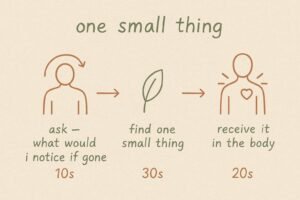
Works anywhere — after a morning routine, before sleep, in the middle of a heavy moment.
STEP 1: Ask the question (10 seconds)
Rather than deciding to feel grateful, ask: What’s here right now that I’d notice if it were gone? The question itself is the switch. It redirects attention before any particular feeling has to arrive.
STEP 2: Find one small thing (30 seconds)
On heavy days, the search resists itself — nothing feels significant enough. That’s the condition under which one small thing is most worth finding. It doesn’t need to be significant. Something functioning, something present, something that’s quietly doing its job.
One part of the body that’s working today
The temperature of the room, the quality of the light, the fact of quiet
Something small that went well today, or simply happened
One is enough. No list required.
STEP 3: Receive it in the body (20 seconds)
Don’t let the finding stay as a thought. Bring attention to the body — is there anything in the chest, the breath, the face? A shift, however slight? Whether something changes or nothing does, that’s the current state. No evaluation. Just notice.
Session 3: Why the Brain Overlooks What’s There — and How to Look Again
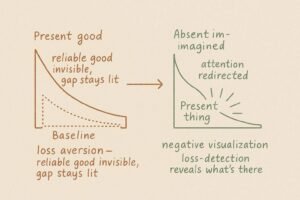
Cognitive psychology’s framework of positive reappraisal describes the process of changing not a situation but the way attention is directed toward it — altering the meaning assigned to an experience rather than the experience itself. Gross’s research on emotion regulation has consistently found that reappraisal is more effective than suppression: trying not to feel something is less efficient than changing how a situation is being read. Gratitude is a specific form of positive reappraisal — redirecting attention from what’s absent to what’s present, from what’s failing to what’s functioning. The situation doesn’t change. The attention does. And that turns out to be enough to shift the quality of the experience.
Behavioral economics explains why this redirection requires effort. Kahneman and Tversky’s work on loss aversion — the finding that losses feel larger than equivalent gains — applies not just to decisions but to attention itself. Things that are consistently present are processed as baseline, not benefit. They don’t register as gains because the brain has reclassified them as neutral. Things that are absent, at risk, or insufficient are processed as potential losses and pulled into the foreground. The attentional asymmetry this creates is structural: the good that’s reliably there becomes invisible; the gap between what is and what’s wanted stays lit. Gratitude practice is an intervention at exactly this point — a deliberate reclassification of baseline as gain.
The most counterintuitive tool for generating gratitude comes not from psychology but from Stoic philosophy. Negative visualization — the deliberate practice of imagining the absence of something currently present — appears repeatedly in Epictetus, Marcus Aurelius, and Seneca. The logic is precise: trying to feel grateful directly is effortful and often fails; imagining loss activates the brain’s detection system in a way that naturally produces appreciation. Contemporary psychology has supported this intuition experimentally. Wilson and colleagues found that mentally subtracting a positive event from one’s life — imagining it had never happened — produced stronger appreciation for it than simply reflecting on how good it was. The question — what would I notice if it were gone — is built on this same mechanism. It uses the brain’s loss-detection system to illuminate what the gratitude-detection system tends to miss.
The neuroscience of gratitude is real but still being mapped. What’s clear is that the cognitive mechanism — redirecting attention — functions independently of mood state. Gratitude practice doesn’t require feeling good first. The reappraisal happens at the level of attention, and the feeling, when it arrives, follows from that. On heavy days, the operation is the same. The effort required may be greater. The mechanism is identical.
Conclusion: Gratitude Is Attention, Aimed Differently

The brain’s default is to register what’s missing, what’s at risk, what hasn’t arrived yet. This isn’t pessimism. It’s the architecture — built for threat detection, not inventory. Left to run without interruption, it produces a reliable accounting of everything that falls short.
Gratitude isn’t a feeling that arrives. It’s the moment attention lands on what was already there.
KEY TERMS
Positive Reappraisal
The emotion regulation strategy of changing not a situation but the way attention and meaning are directed toward it. Identified by Gross as more effective than emotional suppression in his process model of emotion regulation. Gratitude is a specific application: redirecting attention from absence to presence, from deficit to function. The situation is unchanged; the attentional frame shifts, and the quality of experience shifts with it.
Loss Aversion
Kahneman and Tversky’s finding that losses are weighted more heavily than equivalent gains in human cognition — applied here to attention itself. Things that are consistently present are reclassified as baseline and stop generating positive signal. Things that are absent or at risk are pulled into attentional foreground. This asymmetry is why gratitude requires deliberate effort: the brain’s default is to notice the gap, not the ground.
Negative Visualization
A practice from Stoic philosophy — deliberately imagining the absence of something currently present in order to make its presence vivid. Found in Epictetus, Marcus Aurelius, and Seneca. The counterintuitive logic: direct attempts to feel grateful are often effortful and unreliable; imagining loss activates the brain’s detection system in a way that naturally produces appreciation. Experimentally supported by Wilson and colleagues.
Negativity Bias
The universal human tendency for negative events to carry greater weight than positive ones in attention, memory, and emotional processing — the cognitive asymmetry that makes gratitude structurally difficult. Not a character flaw but an evolutionary optimization. Gratitude practice is a deliberate intervention in this default setting, redirecting attention toward what the system is designed to overlook.
Defusion
A core skill in Acceptance and Commitment Therapy (ACT): the capacity to observe thoughts as passing mental events rather than facts requiring immediate response. When there’s nothing to be grateful for arrives as a conclusion rather than a thought, recognizing it as a thought — and returning to the question of what would be noticed if it were gone — is defusion applied to the specific resistance this practice reliably generates.