
Introduction: What Is Actually Happening When Experts Contradict Each Other

Health advice, investment strategy, parenting theory — every domain has its experts, and their opinions are sometimes directly opposed. Now AI presents answers in a confident, authoritative tone. The question who am I supposed to believe deepens with every additional source.
But the anxiety rests on a premise worth examining: that expert opinions should converge. That premise may be a misunderstanding of what knowledge actually is.
Session 1: The Contradiction Isn’t the Problem

The disagreement is supposed to resolve into an answer. When it doesn’t — when the next expert contradicts the last — the instinctive conclusion is that someone must be wrong, or that the topic is too complex for a non-expert to navigate. Both conclusions follow from the same assumption: that knowledge, when properly developed, produces consensus.
Scientific knowledge doesn’t work that way. It is constructed rather than discovered — formed through the best available evidence and reasoning at a given moment, and revised as better evidence and frameworks emerge. The theory that was definitive last decade becomes the approximation that this decade’s research refines. This is not failure. It is the mechanism through which knowledge improves.
When experts hold different positions, they are typically working from different evidence, different methodologies, or different foundational assumptions. The disagreement between them is not a sign that the field is broken. It is a sign that the field is alive — that the questions are still open and the investigation is ongoing.
When that expectation of finality is relaxed, the disagreement stops being a problem to solve and becomes something more useful: a map of where the genuine uncertainty lies.
Session 2: Practice — Using Knowledge Rather Than Borrowing It
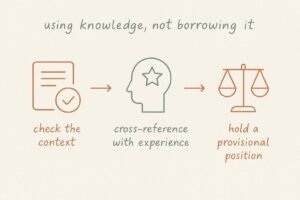
This practice is about changing the relationship with expertise — from receiving it as a verdict to treating it as material that requires the person receiving it to do something with it.
STEP 1: Check One Thing About the Context
When an expert opinion arrives, note one thing about the context it comes from.
Who is speaking here, and what are they working from?
A complete investigation isn’t required. Simply holding the awareness that this is a position taken from a particular standpoint — rather than a transmission of neutral truth — shifts how the information lands. It moves from isolated fact to situated claim, which is what it actually is.
STEP 2: Cross-Reference With Personal Experience
Before taking in an expert recommendation as definitive, bring it into contact with actual experience.
Does this align with what I’ve observed in my own life? Is there a gap between the intellectual understanding and what the body or the situation seems to indicate?
What AI cannot produce is the felt sense of a specific person in a specific situation. The gap between received knowledge and lived experience is not a sign of confusion. It is the beginning of genuine judgment.
STEP 3: Hold a Provisional Position
Replace the goal of finding the one right answer with the goal of maintaining the most accurate current understanding — one that is open to revision.
Based on what I know now, this seems most likely to be true. If better evidence or a different perspective arrives, I’ll update.
This is not indecision. It is the epistemic stance that matches how knowledge actually works. When experts contradict each other, it becomes possible to hold both positions as provisional reference points rather than being forced to choose one as the definitive truth.
Session 3: The Disagreement Was the Knowledge Working
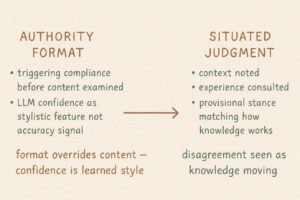
What Knowledge Is Actually Doing When It Updates
Philosopher of science Thomas Kuhn demonstrated that scientific progress does not occur through the steady accumulation of confirmed facts but through paradigm shifts — moments when the entire framework through which a field understood its subject is replaced by a new one. What was correct within the old paradigm becomes an approximation, or an error, within the new one. This is not science failing. It is science’s self-correction mechanism operating as designed. When experts in a field hold contradictory positions, they are often working within different paradigms, or working at the edge of a paradigm that has not yet been replaced. The expectation that expertise produces consensus misunderstands the structure of knowledge at its most fundamental level. Disagreement between experts is not a sign that something has gone wrong. It is what a living field looks like from the outside — evidence that the questions are still being worked on, that the evidence is still being contested, and that the knowledge is still moving.
The Format That Stopped the Thinking
Social psychologist Stanley Milgram’s experiments on obedience demonstrated that the presence of a recognized authority reliably produces compliance that overrides individual judgment — including, at the extreme, ethical judgment. The mechanism is not stupidity or weakness. It is a cognitive shortcut that conserves resources in a complex world: when a recognized authority speaks, the cognitive work of independent evaluation can be suspended. The problem is that this shortcut operates on the format of authority rather than its content. The title, the institutional affiliation, the confident tone — these trigger the compliance response before the substance of the claim has been examined. Kuhn’s insight — that knowledge is provisional and expert disagreement is normal — does not automatically override this tendency. The person who intellectually understands that experts can be wrong will still feel the pull toward the one who sounds most authoritative. The format does something the content cannot easily undo.
The Confidence Was a Style, Not a Signal
Large language models generate text by predicting, at each step, which word is most likely to follow the words already produced — based on patterns learned from vast quantities of human-written text. The output is not the result of understanding, reasoning, or access to verified facts. It is the result of statistical pattern completion. The text that a well-trained LLM produces is, by design, maximally plausible — it reads like authoritative writing because it was trained on authoritative writing. The tone of confidence, the structured argumentation, the apparent command of detail: these are learned stylistic features, not signals of accuracy. Milgram showed that authority in format produces compliance regardless of authority in substance. LLMs produce authority in format as their primary output. The combination creates a specific epistemic problem: a system that generates maximally convincing text without any mechanism for distinguishing true from plausible, evaluated from asserted, known from inferred. The confidence is not a feature of the knowledge. It is a feature of the text.
Conclusion: Disagreement Was Always the Sign of a Living Field

Experts will keep disagreeing tomorrow. The authority compliance tendency will keep responding to whoever sounds most certain. LLMs will keep producing confident-sounding text from probabilistic generation. The structure does not change. But the question who is speaking here, and what are they working from can be asked before any expert opinion, before any AI output, at any moment when a confident claim arrives. That question is what moves knowledge from something borrowed to something used.
The experts weren’t failing when they disagreed. That was knowledge doing what knowledge does.
Key Terms
Provisional Nature of Knowledge
Thomas Kuhn’s demonstration that scientific knowledge advances not through accumulation but through paradigm shifts — the replacement of one explanatory framework by another — meaning that what is correct within one paradigm becomes an approximation or error within the next. Expert disagreement reframed not as failure but as the normal appearance of a living field: evidence that questions are still open, evidence is still contested, and knowledge is still moving. The expectation of expert consensus misunderstands knowledge at its most fundamental level.
Authority Compliance Bias
Stanley Milgram’s finding that the presence of a recognized authority reliably produces compliance that overrides individual judgment — operating on the format of authority (title, tone, institutional affiliation) rather than its content. A cognitive shortcut that conserves resources but suspends independent evaluation before the substance of a claim is examined. Combined with Kuhn’s provisional knowledge, it produces the specific problem of treating updatable positions as settled truths because of who or what delivered them.
Probabilistic Generation in LLMs
The mechanism by which large language models produce text by predicting the statistically most likely continuation of a sequence — generating maximally plausible output from pattern completion rather than from understanding, reasoning, or verified facts. The confident tone, structured argumentation, and apparent command of detail are learned stylistic features of authoritative writing, not signals of accuracy. The combination of LLM output with Milgram’s authority compliance bias creates an environment in which the most convincing text and the most accurate text are structurally indistinguishable.
Provisional Stance
The epistemic position of maintaining the most accurate current understanding while remaining genuinely open to revision — replacing the goal of finding the one right answer with the goal of holding the best available approximation. Not indecision but the stance that matches how knowledge actually works. When experts contradict each other, a provisional stance makes it possible to hold both positions as reference points rather than being forced to resolve the contradiction into a premature certainty.
Defusion
The capacity to notice that the automatic response — this authority is reliable, therefore this claim is true — has fused with the experience of receiving expert or AI-generated information, and to create a brief observational distance before accepting it. Checking one thing about the context in which the claim was produced is the minimum intervention that moves the information from received verdict to situated position — which is what it was in the first place.