
Introduction: Eating Without Tasting

Scrolling through a phone, turning something over in your mind, and then the plate is empty. The fact of having eaten is there. The memory of what it tasted like is not. The intention was efficiency — combining two things at once — but something consistently fails to arrive.
That something has a neurological name.
Session 1: How Distracted Eating Became the Default

Eating while doing something else is not a failure of willpower or table manners. It became a default through a cultural process in which meal time was reframed as a productivity gap — a pause in the day’s output that could reasonably be filled with something more useful.
In a day structured around tasks and deliverables, eating occupies an unusual position: it is one of the few activities that produces nothing measurable. The pressure to fill that gap with something productive — a podcast, email, the news — is not irrational within a framework that treats time as a resource to be managed. Eating at a desk while continuing to work gradually became not just acceptable but a marker of dedication. The meal left the table long before the phone arrived to replace it.
The food environment compounds this. Contemporary food products are engineered to register in the senses even when attention is elsewhere — salt, sugar, and fat calibrated to cut through distraction, texture and color designed for maximum immediate impact. Distracted eating works, in a functional sense, because the sensory experience has already been outsourced. The food announces itself without requiring the eater to be present for it.
Session 2: Practice — Returning to the Meal
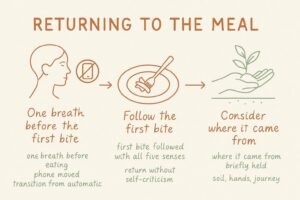
This practice is not about changing eating habits across the board. It is about creating moments in which attention briefly returns to the sensory experience of the meal — enough to let the body’s own signals be received.
STEP 1: One Breath Before the First Bite
Before reaching for the food, pause for a single breath.
I’m about to eat this.
That beat of intention is the transition from automatic to aware. Turning the phone face-down or moving it out of the visual field changes where attention goes without requiring a sustained effort of will. The aim is not to maintain this state throughout the meal — only to begin in it.
STEP 2: Follow the First Bite With All Five Senses
Bring full attention to the first bite. Notice the color and shape before it reaches the mouth. Catch the smell. Register the temperature and texture on contact. Listen for the sound when chewing begins. Follow the way the flavor develops and changes across the first few seconds.
When attention drifts — and it will — return to the sensation without self-criticism. The return itself is the practice. One bite is sufficient. There is no requirement to sustain this through the entire meal.
STEP 3: Take One Moment to Consider Where It Came From
Before swallowing the first bite, or at the end of the meal, hold a brief image of what it took for this food to arrive here.
Soil and water. Someone who grew it. Someone who moved it. Someone who cooked it.
This is not a performance of gratitude. It is a shift in the quality of attention — from consuming an object to receiving something that passed through many hands. Tasting and noticing share the same starting point.
Session 3: The Meal Became a Productivity Gap
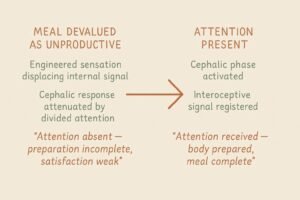
How the Table Was Left Behind
Juliet Schor’s analysis of time poverty takes a specific form at the table. Eating is one of the few daily activities that produces nothing measurable, which positions it as a gap in the productive day rather than a valued part of it. This is distinct from the general experience of time scarcity: what operates here is the specific devaluation of meal time as unproductive duration. The cultural shift is traceable. The working lunch — eating at the desk while continuing to produce — moved from exception to norm across the latter half of the twentieth century. Lunch breaks shortened. The table was replaced by the screen as the companion to the meal. These changes were not driven by individual preference. They followed from a framework in which time not directed toward output requires justification, and eating — nourishing, necessarily slow, sensory — resists that justification.
Taste Was Designed and Delivered From Outside
The modern food industry has developed sophisticated techniques for engineering sensory experience. The bliss point — the precise calibration of salt, sugar, and fat that maximizes palatability — is a documented design target. Texture is controlled for uniformity and immediate impact. Color and aroma are enhanced to signal freshness and quality that may or may not be present. As the writer Michael Pollan has observed, much of what contemporary people eat is not food in the traditional sense but food products — engineered substances designed to produce a specific sensory response. The consequence is a gradual displacement of internal sensation. When the sensory experience is delivered at sufficient intensity from outside, the body’s own signals — am I hungry, what do I want, have I had enough — become secondary. Distracted eating is sustainable in this environment precisely because the food has been built to work without the eater’s full participation. The absence of satisfaction after the meal is not a sign that the wrong food was chosen. It is a sign that the sensation was consumed without being experienced.
Without Attention, the Body Didn’t Prepare to Receive the Meal
The nervous system begins preparing for a meal before the first bite. This preparatory process — known as the cephalic phase response — is triggered by the sight, smell, and anticipation of food: salivation increases, gastric acid begins to be secreted, insulin is released in anticipation of incoming glucose. The cephalic phase response is driven by sensory attention. When the brain is genuinely engaged with the food in front of it, the response is robust. When attention is elsewhere — on a screen, on a problem, on the next task — the response is attenuated. The body receives the calories but the preparatory systems were only partially activated. Digestive efficiency is reduced. More significantly for the experience of eating, the satisfaction signal is weaker than it would otherwise be. The same meal, eaten with and without attention, produces measurably different physiological responses. The interoceptive signals are present. When attention is divided, they are less likely to register. The unsatisfied feeling after a distracted meal is not an absence of food. It is an absence of reception.
Conclusion: Attention Was Always Part of the Meal

The efficiency framework will keep treating meal time as a productivity gap tomorrow. The food industry will keep engineering sensation that works without full presence. The cephalic phase response will keep being attenuated when attention is elsewhere. The structure does not change.
But the question what does this actually taste like can be asked at any meal, before any first bite. That question — genuinely held for a single moment — is what the cephalic phase response was waiting for. The meal was complete. The attention was what was missing.
The meal was always there. The attention wasn’t.
KEY TERMS
Efficiency of Eating
The social process through which meal time was reframed as unproductive duration — a gap in the day’s output to be filled rather than a valued activity in its own right. Distinct from the general experience of time scarcity: what operates here is the specific devaluation of eating as non-productive, which made distracted eating a culturally rational response. The working lunch as norm rather than exception is one visible product of this shift.
Outsourcing of Sensation
The process by which food industry engineering — bliss point calibration, texture uniformity, enhanced color and aroma — delivers sensory experience at sufficient intensity to function without the eater’s full attention. Internal sensation signals — hunger, satiety, preference — become secondary to externally designed stimulation. Distracted eating becomes sustainable in this environment because the food was built not to require presence. The absence of satisfaction after such a meal reflects sensation consumed without being experienced.
Cephalic Phase Response
The preparatory physiological process triggered before the first bite by the sight, smell, and anticipation of food — including increased salivation, gastric acid secretion, and anticipatory insulin release. Driven by sensory attention: robust when the brain is genuinely engaged with the food, attenuated when attention is elsewhere. The same meal produces measurably different digestive and satisfaction outcomes depending on the quality of attention present. The neurological explanation for why distracted eating leaves the body insufficiently prepared to receive what it consumes.
Interoception and Eating
The body’s ongoing internal signal system — hunger, fullness, digestive state — that informs the experience of eating and the sense of satisfaction following a meal. When attention is divided, interoceptive signals are less likely to be processed and registered, even when the physiological state they describe is present. In combination with a weakened cephalic phase response, attentional absence during eating produces the characteristic experience of having consumed without being satisfied.
Defusion
The capacity to notice that the habit narrative — eating while doing something else is simply how meals work — has fused with the automatic behavior, and to create a brief observational distance from it. The single breath before the first bite is the interval in which the automatic chain can be interrupted — not to reform the habit entirely, but to allow one moment of genuine reception before the meal proceeds.