
Introduction: Why Sitting All Day Leaves the Mind Feeling Stuck
Morning commute, office desk, evening sofa. The body barely moves while attention races across screens. By the end of the day what remains is tight shoulders, heavy eyes, a dull ache in the lower back — and something harder to name. A vague restlessness. A thinness to the sense of being alive.
This is not a fitness problem. It is a reception problem. The body has been sending signals all day. The question is whether anything was there to receive them.
Session 1: The Body Became a Tool — and the Signal Went Quiet

In desk-centered urban work, the body is assigned a narrow function. Fingers type. Eyes track. The spine holds a position. Everything else the body might communicate gets filtered out as irrelevant to the task. This is not carelessness. It is optimization.
The workplace was not designed accidentally around stillness. Seated work came to carry the cultural weight of intellectual superiority — a visible distinction from physical labor, built into the architecture of the office itself. The body was arranged to support efficient thought. What it might do beyond that was treated as noise.
What this design extracts is something less visible than movement. When walking, stretching, balancing, feeling temperature and ground and resistance are removed from the day, the range of information the brain receives from the body contracts sharply. The variety narrows. The input becomes monotonous. The restless reach toward a phone, a snack, a news feed is not a failure of discipline — it is the brain’s automatic search for the stimulation the body is no longer providing.
The unsettled mind and the still body are the same condition, seen from two directions.
Session 2: Practice — Learning to Receive Again
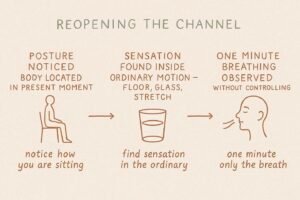
This practice is not about adding exercise to the day. It is about finding moments within what is already there — ordinary movements and pauses — and using them to reopen the channel between body and attention.
STEP 1: Notice How You Are Sitting
At the desk, in a meeting, on a commute — the moment you notice that you are sitting is the starting point. Is the back rounded? Are the shoulders rising toward the ears? Are the feet in contact with the floor? No correction is required. Just observation.
Then tilt the pelvis slightly upright and exhale once, fully. The aim is not to achieve correct posture. It is to locate the body — to register that it is here, in this chair, in this room, at this moment. That registration is what moves the body from unconscious object to conscious coordinate.
STEP 2: Find the Sensation Inside the Ordinary
Walking through an office or down a hallway, bring attention for a few seconds to the pressure of the foot against the floor and the subtle shift of weight from side to side. Drinking water, follow the coolness of the glass, the contact at the lips, the path of liquid through the throat. Standing up from a chair, reach both arms upward and stay with the sensation of the stretch through three full breaths.
No evaluation. No comparison. The only aim is to feel what is actually happening. These are not relaxation exercises. They are attempts to make contact with the interior signal that has been running beneath the day’s noise — to give the body’s transmissions somewhere to land.
STEP 3: One Minute, Only the Breath
Several times a day, set aside one minute in which nothing else is being done. In a comfortable position, eyes closed or lowered, notice that breathing is happening without being directed. Inhaling now. Exhaling now. When attention drifts — and it will — return without criticism.
This is not meditation as a formal practice. It is a minute of being present to the body’s most continuous signal. The quality of attention this requires — observing without controlling — is what the Pali tradition calls sati: bare noticing, prior to judgment or response.
Session 3: The Body Was Never the Background
The Loss Was Structural, Not Personal
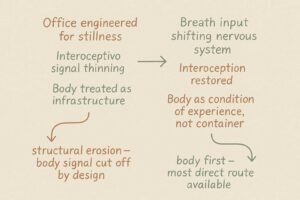
Richard Sennett’s work on the craftsmanship of labor documents how modern workplaces progressively separated bodily intelligence from productive value. The office did not accidentally produce stillness — it was engineered for it. Seated work carried the cultural weight of intellectual superiority; movement signified manual, and therefore lesser, labor. The physical environment of the contemporary workplace is an artifact of that hierarchy, built to minimize what the body does beyond sustaining focused cognitive output. The erosion of bodily awareness in urban professional life is not the result of individual neglect. It is the predictable output of an environment designed to treat the body as infrastructure — present, necessary, and otherwise irrelevant.
What Was Being Cut Off Was the Signal Before the Feeling
Neuroscientist António Damásio’s research reframes what emotions actually are. Much of what we experience as feeling — the vague unease, the low-grade anxiety, the flatness that descends without obvious cause — is the brain’s interpretation of signals arriving from inside the body: the state of the organs, the tension held in muscle, the rhythm and depth of breath, the pace of the heartbeat. This signal system is called interoception. When the body remains still and its range of movement narrows, the variety and intensity of these signals diminishes. The brain receives a thinner stream of information from the interior, and its capacity to recognize and differentiate emotional states degrades with it. The restlessness that builds through a sedentary day may not be an emotional problem at all. It may be interoceptive signals that have nowhere to go — the body transmitting and nothing registering on the other end.
When the Breath Changes, the Nervous System Follows
Neuroscientist Stephen Porges’s polyvagal theory describes the relationship between the state of the autonomic nervous system and the physical state of the body as genuinely bidirectional. Shallow breathing and fixed posture push the nervous system toward sympathetic dominance — the physiological signature of threat response. But the channel runs in both directions. A single full exhale, a slight shift in the position of the pelvis, a few seconds of deliberate contact with the breath — these are not gestures of relaxation. They are inputs into a system that responds to them. Philosopher Francisco Varela’s framework of embodied cognition makes the underlying point explicit: thinking and feeling do not occur in a mind that happens to be attached to a body. They occur in and through the body’s ongoing state. The body is not the container of experience. It is the condition of it. Beginning with the body is not a workaround. It is the most direct route available.
Conclusion: The Signal Was Always There
Urban work will continue to use the body as infrastructure. The interoceptive signal will keep being filtered out. The nervous system will keep tilting toward activation. The structure does not change.
But the question where is my body right now can be carried into any office, any commute, any meeting. The pressure of a foot against the floor. One breath, exhaled fully. These are not small compensations for a large problem. They are the first point of contact with a signal that has been running all along. The body was always sending it. Sitting still just made it harder to receive.
KEY TERMS
Instrumentalization of the Body
Richard Sennett’s analysis of how modern urban labor has progressively optimized the body as a support apparatus for efficient cognitive output. Seated work was historically constructed as the mark of intellectual labor — a distinction from physical work that became embedded in the design of office environments. The result is a built environment that systematically suppresses the body’s sensory activity beyond what is strictly required for task performance. Bodily disconnection in professional urban life is a structural output, not a personal failure.
Interoception
The sensory system through which the brain receives and interprets signals from inside the body — organ state, muscle tension, breath depth, heart rate. Neuroscientist António Damásio’s research established that much of what is experienced as emotion is the brain’s reading of these internal signals. When the body remains sedentary and its range of movement contracts, the variety and intensity of interoceptive input diminishes, degrading the brain’s capacity to recognize and differentiate emotional states. Vague restlessness or unaccountable anxiety may be interoceptive signals with nowhere to land.
Polyvagal Theory
Stephen Porges’s framework describing the bidirectional relationship between autonomic nervous system state and bodily state. Shallow breathing and postural fixation push the nervous system toward sympathetic dominance — the physiological signature of threat response. Deliberate shifts in breath and posture engage the vagus nerve and move the system toward a state associated with safety and regulation. The channel between body and nervous system runs in both directions, making physical intervention a legitimate entry point into psychological state.
Embodied Cognition
Francisco Varela’s position that thinking, feeling, and self-awareness do not occur in a mind separate from the body but are constituted by and through the body’s ongoing physical state. The body is not the container of experience — it is the condition of it. This framework provides the philosophical basis for approaching psychological states through physical practice: not as an indirect workaround, but as the most structurally accurate route available.
Sati
The Pali term for the quality of attention involved in observing present-moment experience — sensation, breath, posture — without evaluation or elaboration. In the context of this guide, it names the basic attentional stance underlying all three Session 2 practices: noticing what is actually happening in the body before the mind has categorized or responded to it. The capacity to receive the body’s signal before interpreting it.