
Introduction: Why Doing Nothing Feels Like Doing Something Wrong

A Sunday afternoon spent without purpose. The strange unease that arrives afterward. I should have used that time for something. Everyone else is being more productive. Too tired to work, and yet there you are on the sofa, checking email anyway.
Rest doesn’t feel like a right. It feels like evidence of something. That feeling has a source — and it isn’t you.
Session 1: The Guilt Is Automatic — And It Wasn’t Always Yours
Rest guilt emerges from a state in which self-worth and measurable output have become fused. The belief that a self producing nothing has no value is rarely chosen consciously. It is absorbed — present in the environment before there is any decision to adopt it.
In this state, time itself is experienced as a commodity. Gaps in the schedule become resources to be used. Unproductive time registers as loss. Rest is processed as the absence of activity — zero value, or negative — and that evaluation is what triggers the guilt.
What makes rest particularly difficult is that staying busy also functions as an anxiety management system. When the future feels uncertain — career, finances, direction — activity keeps the anxiety at a distance. Rest means stepping away from that mechanism, which allows what was being suppressed to surface. The guilt that arrives during stillness is not caused by rest. It is the anxiety that activity was holding back, now visible in the quiet.
The guilt is not yours because you are lazy. It is the environment’s story — that a self not producing anything has no value — running so automatically it no longer announces itself as a story.
Session 2: Practice — Noticing the Guilt, Choosing the Rest
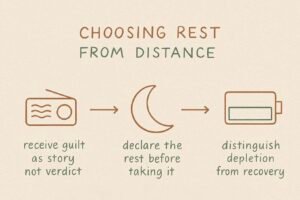
This practice is not about eliminating the guilt response. It is about catching it in motion, creating a small distance from it, and making the choice to rest from that distance rather than from inside the reaction.
STEP 1: Receive the Guilt as a Story, Not a Verdict
When the thought arrives — I wasted that time, I did nothing useful — pause before receiving it as fact.
My mind is running the story that a self not producing anything has no value.
Hear it as a broadcast passing through — present, audible, not necessarily true. Recognizing it as a story rather than a verdict doesn’t make the guilt disappear. It makes a gap. And the gap is enough to work with.
STEP 2: Declare the Rest Before You Take It
Rather than drifting into inactivity and then criticizing yourself for it afterward, name the rest before it begins.
For the next fifteen minutes, I am going to sit by the window and look outside. No phone, no book, nothing to accomplish. The declaration shifts the experience from something that happened to you — I ended up doing nothing — to something you chose. That shift moves the frame of reference from the productivity metric back toward your own judgment. The time belongs to you again, not to the system evaluating how you used it.
STEP 3: Distinguish Depletion from Recovery
Not every form of inactivity functions as rest. Scrolling through a feed while carrying guilt depletes the nervous system. Deliberately allowing the body and attention to settle returns it toward equilibrium. The question is this consuming me or restoring me — asked honestly, without pressure to answer correctly — gradually builds the capacity to distinguish between the two. A few minutes of quiet, time outdoors without destination, lying in a bath without thinking toward anything. These are not failures of productivity. They are what the nervous system is asking for.
Session 3: The Guilt Had a Manufacturer
Where the Feeling Was Made
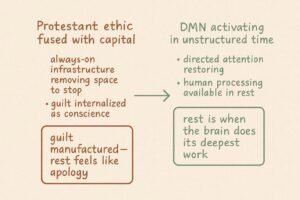
Sociologist Max Weber’s analysis of the relationship between Protestant ethics and the spirit of capitalism traced how the religious imperative to labor diligently — idleness as sin, productivity as evidence of grace — became detached from its theological origins and fused with the logic of capital accumulation. What began as a doctrine of spiritual discipline became a secular ideology: work as inherent virtue, rest as moral failure. The guilt that arrives on a Sunday afternoon when nothing productive has been accomplished is not a private feeling generated from within. It is the residue of a value system manufactured over centuries and internalized so thoroughly that it no longer feels like ideology. It feels like conscience.
When Even Sleep Became a Liability
Sociologist Jonathan Crary’s analysis of what he calls 24/7 capitalism describes a system that does not pause — markets operating continuously across time zones, connectivity that follows the body into the bedroom, light environments that dissolve the distinction between day and night. Within this system, sleep is repositioned not as a biological necessity but as an inefficiency to be minimized. The ideology Weber documented — that idleness is a moral failing — has been amplified by the infrastructure of always-on capital into something more total: a condition in which even the body’s requirement for unconsciousness carries the faint texture of apology. The guilt you feel about resting is not a personal eccentricity. It is what happens when a centuries-old value system meets a technological infrastructure designed to eliminate every remaining space for stopping.
The Resting Brain Had Its Own Agenda
Environmental psychologists Rachel and Stephen Kaplan’s attention restoration theory established that directed attention — the deliberate, effortful focus required for most professional tasks — has a finite capacity. Sustained demand depletes it, degrading judgment, emotional regulation, and the ability to think across connections rather than within them. What this depletion specifically impairs is the functioning of what neuroscientist Marcus Raichle identified as the default mode network. The DMN activates precisely when directed attention releases — during rest, during mind-wandering, during the unstructured time that guilt tends to cut short. It underlies the consolidation of memory, the maintenance of self-awareness, the capacity for empathy, and the generative thinking that does not arrive on demand. The cost of remaining too guilty to rest is not merely fatigue. It is the systematic removal of the time in which the brain performs its most distinctly human processing.
Conclusion: The Guilt Was Always an Import

Weber’s ideology will keep functioning tomorrow. The 24/7 infrastructure will keep pressing against the edges of rest. The DMN will keep losing the time it needs to the guilt that interrupts it. The structure does not change.
But the question is this restoring me or consuming me can be asked in any afternoon, on any weekend. Choosing rest from that question — rather than collapsing into it or fighting it off — is a small act of jurisdiction over your own time.
The guilt was manufactured. The tiredness was always real.
KEY TERMS
Protestant Work Ethic
Max Weber’s account of how the Protestant imperative toward diligent labor — idleness as sin, productivity as spiritual evidence — became detached from its religious context and fused with the logic of capitalism. The result was a secular ideology in which work carries inherent moral value and rest registers as failure. The historical manufacturer of the guilt that arrives during unproductive time — locating the feeling’s origin outside individual character.
24/7 Capitalism
Jonathan Crary’s term for a system that operates without pause — continuous markets, always-on connectivity, light environments that dissolve the boundary between activity and rest. Within this system, sleep is repositioned as inefficiency and rest as liability. The ideology Weber identified has been amplified by technological infrastructure into a condition in which even biological necessity carries an apologetic quality. Rest guilt as structural output rather than personal weakness.
Attention Restoration Theory
Rachel and Stephen Kaplan’s framework establishing that directed attention — deliberate, effortful focus — has a finite capacity that depletes under sustained demand. When depleted, judgment, emotional regulation, and connective thinking degrade. Unstructured rest, particularly in low-demand environments, restores this capacity. The neurological basis for why uninterrupted activity systematically reduces the quality of the thinking it is meant to produce.
Default Mode Network (DMN)
The brain network identified by neuroscientist Marcus Raichle that activates during rest, mind-wandering, and unstructured time — precisely the states that productivity guilt tends to interrupt or prevent. The DMN underlies memory consolidation, self-awareness, empathy, and generative thinking. Remaining too guilty to rest does not preserve cognitive capacity. It removes the time in which the brain performs its most characteristically human processing.
Defusion
The capacity to notice that the story — a self not producing anything has no value — has fused with one’s experience of reality, and to receive it as a story rather than a verdict. Creating observational distance from the guilt thought is the first interruption in the automatic chain, and the entry point into choosing rest rather than reacting to the absence of activity.