
Introduction: Exhausted, But Not Sure Where the Body Is
At the end of a day spent in front of screens, the shoulders are heavy, the eyes are tired, the head is dull. The fatigue is real. But the sense of where the body actually is — the feeling of the legs, the depth of the breath, the state of the back — has gone somewhere vague. The body is there. The sense of inhabiting it is not.
This floating quality is not a symptom of too much screen time in the personal sense. It is the structural result of what digital environments do to the relationship between attention and the body over time.
Session 1: How the Body Became Background
The longer the time spent in front of screens, the more the body retreats from the foreground of awareness into the background. This is not a failure of will. It is a structural redistribution of attention.
Digital environments supply a continuous stream of information directed almost exclusively at vision and hearing. Notifications, color, movement, sound — each is designed to pull attention outward. While that pull is sustained, the signals arriving from inside the body — the accumulating tension in the shoulders, the shallowing of the breath, the pressure of the chair — lose their place in the processing queue. The body continues to send. Nothing is receiving.
The expansion of desk work and screen labor has accelerated this. As productive work shifted from physical tasks to the processing of symbols and information, the body’s role was progressively redefined. It became the vehicle for thought — present, necessary, and otherwise irrelevant. Signals from the body that didn’t bear on the task at hand were treated as interference. The habit of not listening to the body was not chosen. It was structured into the workday.
Session 2: Practice — Returning to the Body
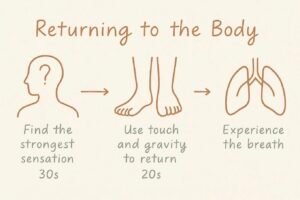
This practice doesn’t require dedicated time. It can be threaded into the natural breaks that already exist in a screen-heavy day — standing up, getting water, moving between meetings. The aim is not to sustain body awareness continuously but to create moments in which the body is briefly and genuinely attended to.
STEP 1: Find the Strongest Sensation
When stepping away from the screen, close the eyes or let the gaze soften for thirty seconds. Rather than scanning from head to toe, direct an open question inward.
Where is the strongest sensation right now?
When something surfaces — the weight in the shoulders, the pressure underfoot, the movement of the breath — bring full attention to it for ten seconds. No evaluation. No attempt to change it. Just confirmation that it is there.
STEP 2: Use Touch and Gravity to Return
When awareness is still drifting in digital space, touch and gravity provide the most direct route back. Plant both feet on the floor and bring attention to the sensation of the soles pressing downward — the weight moving through the feet toward the ground — for twenty seconds. Or hold whatever is in the hand and slowly register its temperature, texture, and weight.
I am here. This sensation is the evidence.
This is the simplest available way of re-establishing the body as a physical object occupying space — rather than a background system running beneath the screen.
STEP 3: Experience the Breath as Sensation
Rather than controlling the breath, approach it as something to be felt. In a comfortable position, direct attention to where the breath is happening — the nostrils, the chest, the abdomen. Don’t attempt to change the rhythm. Simply observe, with some curiosity, what this particular breath is actually doing.
The slight expansion of the chest on the inhale. The gradual release of the breath on the exhale. These sensations were present throughout the day’s screen time. They were simply never asked about.
Session 3: The Digital Economy Turned the Body Into a Device
The Body as Data-Producing Machine
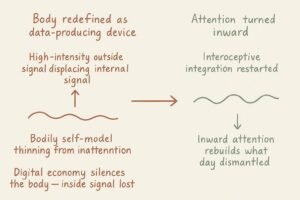
Media scholar Christian Fuchs’s analysis of digital labor argues that the use of social media platforms is not consumption in the traditional sense — it is unpaid labor. Scrolling, clicking, reacting, lingering: each of these actions generates behavioral data that is harvested and converted into advertising revenue. Within this framework, the body seated in front of a screen functions as a device for producing attention and behavioral data. This is distinct from the industrial instrumentalization of the body — the body optimized for physical output. What digital capitalism requires of the body is different: not movement, but presence and reactivity. Sit still, keep the eyes on the screen, keep generating responses. The body doesn’t need to do anything. It only needs to be there, reacting. In this arrangement, the body was redefined as the vehicle through which a data-producing mind operates — present as infrastructure, irrelevant as a source of information in its own right.
The Outside Signal Silenced the Inside One
The stimuli that digital environments supply — notification sounds, vivid color, continuous motion, variable reward — are calibrated to capture and hold external attention. Because the nervous system is structured to prioritize strong incoming signals, sustained exposure to high-intensity digital stimulation progressively displaces the processing of internal body signals: the tension accumulating in the muscles, the gradual shallowing of the breath, the state of digestion. Philosopher Don Ihde’s concept of the technological body describes how perception is shaped by the technologies through which we engage with the world — what a technology mediates, we perceive more readily; what it doesn’t mediate, we perceive less. The screen extends the outward-facing senses while shrinking the inward-facing ones. The sense of having a body doesn’t disappear because the body disappears. It thins because the outside has been speaking so much louder than the inside for so long.
The Sense of Having a Body Has to Be Rebuilt
Philosopher and neuroscientist Thomas Metzinger’s work on the bodily self-model establishes that the sense of inhabiting a body — the feeling of I am here, in this physical form — is not automatically given. It is actively constructed by the nervous system through the continuous integration of interoceptive signals, proprioceptive information from joints and muscles, and visual input. This integration is maintained by attention. When attention is directed outward for extended periods, the signals that sustain the integration are less likely to be processed, and the bodily self-model becomes less stable — producing the floating quality that characterizes the end of a screen-heavy day. The implication runs in both directions. If the sense of embodiment is constructed rather than given, it can be rebuilt. Directing attention to the sensation of the foot against the floor, the temperature of the exhale, the position of the shoulders — these are direct inputs into the integration process. The attention the screen captured is the same attention that, briefly turned inward, begins to rebuild what the day dismantled.
Conclusion: The Body Was Always There

The digital economy will keep using the body as a data-producing device tomorrow. External stimulation will keep displacing internal signals. The bodily self-model will keep thinning when attention stays outward. The structure does not change.
But the question where is my body right now can be asked at any screen break, at the end of any day. The pressure of the foot against the floor, the warmth of the exhale — ten seconds of attention directed there is not a wellness practice. It is the minimum input required to begin rebuilding what the day’s attention economy has been quietly taking apart.
The body didn’t disappear. The attention that made it real did.
KEY TERMS
Digital Labour
Christian Fuchs’s term for the unpaid productive activity performed by social media users — scrolling, clicking, reacting — that generates behavioral data converted into advertising revenue. Within this framework, the body in front of a screen functions as a device for producing attention and data rather than as a subject with its own informational value. Distinct from the industrial instrumentalization of the body: digital capitalism requires not physical output but presence and reactivity — the body as infrastructure for a data-producing mind.
Colonization of Sensation
The process by which high-intensity digital stimuli — notifications, vivid color, continuous motion — calibrated to capture external attention progressively displace the processing of internal body signals. Drawing on Don Ihde’s concept of the technological body, the screen extends outward-facing perception while shrinking inward-facing perception. The thinning of bodily awareness is not a disappearance of the body but the result of the outside having spoken louder than the inside for an extended period.
Bodily Self-Model
Thomas Metzinger’s term for the sense of inhabiting a body — I am here, in this physical form — understood not as automatically given but as actively constructed by the nervous system through the integration of interoceptive, proprioceptive, and visual signals. This integration is maintained by attention and degrades when attention is sustained outward. The implication: bodily presence can be rebuilt through directed attention, making practices of brief body-oriented awareness direct inputs into the construction process rather than peripheral compensations.
Proprioception
The sensory system that delivers information about joint position, muscle state, and body movement to the brain — a primary contributor to the bodily self-model alongside interoception. Screen-based sedentary posture reduces the variety and intensity of proprioceptive input, weakening the neural integration that sustains the sense of physical presence. The grounding practices in Session 2 — attending to foot pressure, holding and sensing objects — work partly by reintroducing proprioceptive variation into a system that has been receiving too little of it.
Defusion
The capacity to notice that the habitual pattern — during screen time, the body simply recedes — has been operating automatically, and to create a brief interval of observation before the pattern resumes. Directing a question inward when stepping away from the screen — where is the strongest sensation right now — is the interruption that makes the body’s ongoing presence briefly available to attention rather than continuously bypassed by it.