
Introduction: It Had Already Started Before the Noticing Did

Something in the chest. That was there, somewhere, through the meeting, through the commute home. And then, midway through dinner, something sharp came out that hadn’t been intended. The question afterward — why did that happen — arrives without an answer, because the emotion felt sudden.
It wasn’t sudden. It had been accumulating somewhere specific, in a language the day hadn’t made room to read.
Not noticing is not a failure of sensitivity. It is what happens when the daily structure leaves almost no space for attention to turn inward.
Session 1: What Emotion Actually Is

When a strong emotion feels like it arrives without warning, what is actually happening is that the body has been changing for some time — and the changes went unread.
Heart rate shifting slightly upward. Shoulders beginning to carry something. A faint tightening somewhere around the stomach. These are happening before anything gets labeled as an emotion. They accumulate quietly, in the background of a day organized around everything else. And when they cross a certain threshold, the experience is of something arriving all at once.
Emotion researcher Lisa Feldman Barrett’s theory of constructed emotion reframes this structure. Emotion is not something that wells up naturally in response to events. It is something the brain constructs — interpreting the body’s internal states against the background of context and past experience, and generating a label after the fact. The body changes first. The brain interprets those changes into what becomes the felt emotion. The emotion is the output, and the body state is the raw material.
Which means: the more thoroughly attention to body states has been cut off, the more emotion arrives as something sudden and total. Noticing earlier is not about developing unusual sensitivity. It is about returning attention — incrementally — to where the construction begins.
Session 2: Practice — Reading the Body’s Signal
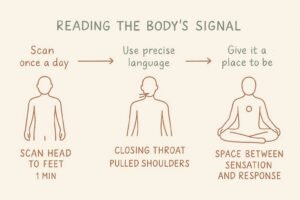
This practice is not about eliminating emotion. It is about receiving the signal at the stage before it becomes a fully constructed emotional experience — at the level of body state, where the building is still in progress.
STEP 1: Once a day, scan
Morning, after lunch, before sleep — any point works. Spend one minute moving attention from head to feet, looking for anywhere that is holding something.
Warm or cool. Heavy or tight. Fast or slow.
No evaluation is needed. The only question is what is actually there. This is not training sensitivity into existence. It is practice at returning the direction of attention to a place it has been systematically pointed away from.
STEP 2: Use precise language
Instead of reaching for a large label — irritated, anxious, sad — try to describe what is actually happening in the body right now.
Something closing in the throat. Shoulders pulled upward. Breathing that has become shallow without a decision to make it so.
The difference between settling for one word and finding the specific physical description changes how the brain processes what is happening. Precise language reduces the emotional grip of the experience and creates a small observing distance that the large label does not.
STEP 3: Give the sensation a place to be
When a strong body sensation is noticed, instead of trying to remove it, simply confirm that it is there.
There is heat in the chest. It is here. It is not everything.
Attempting to eliminate a sensation tends to increase its grip. Acknowledging that it has a place — without making it the whole of what is present — creates a small distance between the sensation and the automatic response. That distance is where choice becomes available.
Session 3: The Body Had Been Sending the Signal the Entire Time
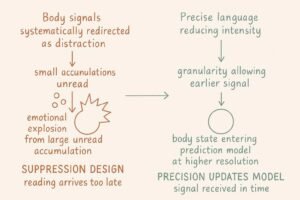
Professional competence had been defined as not feeling
Sociologist Richard Sennett’s analysis of bodily knowledge takes a different angle here than its application to craft and skill. What the modern professional environment did to the body was not only to devalue tactile knowledge — it was to make the suppression of internal body states a condition of functional competence. To concentrate is to ignore hunger. To perform well in a meeting is to override the fatigue that has been building since morning. To stay focused at a screen is to treat every internal signal as an interruption. Desk work, sustained digital attention, long consecutive hours without physical transition — the structure of urban professional life is organized, in practice, around the systematic redirection of attention away from the body’s interior. This is not a personal failure of sensitivity. It is the result of a habit formed over years, under conditions that defined feeling one’s body as a distraction from the work of being competent.
Emotion was being constructed from body states the whole time
Lisa Feldman Barrett’s theory of constructed emotion makes the mechanism precise. The brain continuously monitors the body’s internal states — heart rate, muscle tension, temperature, visceral sensation — and uses that incoming data, cross-referenced against context and prior experience, to generate what becomes the felt emotion. Emotion is not triggered by events. It is constructed by the brain from body-state material, after the fact. This is where the occupational suppression connects to the experience of sudden emotional explosion. When attention to body states has been systematically redirected for years, the brain continues processing without the benefit of that monitoring. The small accumulations go unread. And when a threshold is crossed, the brain constructs a large emotional label from a large accumulation of unread material — which arrives, from the inside, as something sudden and disproportionate. The explosion was not sudden. The reading was just very late.
Precise language was updating the prediction model
Neuroscientist Matthew Lieberman’s affect labeling research demonstrated that putting words to emotional states changes how those states are neurologically processed — reducing activation in the circuits most associated with emotional intensity. Barrett’s concept of emotional granularity extends this: the more precisely a person can distinguish and name emotional experience — not just sad but quietly sinking or hollowed out from effort — the greater the sense of manageability in that experience. In the language of constructed emotion, this precision is doing something specific. It is introducing higher-resolution data into the prediction system that will generate the next emotional construction. A body state that was once labeled only as overwhelmed — and therefore arrived as a single undifferentiated wave — can, with accumulated practice, begin to arrive as tight across the chest since mid-afternoon, which is a signal that can be received much earlier, and met with something proportionate.
Conclusion: The Signal Was Never the Problem

The professional environment continues to be organized around redirecting attention away from the body. Emotion will keep being constructed from body states, with or without awareness of what those states are. The suppression habit does not disappear.
But the question what is in the body right now can be brought into any moment of the day. That question is the beginning of a receiving place — somewhere for the signal to land before it becomes something larger than it needed to be.
The body had been sending the signal the entire time. The environment had just made it very easy not to hear.
KEY TERMS
Theory of Constructed Emotion
Lisa Feldman Barrett’s framework proposing that emotion is not a natural response that wells up from events, but something the brain actively constructs by interpreting the body’s internal states against context and prior experience. The body changes first; the brain generates the emotional label after. When internal body states go unmonitored, emotion tends to arrive as something sudden and total — because the construction happens all at once from accumulated unread material.
Interoception
The sensing of the body’s internal states — heart rate, muscle tension, temperature, visceral sensation. In Barrett’s constructed emotion framework, interoceptive data is the raw material from which emotional experience is built. When attention to interoceptive signals has been systematically redirected — as it tends to be in professional and urban environments — emotional construction loses resolution, and the gap between signal and awareness widens.
Emotional Granularity
Lisa Feldman Barrett’s concept describing individual differences in the precision with which emotional experience can be distinguished and named. Higher granularity — the ability to distinguish quietly sinking from hollowed out from effort rather than settling for sad — is associated with greater manageability of emotional experience. In constructed emotion terms, precise labeling introduces higher-resolution data into the prediction system, allowing future body states to be noticed earlier and met more proportionately.
Affect Labeling
Matthew Lieberman’s finding that putting words to emotional states changes how those states are neurologically processed, reducing activation associated with emotional intensity. The more specific the language — grounded in concrete body-state description rather than abstract emotion categories — the greater the observing distance created. The practical basis for the emotional granularity work in Session 2.
Occupational Suppression of Bodily Knowledge
Drawing on Richard Sennett’s analysis of bodily knowledge, applied here to the professional environment’s systematic redirection of attention away from internal body states. Modern professional competence has been structurally defined as the ability to override bodily signals — hunger, fatigue, tension — in the service of sustained cognitive performance. The result, accumulated over years, is not low sensitivity but a practiced habit of inattention. A structural condition, not a personal one.