
Introduction: Why Trying to Forgive Often Makes It Worse

I should just let it go. I can’t keep holding onto this. If you’ve directed these words at yourself, you know what tends to follow: not release, but a second layer of weight — the original hurt, plus the judgment that you’re failing to move past it.
This isn’t a willpower problem. Forgiveness psychology has a structural explanation for why rushing it doesn’t work.
Forgiveness is not a decision. It is something that becomes possible after the injury has been sufficiently recognized and processed. Trying to skip to it is attempting to reverse the sequence. The anger doesn’t dissolve because you’ve decided it should. It dissolves when what it was signaling has been seen.
Session 1: Why the Anger Continues

Social psychologist Jonathan Haidt’s moral foundations framework positions anger as a moral emotion — a detection system for moral violations. When something is perceived as unjustly damaged — dignity, fairness, trust, safety, care — anger functions as the signal marking that damage.
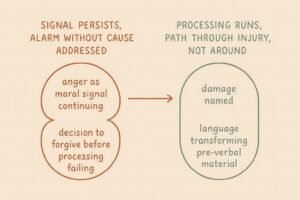
The functional property of this signal is important: it persists until the damage is recognized and processed. This is a design feature, not a malfunction. The pressure to forgive — just let it go, move on — operates as an attempt to silence the signal while bypassing its cause. The signal, finding its cause unaddressed, continues. Pressing harder on the decision to forgive doesn’t accelerate the process. It adds self-criticism to the original injury and leaves the underlying signal running.
The reason I can’t forgive this continues is not weakness. It is that the injury hasn’t been fully seen yet.
Session 2: Four Steps
⚠️ This guide works with deep hurt and anger
If the practice becomes too intense at any point, return attention to the breath or stop. If what arises feels beyond the scope of a self-guided practice, please prioritize professional support.
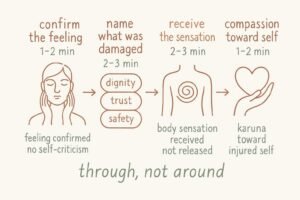
STEP 1: Confirm the legitimacy of the feeling (1–2 minutes)
In a quiet space, turn toward the feeling of not being able to forgive. Don’t try to change it. Confirm it.
This feeling has its reasons.
Being hurt is a fact.
Not being ready to forgive right now is also a fact.
No self-criticism. Just acknowledgment that the feeling is present and warranted.
STEP 2: Name what was damaged (2–3 minutes)
Without judgment, identify what the injury actually affected.
What was damaged — dignity, trust, fairness, safety, care?
What was the most painful part?
What value or need was violated?
The goal is not to produce an answer but to make the damage visible in language. The signal persists partly because what it is signaling hasn’t been clearly named.
STEP 3: Receive the body sensation (2–3 minutes)
Turn attention to where the feeling lives in the body.
Constriction or pain in the chest.
Tightness in the throat.
Tension in the abdomen.
Don’t try to release it. Receive what is actually there. If the intensity becomes too much, return to the breath.
STEP 4: Direct Karuṇā toward the injured self (1–2 minutes)
Turn toward the part of you that was hurt — not with the goal of forgiveness, but with the response that suffering calls for.
That was genuinely painful.
This pain makes sense.
May this suffering ease.
Not forgiveness extended to the other person. Compassion directed toward the self that was injured.
Session 3: The Forgiveness Process Model, Anger as Moral Signal, and Why Putting the Injury Into Words Changes the Processing
The reason forgiveness can’t be rushed, and the conditions under which it becomes possible, have a psychological structure worth knowing.
Robert Enright’s forgiveness process model describes forgiveness as a four-phase process: uncovering, decision, work, and deepening. The first phase — uncovering — is where most attempts at forgiveness fail to begin. Uncovering means examining what was actually damaged: acknowledging the anger and pain without minimization, identifying what was violated, and allowing the full weight of the injury to be recognized rather than bypassed. Enright’s research has consistently found that attempts to move directly to the decision phase — choosing to forgive before the injury has been adequately processed — do not produce genuine forgiveness. They produce either suppression of the feeling or a performance of forgiveness that leaves the underlying signal intact. The paradox his research describes is precise: the path to forgiveness runs through the injury, not around it. Enright’s Forgiveness Is a Choice lays out this process in practical terms and has influenced clinical work with trauma, divorce, and interpersonal harm across several decades.
Jonathan Haidt’s moral foundations theory provides the functional explanation for why the anger persists. Haidt identifies care, fairness, loyalty, authority, and sanctity as foundational moral domains — and anger as the emotional response to perceived violations of these domains. As a signal system, anger is structured to continue until its cause is addressed. Just decide to forgive is, from this angle, an instruction to silence an alarm without attending to what triggered it. The alarm has no mechanism for stopping in response to a decision alone — it responds to the underlying condition being processed. This is why the most direct path to reducing the anger is not suppressing it but completing the recognition it was asking for. Haidt’s The Righteous Mind develops the full account of moral emotions and their social and psychological functions.
James Pennebaker’s research on expressive writing — among the most replicated findings in health psychology — established that putting emotional experience into language facilitates emotional processing in measurable ways. Studies across several decades have shown that writing about emotional experiences correlates with reduced intrusive thought, improved immune function, and decreased psychological distress. The proposed mechanism is that language transforms pre-verbal emotional material — an undifferentiated internal state — into a narrative with temporal and causal structure. Once the experience has a before, a during, and an after; once the damage has a name; once the violation can be described rather than only felt — the processing that was stalled becomes available. STEP 2 uses this mechanism: not writing necessarily, but the act of naming what was damaged is itself a form of the linguistic transformation that Pennebaker’s research describes. Opening Up: The Healing Power of Expressing Emotions documents this work in full.
Conclusion: Seen First. Forgiven Later — If and When That Becomes Possible

Today, if unforgiveness is present — don’t rush it.
Confirm that the feeling is legitimate. Name what was damaged. Receive what the body is holding. Direct some compassion toward the part of you that was hurt.
Forgiveness is not today’s goal. Today’s goal is seeing the injury clearly.
Forgiveness isn’t what happens when the anger stops. It’s what becomes possible after the injury has been fully seen.
KEY TERMS
Forgiveness Process Model
Robert Enright’s framework describing forgiveness as a four-phase process — uncovering, decision, work, deepening — in which the first phase (uncovering the injury: acknowledging the anger, identifying what was violated, receiving the full weight of the damage) is the necessary precondition for genuine forgiveness. Attempts to begin at the decision phase, before uncovering is complete, tend to produce suppression or performance rather than actual release. The paradox: the path to forgiveness runs through the injury, not around it. Forgiveness Is a Choice provides the full practical account.
Anger as Moral Signal
Jonathan Haidt’s moral foundations framework positions anger as a detection and signaling system for moral violations — damage to care, fairness, loyalty, authority, or sanctity. As a signal, anger is structured to persist until its cause is addressed. The instruction to simply forgive or let go operates as an attempt to silence the signal without attending to its cause — which is why it tends to maintain rather than resolve the anger. The Righteous Mind develops the full account of moral emotions.
Expressive Writing and Emotional Processing
James Pennebaker’s finding that putting emotional experience into language facilitates processing — reducing intrusive thought, improving immune markers, decreasing distress. The mechanism: language transforms pre-verbal emotional material into narrative with temporal and causal structure, making processing available where it had been stalled. Naming what was damaged (STEP 2) uses this mechanism. Opening Up: The Healing Power of Expressing Emotions documents this work in full.
Karuṇā Directed Toward the Self
The compassionate response to suffering — when directed toward one’s own injury rather than another person’s. STEP 4 is not forgiveness extended to the person who caused harm. It is the response that the injured self calls for: recognition that the pain is real, that it makes sense, and that its easing is something to be wished for. Karuṇā directed toward the self provides the internal condition from which forgiveness — when it eventually becomes possible — can genuinely arise. See Metta Guide 0.
Defusion
See Guide 5. When I should be over this by now or not forgiving makes me the problem arrives as a verdict, recognizing it as a thought rather than an accurate assessment — and returning attention to STEP 1’s confirmation that the feeling is legitimate — is defusion applied to the self-critical layer that unforgiveness consistently generates.