
Introduction: Why “Be Stronger” Makes It Worse

After a failure, we are hurt twice. The first time by the failure itself. The second time by the voice that asks why it happened, what it says about us, whether it will happen again.
This second attack is what the neuroscience of recovery identifies as the primary obstacle — not the failure, but what gets added to it. The assumption that resilience requires toughness misses this structure entirely. What recovery requires is the capacity to stop the second attack.
Session 1: What Self-Criticism Is Actually Doing

After a failure, two things are happening at once. The failure itself is one event. It produced pain. That is real and does not need to be minimized.
When self-criticism is added, the brain begins processing the failure not as an event but as evidence about the self. The threat system reactivates. A loop generates: this will happen again, there is something wrong with me, I am not capable of this. That loop consumes the resources that recovery would otherwise use.
Resilience is not the absence of being hurt. It is the capacity to be hurt once — and not add a second wound on top of it.
Session 2: Interrupting the Second Attack
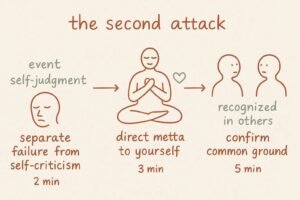
STEP 1: Separate the failure from the self-criticism (2 minutes)
Within what is being felt right now — what is present? The pain of what didn’t work. And layered on top of it, is there an evaluation of what that means about you?
Try to confirm the difference between this didn’t go well and therefore I am deficient. They are not the same thing, even when they arrive together and feel like one. The separation does not need to be complete. Noticing that there are two things — the event and the judgment — is already a different relationship to both.
STEP 2: Direct Mettā toward yourself (3 minutes)
Toward the self that is carrying both the failure and the criticism, direct quiet intention.
May I be gentle with myself right now. May this difficulty be met with care.
The intention toward the self that is in pain is the practice. Warmth does not need to arrive for the intention to be real. If what comes is more like a wish than a feeling, that is enough. The pain does not need to move first.
STEP 3: Confirm the common ground (5 minutes)
Failing, being hurt, and struggling with a critical inner voice — this is not a private condition. At this moment, others are inside the same structure. The specific content differs. The structure is the same.
This recognition is not a minimization of what happened. It is a reorientation — from what is wrong with me toward what is difficult for us. From that ground, extend the intention outward: May we all find our way through what is difficult.
Session 3: Why Self-Criticism Closes the Door That Failure Left Open — Secondary Suffering, the Shame-Avoidance Circuit, Allostatic Load, and the Conditions Under Which Growth Becomes Possible
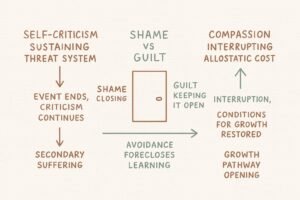
Recovery stalls at a specific point — not at the failure, but at what the mind does immediately after. Psychology and neuroscience each locate that point precisely, and describe what moves through it.
Paul Gilbert’s emotion-regulation framework identifies the structure of secondary suffering as the central mechanism by which self-criticism extends and amplifies the original pain of failure. In The Compassionate Mind (2009), Gilbert showed that while difficult events generate unavoidable primary suffering, self-criticism maintains the threat system’s activation long after the event itself has passed — converting a completed event into an ongoing state. The threat system, anchored in the amygdala, was evolutionarily designed to respond to physical danger; it does not distinguish between external threats and self-directed attack. The loop of I am deficient, this will happen again runs through the same neural pathway as a physical threat response — and consumes the same physiological resources that recovery would otherwise draw on. The event ends. The self-criticism keeps the threat response running.
What self-criticism specifically prevents is described by June Price Tangney’s comparative research on shame and guilt. In Shame and Guilt (2002), Tangney documented a consistent distinction in how these two responses function after failure. Guilt — the feeling that attaches to a specific action — tends to generate motivation toward correction and repair. Shame — the feeling that attaches to the self as a whole — tends to generate avoidance: looking away from the failure, withdrawing from the situation, and foreclosing the direct examination that learning requires. Self-criticism that takes the form of I am deficient rather than that action did not work activates shame rather than guilt. In that state, the core process of recovery — looking clearly at what happened, understanding it, and extracting what can be used — is structurally unavailable. The door to learning closes at the moment it is most needed.
The physiological cost of sustained self-criticism is described by Bruce McEwen’s concept of allostatic load. McEwen’s research showed that while the stress response is adaptive in the short term, its chronic activation accumulates measurable costs across the nervous, immune, and endocrine systems. Persistent self-criticism following a failure maintains HPA axis activation, sustaining cortisol output and depleting the cognitive and emotional resources — attentional flexibility, working memory capacity, emotional regulation — that recovery draws on. The original difficulty has a cost. Self-criticism adds a second bill on top of it.
What becomes available on the other side of that interruption is described by Richard Tedeschi and Lawrence Calhoun’s research on post-traumatic growth. In Posttraumatic Growth: Conceptual Foundations and Empirical Evidence (2004), Tedeschi and Calhoun documented that a significant proportion of people who experience serious adversity report not merely returning to a prior baseline but undergoing growth — restructured values, deepened capacity for connection, and an expanded sense of possibility. Their research identified the mode of response as a primary determinant: processing difficulty as evidence of personal deficiency — the shame structure that Tangney described — forecloses that pathway. The condition for growth is not the absence of damage. It is what the self does with the damage in the period that follows.
Conclusion: Knowing About the Second Attack

The failure produced pain. The self-criticism extended that pain by keeping the threat system running after the event had already ended — turning a single blow into something the body and mind continued to absorb.
Compassion intervenes at that point. Not to undo what happened. To stop the addition
KEY TERMS
Secondary Suffering
The ongoing pain generated not by a difficult event itself but by the self-critical response that maintains threat system activation after the event has passed. Converts a completed event into a continuous state, consuming recovery resources in the process. Central to Paul Gilbert’s Compassion-Focused Therapy framework, developed in The Compassionate Mind (2009). Gilbert’s research program has since generated a clinical treatment framework applied across depression, trauma, and shame-based disorders — documented further in The Compassionate Mind Workbook (2014, with Irons).
Shame vs. Guilt
Tangney’s distinction between guilt — which attaches to a specific action and tends toward repair — and shame, which attaches to the self as a whole and generates avoidance. Self-criticism in the form of I am deficient activates shame, closing off the direct examination of failure that learning and recovery require. June Price Tangney’s comparative research is collected in Shame and Guilt (2002, with Ronda Dearing).
Allostatic Load
The cumulative physiological cost of chronic stress system activation across the nervous, immune, and endocrine systems. Persistent self-criticism maintains HPA axis output, depleting the cognitive and emotional resources that recovery draws on. Bruce McEwen’s foundational research is developed in The End of Stress As We Know It (2002).
Post-Traumatic Growth
The phenomenon in which serious adversity produces not merely recovery but growth — restructured values, deepened relational capacity, expanded possibility. Tedeschi and Calhoun’s research identified the mode of response as a primary determinant: processing difficulty as shared human experience keeps the pathway to growth open; processing it as evidence of personal deficiency forecloses it. Documented in Posttraumatic Growth: Conceptual Foundations and Empirical Evidence (2004).