
Introduction: This Is Not a Willpower Problem

Lying in bed, the thinking won’t stop. Today’s failure. Tomorrow’s uncertainty. What should have been said. What shouldn’t have been said. Deciding to stop thinking doesn’t stop the thinking.
This is not a failure of willpower. It is a structural problem: the threat system is still running, and sleep is being attempted on top of it. The thinking is not the cause. It is the symptom. And symptoms respond to different interventions than causes do.
Session 1: Why the Nighttime Loop Keeps Running

Confirm what is actually happening in the sleepless night
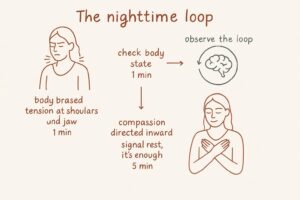
STEP 1: Check the body’s current state (1 minute)
Lying in bed — is there tension somewhere in the body? Shoulders, jaw, the area around the chest. The body on a sleepless night is often in a state of readiness, braced for something. No need to change the tension. Just confirm it is there.
STEP 2: Observe the thinking as a loop (2 minutes)
Notice the thoughts repeating in the mind — not as problems to solve, but as a loop running on its own. This thought is here again. That is enough to register. No need to enter the content. The loop does not require engagement to continue running. Noticing it without following it is already a different relationship to it.
STEP 3: Direct compassion toward yourself (5 minutes)
The intention here is not a wish so much as a permission — a signal to the part of you still standing watch that it can stand down. Today is done. This can wait until tomorrow. Tonight, rest is enough.
Whatever warmth moves toward the present self in that direction is the practice. The signal does not need to feel strong to be real. Placing it is what matters.
Session 2: Letting the Nervous System Follow
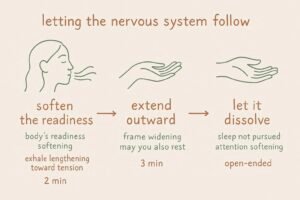
STEP 1: Soften the body’s readiness (2 minutes)
Return attention to the places of tension confirmed earlier — shoulders, jaw, chest. Without forcing a change, breathe toward those areas. Notice whether the exhale is shorter than the inhale. Letting the exhale lengthen slightly is enough. This is not a breathing exercise. It is an invitation.
STEP 2: Extend the permission outward (3 minutes)
From the compassion directed toward yourself, extend the same permission to anyone else who may be lying awake tonight — someone known, someone unknown. May you also rest. This is not a distraction from your own state. Directing warmth outward shifts the nervous system’s frame from self-focused threat monitoring to something broader, and quieter.
STEP 3: Let the practice dissolve (open-ended)
There is no completion to reach. If the thoughts return, they return. The practice does not require that they stop. What has been placed — the permission, the warmth, the signal — has been placed. Allow the attention to soften without directing it anywhere. Sleep does not need to be pursued. It arrives in the space that opens when the threat system is no longer the only thing running.
Session 3: The Sequence the Nighttime Loop Follows — The Threat System, the HPA Axis, the Vagus Nerve, and What Determines the Quality of Sleep
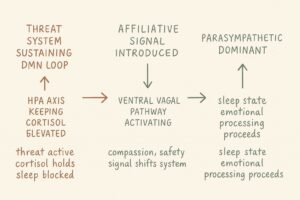
The nighttime loop is not a psychological quirk. It is a sequence of physiological events — each stage following from the last. Neuroscience and sleep research describe that sequence from the inside out.
At the center of the can’t-stop-thinking state is the sustained activation of the threat system. The amygdala-driven threat system is evolutionarily ancient and does not distinguish between physical danger and social or psychological threat. Today’s failure, tomorrow’s evaluation, the ambiguous meaning of something said — these are not survival threats, but the threat system does not make that distinction. With the threat system running, the brain’s default mode network generates self-referential rumination: I should have handled that differently, what does this mean about me, what will happen tomorrow. The loop functions as a mutually reinforcing circuit: threat system activation sustains self-referential thinking, and self-referential thinking reactivates the threat system. Paul Gilbert’s three-system framework — the theoretical basis of Compassion-Focused Therapy, developed in The Compassionate Mind (2009) — provides the structural account of why the affiliative system is the relevant intervention point: it is the system capable of introducing a competing signal into this circuit.
What that circuit is doing physiologically is described by the HPA axis — the hypothalamic-pituitary-adrenal system that regulates cortisol release. Sustained threat system activation maintains HPA axis output, keeping cortisol elevated. In a healthy sleep cycle, cortisol declines from late afternoon through the evening, reaching its lowest point in the middle of the night. Self-critical rumination continuing into the pre-sleep period disrupts this decline: HPA axis over-activation holds cortisol at levels that promote wakefulness and inhibit sleep onset. Pre-sleep rumination is not merely an emotional state — it is a physiological operation that alters the hormonal environment the body needs to transition into sleep. Bruce McEwen’s research on allostatic load documented how sustained psychological threat activates the same neuroendocrine pathways as physical stressors, with cumulative effects on that hormonal environment.
Why compassion practice can intervene in this pathway is what Stephen Porges’s Polyvagal Theory explains. Porges, in The Polyvagal Theory (2011), identified the ventral vagal complex — a branch of the vagus nerve — as specifically associated with social safety signals and the regulation of the parasympathetic nervous system. Sensations of safety, connection, and care activate this pathway and promote a shift toward parasympathetic dominance. The permission directed toward the self — tonight, rest is enough — is processed as a social safety signal through this route. It introduces an affiliative signal into a system that has been running on threat: not by suppressing the threat response, but by giving the nervous system what it has been waiting for.
How the pre-sleep emotional state affects sleep quality is where sleep architecture research provides the endpoint of the sequence. Matthew Walker’s account in Why We Sleep (2017) suggests that REM sleep plays a central role in the processing and reintegration of emotional memories — and that the emotional state at sleep onset influences the quality and composition of REM sleep during the night. Falling asleep with the threat system still activated is associated with more fragmented sleep and leaves emotional memories less fully processed by morning. Falling asleep with the parasympathetic nervous system in relative dominance creates the conditions under which that processing can proceed more completely. The same hours of sleep produce different outcomes depending on the system state in which they begin.
Conclusion: What Sleep Actually Needs
The structural problem is not the thinking. It is attempting sleep while the threat system is still running. Willpower applied to that structure does not change it. What changes it is a signal — affiliative, directed inward, specific enough for the nervous system to register as real.
KEY TERMS
Threat-DMN Loop
The mutually reinforcing circuit between amygdala-driven threat activation and the brain’s default mode network rumination. Threat system activation sustains self-referential loops; self-referential thinking reactivates the threat system. The nighttime thought loop is this circuit continuing after sleep onset is attempted. Paul Gilbert’s three-system framework — developed in The Compassionate Mind (2009) and foundational to Compassion-Focused Therapy — describes the affiliative system as the relevant intervention point: the system capable of introducing a competing signal into the circuit.
HPA Axis Over-Activation
The hypothalamic-pituitary-adrenal system’s role in maintaining cortisol elevation when the threat system is persistently active. Healthy sleep onset requires cortisol decline through the evening; self-critical rumination sustained into the pre-sleep period disrupts this decline through continued HPA axis output. Pre-sleep rumination is a physiological operation altering the hormonal environment, not only an emotional state. Bruce McEwen’s research on allostatic load documents how sustained psychological threat activates the same neuroendocrine pathways as physical stressors.
Polyvagal Theory
Stephen Porges’s framework, from The Polyvagal Theory (2011), identifying the ventral vagal complex as the neural pathway linking social safety signals to parasympathetic nervous system regulation. Sensations of care, connection, and safety activate this pathway and promote the shift away from sympathetic dominance. Compassion directed toward the self functions as a social safety signal through this route — an affiliative intervention into a system running on threat activation.
Sleep Architecture and REM Sleep
Matthew Walker’s account in Why We Sleep (2017) describes REM sleep’s role in emotional memory processing and reintegration, and suggests that the emotional state at sleep onset influences the quality and composition of REM sleep during the night. Threat-system activation at sleep onset is associated with fragmented REM and elevated next-day emotional reactivity; parasympathetic dominance at sleep onset creates conditions for more complete emotional processing. The same hours of sleep produce different outcomes depending on the system state in which they begin.