
Introduction: Not Knowing What to Say to That Person

A moment from the past returns without warning. A failure. A loss. The particular loneliness of a place you once were.
You tell yourself it’s over. The emotion disagrees.
When you try to say something to the person you were then, the words don’t quite land. You did your best. It wasn’t your fault. Something in the attempt feels hollow. Not because the words are wrong, but because the distance is still too short.
When the past self is still seen as self, compassion is hard to direct there. Seen from a little further away — as someone else, someone you are looking at rather than looking from — something different becomes possible. There are words that only arrive from that distance.
Session 1: Why the Distance Is What Makes It Work
When you try to speak to the person you were during a difficult moment, the words often fail — not because you don’t mean them, but because the gap between then and now hasn’t fully opened yet.
Psychology has a specific account of why this happens. When a past experience is processed from an immersed perspective — I was there, I felt this, this is mine — retrieving the memory tends to reactivate the original emotional response. The distance between past and present collapses. What is being revisited is not a memory but something closer to a re-experience.
The same memory, processed from a distanced perspective — that person was there, they felt this — produces a different result. Emotional reactivity decreases. The capacity to make meaning from what happened increases. The person who is seen from that slight distance is no longer identical to the person doing the seeing — and that gap is what compassion requires. The circuit that responds naturally to another person’s suffering activates when the self has been given enough distance to be seen as one.
Both things are true simultaneously: that person was you, and that person is someone you can now look at rather than be. The practice here uses both at once.
Session 2: Create the Distance, Then Write
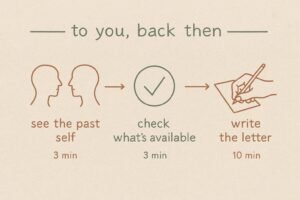
STEP 1: See the past self as a different person (3 minutes)
Close your eyes and bring to mind the moment you want to write toward.
The age you were. The place. What you were carrying.
Then step back from the scene. Watch it the way you would watch a moment in a film. The person there is not me right now — it is that person, then.
Look at their face. Notice what they are holding.
STEP 2: Check what compassion is available (3 minutes)
From this slightly further position — is there anything present?
It might be warmth. It might be something more like grief. It might be very little. Whatever is there is the accurate starting point.
If something moves toward that person, let it. If nothing does yet, that is where to begin.
STEP 3: Write the letter (10 minutes)
Write by hand if you can — begin with To you, back then and continue from there. If the words don’t come immediately, wait. What arrives is enough.
When you finish, read it back slowly and silently. If something shifts somewhere in the body, notice it.
Session 3: Self-Distancing, Expressive Writing, and the Window When Memory Can Be Reached
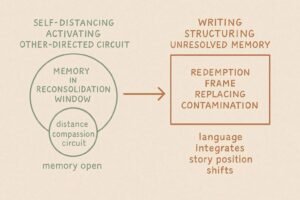
Writing to a past self is not a literary exercise. Psychology and neuroscience each have a specific account of why it works — and the accounts converge on the same mechanism.
Psychologist Ethan Kross’s research on self-distancing identified a consistent finding: whether a person processes their own experience from an immersed perspective or a distanced one produces measurably different outcomes. In self-immersion — I felt this, I was there — retrieving a painful memory tends to reactivate the original emotional response. In self-distancing — that person felt this, they were there — the same memory is processed with lower emotional reactivity and greater capacity for meaning-making. Kross found that referring to oneself in the third person was enough to initiate this shift. Calling the past self you, back then rather than me is not a literary choice. It is the operation that makes compassion available — the same circuit that responds naturally to another person’s suffering can be activated toward a self that has been given enough distance to be seen.
From that distance, the act of writing has its own documented effects. Psychologist James Pennebaker’s decades of research on expressive writing showed that putting emotional experience into language produces measurable changes in psychological wellbeing, immune function, and the frequency of intrusive thoughts. One mechanism Pennebaker identified is that language imposes structure on experience. Emotional memories without structure tend toward rumination — the same scene returning repeatedly is partly a function of the memory remaining unintegrated, still flagged as unresolved. Writing gives the memory context, sequence, and meaning. It supports the process by which something unprocessed moves toward integration. The content of what is written matters less than the act of writing itself.
Neuroscience adds a layer that explains why this is possible at all. Karim Nader and colleagues’ research on memory reconsolidation, published in Nature (2000), established that retrieved memories briefly enter a state of instability — a reconsolidation window during which they become temporarily open to revision before being re-stored. The moment of remembering a painful past is also, simultaneously, the moment when that memory is most available to receive new information. Writing from a distanced perspective while the memory is active is an intervention that uses this window: not to rewrite what happened, but to alter the context in which the memory is held. What changes is not the event but how it is carried.
Psychologist Dan McAdams’s research on narrative identity showed that how people construct their life story correlates significantly with psychological wellbeing. One pattern McAdams identified is the difference between contamination sequences — stories in which something good becomes bad — and redemption sequences — stories in which difficulty gives rise to something. Writing to a past self works directly on this construction. When the moment that was once framed as what broke you is reframed as what you survived, the emotional weight of that memory shifts. The story itself does not change. What changes is the position of the self within it.
Conclusion: What the Letter Actually Changes
What happened then does not change.
What changes is who is holding it now — and how.
Create the distance. Write from there. The words that arrive from that position are the ones that can actually land.
The letter doesn’t change what happened. It changes who is holding it.
KEY TERMS
Self-Distancing
Ethan Kross’s research distinguishes between self-immersion — processing experience as I — and self-distancing — processing it as that person. The shift reduces emotional reactivity and increases capacity for adaptive meaning-making. Third-person self-reference is enough to initiate it. Addressing the past self as you, back then creates the distance from which compassion toward that person becomes available. Kross’s broader research program — documented in Chatter (2021) — examines how the voice in the head becomes an obstacle to clear perception, and how distance-creating techniques interrupt that loop.
Expressive Writing
James Pennebaker’s research established that writing about emotionally significant experiences produces measurable effects on psychological and physical health. Emotional memories without linguistic structure tend to recur as rumination. Writing imposes context and sequence on unstructured experience, supporting the movement from unprocessed to integrated. The act of writing matters more than what is written.
Memory Reconsolidation
Karim Nader and colleagues’ finding, published in Nature (2000), that retrieved memories briefly enter an unstable state — a reconsolidation window — before being re-stored, during which they are open to new information. The moment of remembering is also the moment of greatest accessibility. Writing from a distanced perspective while the memory is active uses this window to introduce new context — not changing the event, but changing how it is held.
Narrative Identity
Dan McAdams’s research on how people construct their life story and its correlation with psychological wellbeing. The distinction between contamination sequences and redemption sequences describes how the same event can be carried differently depending on the narrative position of the self. Writing to a past self works on this construction directly — not rewriting the story, but shifting where within it the self stands.