
Introduction: Criticizing Yourself for Still Being in It

After losing someone, or something that mattered — the grief doesn’t go away. It returns in unexpected moments. I should be past this by now. Why didn’t I do more when I had the chance.
On top of the grief itself, a second layer arrives: criticism of the person who is still grieving. This is the most exhausting part of loss — not the sorrow alone, but the judgment of the sorrow.
Grief continuing is not a failure of recovery. Regret arriving is not evidence of having loved wrongly. This article describes the structure of both forms of self-criticism.
Session 1: Grief Has Two Layers

When grief is present, two distinct things are happening at the same time.
The first is the response to the loss itself — the sadness, the absence, the awareness of the space where someone or something used to be. This is an unavoidable response to what happened.
The second is the criticism of that response — I’m still dwelling on this, I haven’t moved forward, I should have done things differently. This layer consumes the energy that grief itself requires.
They are not the same thing. The first cannot be avoided. The second has a structure — and knowing that structure changes how it can be met.
Session 2: Directing Compassion Into the Grief
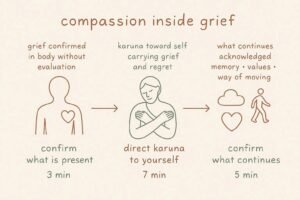
STEP 1: Confirm what is present right now (3 minutes)
Close the eyes and check what is here in this moment.
Sadness, regret, a sense of absence, anger — whatever arrives, confirm it without evaluation. Is there a response somewhere in the body? Around the chest, the throat, the stomach.
This is here. This is what is present right now. That confirmation is the first move.
STEP 2: Direct Karuṇā toward the self that is carrying this (7 minutes)
Toward the self that is holding this grief, direct quiet intention.
May I be gentle with what I am carrying.
May this grief be met with care, not judgment.
When regret arrives, toward the part of the self that wishes things had been different:
May I be kind to the part of me that wishes things had gone differently.
The intention is not to dissolve the feeling. It is to bring warmth toward the self that is in it.
STEP 3: Confirm what continues (5 minutes)
The person, the relationship, the thing that was lost — something of it remains present. In memory, in what was learned, in values that were shaped by that presence, in the way of moving through the world that came from being in contact with it.
The intention here shifts direction — not a wish for the person’s wellbeing, but an acknowledgment of what continues.
Toward whatever continues, direct intention quietly:
May what you gave me continue to be part of how I move through the world.
Session 3: Continuing Bonds, the Dual Process Model, Counterfactual Thinking, and Compassion Inside Grief
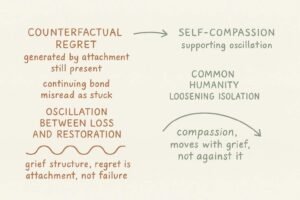
Grief research and cognitive psychology each have a precise account of why the self-criticism that attaches to grief — for still being in it, and for what was left undone — is a misreading of what is actually present.
For most of the twentieth century, clinical models of grief assumed that healthy recovery required severing emotional ties with the lost person — and that failure to do so indicated pathology. Dennis Klass and Phyllis Silverman’s continuing bonds framework, developed in Continuing Bonds: New Understandings of Grief (1996), challenged this assumption directly. Their research across multiple cultures and contexts showed that maintaining an internal continuing relationship with the lost person is, for many people, the actual form that adaptive grief takes. The goal is not detachment but transformation: finding a way to carry the relationship forward without the physical presence. Still thinking about the person, still feeling connected to them, still being shaped by what they meant — these are not signs of being stuck. They are the normal operation of a bond that has changed form rather than ended. The continuing bonds framework has since become a central reference point in contemporary grief therapy and cross-cultural bereavement research.
How grief moves — not linearly toward resolution, but in an oscillating pattern between different orientations — is described by Margaret Stroebe and Henk Schut’s Dual Process Model, published in Death Studies (1999). Stroebe and Schut identified two orientations that characterize adaptive grieving: loss orientation, in which attention moves toward the loss itself — the grief, the absence, the processing of what happened — and restoration orientation, in which attention moves toward re-engagement with daily life and the adjustments that loss requires. Healthy grieving, in their model, involves oscillating between these two orientations rather than progressing through them in sequence or remaining fixed in either. The self-criticism of I can’t move forward typically arises from evaluating time spent in loss orientation as a failure state rather than as a necessary part of the oscillation. Stroebe and Schut’s model has since informed diagnostic criteria for complicated grief and continues to shape grief intervention research.
The regret and guilt that accompany grief — I should have done more, why didn’t I say that, if only I had been there — have a cognitive structure that Neal Roese’s research on counterfactual thinking describes. In If Only: How to Turn Regret into Opportunity (2005), Roese showed that after loss or failure, the cognitive system automatically generates “if only” alternatives — not as accurate assessments of what was genuinely possible, but as a forward-looking preparation mechanism, orienting the system toward how similar situations might be handled in the future. Counterfactual thinking is generated even when the alternatives it imagines were never genuinely available. This means that the presence of regret does not confirm that different choices were actually possible. When grief’s counterfactual thinking is directed toward a relationship — I should have called more, spent more time, said what I felt — the intensity of the regret reflects the depth of the attachment that generated it. Research has also found that imagining better alternatives to what happened tends to generate stronger emotional responses than imagining worse ones — a pattern that intensifies in contexts of loss, where the gap between what was and what might have been feels unbridgeable. The guilt arriving in grief is not evidence that the love was inadequate. It is the attachment, still present, expressing itself in the only direction now available to it.
How compassion functions inside grief rather than in opposition to it is where Kristin Neff’s research on self-compassion provides the final layer. In Self-Compassion: The Proven Power of Being Kind to Yourself (2011), and in subsequent research extending her framework into bereavement contexts, Neff showed that self-compassion does not inhibit the processing of grief — it supports the oscillation that Stroebe and Schut described. Of the three components of self-compassion, Common Humanity carries particular weight in grief: the recognition that loss, sorrow, and the regret of not having done enough are not private failures but universal features of loving anything that can be lost. This recognition does not minimize the specific grief. It loosens the isolation that surrounds it — the sense that this degree of pain, or this persistence of it, marks the person as someone who has failed at something others manage more successfully.
Conclusion: As Evidence of the Attachment

Grief does not end when the person is no longer there. It changes shape around the space they left.
Regret arriving does not indicate that the love was insufficient. It is the attachment, still present, taking the only shape now available to it.
The guilt was not evidence of having loved wrong. It was evidence of having loved.
KEY TERMS
Continuing Bonds
Dennis Klass and Phyllis Silverman’s framework, from Continuing Bonds: New Understandings of Grief (1996), showing that maintaining an internal continuing relationship with a lost person is an adaptive form of grief rather than a failure to detach. Challenges the twentieth-century clinical model in which healthy grieving required severing emotional ties. The framework has become a central reference in contemporary grief therapy and cross-cultural bereavement research, generating a substantial body of work on how continuing bonds are maintained across different loss contexts.
Dual Process Model
Margaret Stroebe and Henk Schut’s model, from Death Studies (1999), describing healthy grief as oscillation between loss orientation — processing the loss itself — and restoration orientation — re-engaging with daily life. Fixed attention in either direction indicates difficulty; the oscillation is the adaptive structure. The model has informed diagnostic criteria for complicated grief and continues to shape bereavement intervention research internationally.
Counterfactual Thinking
Neal Roese’s framework, from If Only: How to Turn Regret into Opportunity (2005), describing the automatic generation of “if only” alternatives after loss or failure as a forward-looking cognitive preparation mechanism — not an accurate assessment of what was genuinely possible. In grief, the intensity of counterfactual thinking reflects the depth of the attachment it references. The presence of regret does not confirm that different choices were actually possible — it confirms that the attachment was real.
Karuṇā
The Pāli term for compassion as a response to suffering — the movement toward pain rather than away from it. In this guide, practiced as compassion directed toward the self inside grief: bringing the same quality of response to one’s own sorrow and regret that one would naturally bring to another person’s.