
Introduction: When Capable People Produce Ordinary Results

The meeting has ended. The capable person in the room said almost nothing, and nobody asked why.
A capable team member isn’t contributing in meetings. New ideas aren’t coming. Mistakes are reported late, or not at all.
Diagnosing this as a problem of individual ability or motivation is, in most cases, the wrong analysis.
Cognitive capacity is finite. What it gets used for is determined by the environment. The brain of someone who feels threatened is using its resources for self-protection, not for work. Compassion is the intervention that changes that allocation.
Session 1: When the Threat System Runs at Work

A dismissive tone in passing. A message that didn’t get a reply. Being talked over in a meeting and deciding not to try again. Each of these is small. And yet, as social neuroscience has confirmed, workplace criticism, dismissal, and rejection are processed through the same neural circuitry as physical pain. The meeting comment that stays with someone for days is not a sign of oversensitivity — it is a structural fact about how the brain assigns priority to social threat.
That circuit does not wait for a dramatic moment to activate. Each small signal registers as threat. And the circuit, once running, does not pause between tasks — it runs alongside them.
With that happening, the person is still doing their work. Still showing up, still trying. But a portion of what they have is no longer available for the work itself. It has been redirected — quietly, automatically, without anyone choosing it — toward self-protection.
That is not underperformance. That is the nervous system doing exactly what it was designed to do, in an environment it was not designed for.
Session 2: Directing Compassion Into the Workplace
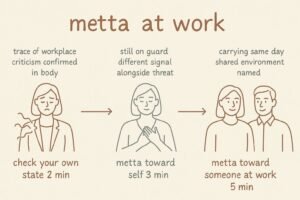
STEP 1: Check your own state (2 minutes)
Bring today’s workplace experience to mind.
Was there a moment of criticism, dismissal, or negation — however small? A comment that landed somewhere it stayed. A silence where acknowledgment would have helped.
Is there a trace of that response still present somewhere in the body? Around the chest, the shoulders, behind the eyes.
Confirm it — not as an emotion to be processed, but as a physical fact to be noted. The circuit was running. That is enough for this step.
STEP 2: Direct Mettā toward yourself (3 minutes)
Toward the self that carried that today — through the meetings, the tasks, the moments of monitoring — direct quiet intention.
May I meet this with some ease
May the part of me that is still on guard find some rest.
The threat system may still be running. The intention is not to silence it — only to give the nervous system a different signal alongside it.
STEP 3: Direct Mettā toward someone at work (5 minutes)
Bring to mind someone who was in the same environment today. Someone who sat through the same meeting. Someone who is also, right now, carrying whatever the day left in them.
That person is working with the same circuitry. The same finite cognitive capacity. The same environment making its claims on both of you — without either of you having chosen the design.
May you have what you need to do good work today.
May this place become a little easier to be in.
Session 3: Threat Doesn’t Block Performance — It Redirects the Capacity That Would Have Produced It
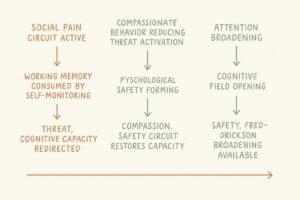
Why workplace environment affects performance is not a question of motivation or attitude. It is a structurally describable problem — one that social neuroscience, cognitive science, and organizational psychology address at different levels of resolution.
Social neuroscientist Naomi Eisenberger’s research on social pain provides the most direct foundation for understanding the relationship between workplace environment and performance. In a study published in Science (2003), Eisenberger and colleagues showed that social exclusion — the experience of being left out of a group — activates the dorsal anterior cingulate cortex and anterior insula: regions substantially overlapping with those involved in processing physical pain. Workplace criticism, dismissal, and negative evaluation are not distinguished from physical pain at the level of neural processing. The practical implication is precise: compassion functions in the workplace not because it is a virtue, but because it reduces the activation of a circuit that, when running, redirects cognitive resources away from work.
Eisenberger’s circuit does not merely generate discomfort — it actively consumes the cognitive resources that work requires. That mechanism is what cognitive scientist Sian Beilock’s research on choking under pressure describes. In Choke (2010), Beilock showed that under conditions of evaluative threat, working memory capacity is consumed by self-monitoring — leaving less available for the task itself. This is not an ability problem. The same individual, with the same capability, produces measurably different outcomes in threatening versus safe conditions, because the cognitive resources are being allocated differently. The question of why a capable person is not performing is almost never answered by examining the person alone. The environment’s claim on their cognitive capacity is the more informative variable.
How compassion changes that environment is described by organizational psychologist Amy Edmondson’s research on psychological safety. In her foundational study in Administrative Science Quarterly (1999), and developed across subsequent work collected in The Fearless Organization (2018), Edmondson showed that psychological safety — the shared belief that interpersonal risk-taking will not be punished — is not installed by leadership alone. It is formed bidirectionally, through the cumulative effect of each member’s behavior on the collective environment. Compassionate actions — receiving a colleague’s failure without criticism, confirming rather than dismissing a contribution — function as inputs to this formation. A single person’s compassionate behavior shifts the terrain for the group — reducing the activation of the social threat circuit that Eisenberger described, and returning cognitive resources to their original purpose.
What becomes available when safety is established is described by psychologist Barbara Fredrickson’s Broaden-and-Build Theory. In American Psychologist (2001), Fredrickson showed that positive emotional states expand the scope of attention and cognition — broadening the range of options and associations that become perceptible. Under threat, attention narrows to the source of danger. Under safety, it widens. The stilling of Eisenberger’s social pain circuit is the prerequisite for Fredrickson’s broadening: the cognitive field that safety opens is the same field that threat had closed. What gets called creativity or innovation is less a matter of special talent than of whether this broadening is occurring — and broadening is a condition of environment, not a property of individuals.
Conclusion: The Environment Had Been Deciding

The capacity was present all along.
With the threat circuit running, that capacity was occupied with monitoring. Compassion intervenes in the allocation — reducing the activation of the social pain circuit and returning cognitive resources to the work they were intended for.
Nobody was underperforming. The environment was using their capacity for something else.
KEY TERMS
Social Pain
Naomi Eisenberger’s finding, published in Science (2003), that social exclusion activates neural regions — the dorsal anterior cingulate cortex and anterior insula — substantially overlapping with those that process physical pain. Workplace criticism and rejection are not distinguished from physical pain at the level of neural processing. The practical implication: compassion in the workplace reduces the activation of a circuit that, when running, redirects cognitive resources away from work.
Choking Under Pressure
Sian Beilock’s framework, developed in Choke (2010), for how evaluative threat consumes working memory capacity through self-monitoring, reducing cognitive resources available for the task itself. Performance decrements in threatening environments reflect allocation problems, not ability deficits. The question of why a capable person is not performing is almost never answered by examining the person alone — the environment’s claim on their cognitive capacity is the more informative variable.
Psychological Safety
Amy Edmondson’s concept, introduced in Administrative Science Quarterly (1999) and developed in The Fearless Organization (2018), describing the shared belief that interpersonal risk-taking will not be punished. Formed bidirectionally through each member’s behavior — not installed by leadership alone. Compassionate actions function as inputs to its formation, shifting the relational terrain for the group as a whole.
Broaden-and-Build Theory
Barbara Fredrickson’s theory, from American Psychologist (2001), that positive emotional states expand attentional scope and cognitive range — broadening the field of available options and associations. Threat narrows this field; safety reopens it. The relationship between Eisenberger’s social pain circuit and Fredrickson’s broadening makes the former a prerequisite for the latter — the cognitive field that safety opens is the same field that threat had closed.