
Introduction: The Standard Was Never the Problem

After a mistake, the replay begins. That decision was wrong. I could have done more. Why didn’t I handle it differently.
Holding high standards is not the problem. The problem is what happens when those standards are missed.
At the center of perfectionism is not the pursuit of excellence. It is a penalty system — designed so that missing the standard causes the self to collapse — and a structure in which the fear of that penalty is precisely what makes it impossible to stop. This article describes both layers.
Session 1: Perfectionism as a Penalty System

Holding high standards and perfectionism are different things.
High standards move toward something: I want this work to be good. Perfectionism moves away from something: if I fail, I am worthless. The first is approach-oriented. The second is organized around avoidance.
The difference shows up most clearly after a failure. Someone with high standards processes failure as information and moves toward the next attempt. Someone inside the perfectionist structure processes failure as an attack on self-worth — not that didn’t work but therefore I am inadequate.
That processing happens for a structural reason, not a personal failing.
Session 2: Intervening in the Penalty System
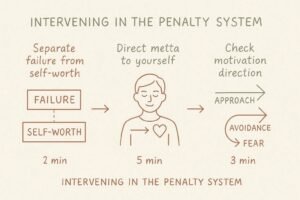
STEP 1: Separate the failure from the self-worth response (2 minutes)
Bring to mind a recent moment of I should have done better.
In that moment — was the response a reaction to what didn’t work? Or did it move immediately to therefore something is wrong with me?
Confirm the difference between the two. They arrive together, but they are not the same thing.
STEP 2: Direct Mettā toward yourself (5 minutes)
Toward the self that missed the standard, direct quiet intention.
May I be allowed to be imperfect and still worthy of care.
May I meet this standard without attaching my value to it.
The intention is not to dismantle the system — it is to introduce warmth at the point where the penalty lands.
STEP 3: Check the direction of the motivation (3 minutes)
Is this standard something being moved toward — because the work matters? Or is it something being maintained to avoid what happens when it is missed?
Confirm whichever arrives, without evaluation. When avoidance motivation is present, direct intention once more:
May I pursue what matters from a place of care, not fear.
Session 3: The Structure of Perfectionism, Contingent Self-Worth, Avoidance Motivation, and the Pathway Compassion Opens
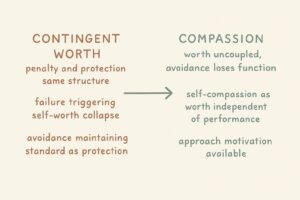
Perfectionism’s function as a penalty system, and the reason that system persists, is addressed by personality psychology and achievement motivation research — each identifying a different layer of the same structure.
Paul Hewitt and Gordon Flett’s multidimensional model of perfectionism, introduced in Journal of Personality and Social Psychology (1991), describes perfectionism not as a single trait but as three distinct dimensions differentiated by target: self-oriented perfectionism — setting high standards for oneself and demanding their achievement — other-oriented perfectionism, and socially prescribed perfectionism. Self-oriented perfectionism is the dimension most consistently associated with post-failure self-critical loops. Within this structure, achievement tends to be processed as expected — as the baseline — while failure is processed as evidence. The asymmetry between how success and failure are weighted produces a system in which no amount of achievement resolves the underlying vulnerability, but each failure confirms it.
Why failure lands so heavily within that structure is where Jennifer Crocker’s research on contingent self-worth provides the mechanism. In a foundational paper in Psychological Review (2003), Crocker showed that when self-worth is contingent on performance in a given domain, failures in that domain are processed not as isolated setbacks but as threats to the self as a whole. The automatic conversion of this didn’t go well into I am therefore inadequate runs through the contingency that has been established between performance and self-value. Crocker’s research identified a second function of contingent self-worth that is directly relevant to perfectionism’s persistence: the same contingency that makes failure devastating also provides a maintenance logic for high standards — if I perform perfectly, my self-worth is secured. The penalty system and the motivation to avoid triggering it are the same structure.
Why perfectionism is so difficult to stop, even when its costs are recognized, is what Andrew Elliott’s achievement motivation research describes. Elliott’s 2×2 achievement goal model, published in Journal of Personality and Social Psychology (1999), distinguishes between approach motivation — movement toward a positive outcome — and avoidance motivation — movement away from a negative one. The motivation underlying perfectionism is, in many cases, not the pursuit of excellence but the avoidance of failure. When that avoidance motivation is combined with the contingent self-worth structure that Crocker described, the result is a system that is particularly resistant to voluntary change: abandoning perfectionism feels equivalent to removing the protection against self-worth collapse. If I stop holding this standard, I will have nothing to protect me when I fail. The perfectionism is functioning as an anxiety management system — and systems that are managing anxiety do not stop while they are still working.
The exit from the penalty structure is where Kristin Neff’s research on self-compassion and motivation provides the mechanism. In work published in Self and Identity (2003) and extended in subsequent studies, Neff showed that self-compassion does not reduce motivation — it changes its direction. Within the contingent self-worth structure that Crocker described, self-worth depends on performance, making failure a threat that must be avoided. Self-compassion functions as a source of self-worth that is independent of performance: directing warmth toward oneself after a failure does not require the failure to have not happened. It establishes the circuit in which missing a standard does not trigger self-worth collapse — and when the collapse no longer follows the failure, the primary function of avoidance motivation is removed. The standard can remain; the penalty attached to missing it changes.
Conclusion: It Was a Design Problem

The standard was not the issue.
The design — in which missing the standard caused self-worth to collapse, and in which that collapse was frightening enough to make the system impossible to stop — was the issue.
Compassion intervenes in the design, not the standard.
Perfectionism wasn’t a pursuit of excellence. It was a management strategy for the fear of what would happen without it.
KEY TERMS
Self-Oriented Perfectionism
One dimension of Hewitt and Flett’s multidimensional model, introduced in Journal of Personality and Social Psychology (1991): setting high standards for oneself and demanding their achievement. Characterized by an asymmetric processing of success and failure — achievement is expected, failure is evidence. The dimension most consistently associated with post-failure self-critical loops and the persistence of self-worth vulnerability.
Contingent Self-Worth
Jennifer Crocker’s concept, from Psychological Review (2003), describing the cognitive pattern in which self-worth is tied to performance, causing failures in that domain to threaten the self as a whole. Simultaneously functions as the maintenance logic for perfectionism: the same contingency that makes failure devastating provides the motivation to avoid it through high standards. The penalty system and the motivation to avoid triggering it are the same structure.
Avoidance Motivation
The motivational form, in Andrew Elliott’s 2×2 achievement goal model from Journal of Personality and Social Psychology (1999), oriented toward moving away from negative outcomes rather than toward positive ones. Perfectionism frequently operates as avoidance motivation — maintaining high standards to prevent failure rather than to pursue excellence. When combined with contingent self-worth, produces a system resistant to voluntary change.
Self-Compassion and Motivation
Kristin Neff’s finding, from Self and Identity (2003) and subsequent research, that self-compassion supports a shift from avoidance to approach motivation by functioning as a source of self-worth independent of performance. When missing a standard no longer triggers self-worth collapse, the primary function of avoidance motivation is removed. The standard can remain; the penalty attached to missing it changes.