
Introduction: When Someone Else’s Good News Lands Somewhere Complicated

A friend gets the promotion. Someone achieves what they had been working toward. A post appears on a screen showing someone’s happiness.
Good for them, the thought begins. And underneath it, something heavier. Comparison, urgency, a question turned inward. Why am I still here.
This is not a problem with your character. Envy is an automatic response — the nervous system processing another person’s success as social pain. And the environment of contemporary life is structurally designed to produce that response, continuously.
Muditā — sympathetic joy — is the circuit that runs in the other direction. Not a moral effort, but a different activation: the capacity to respond to another person’s happiness the way compassion responds to another person’s suffering.
Session 1: Why Another Person’s Joy Is Hard to Meet

When someone else’s success is difficult to be with, two things are happening at the same time.
One is an automatic neural response — envy activating the social pain circuit, another person’s gain processed as a relative loss. The other is a structural condition — the contemporary environment continuously supplying comparison points, making someone else’s advantage permanently visible.
Where these two overlap is where sympathetic joy becomes most difficult. That difficulty is not a personal failing. It is a designed difficulty — built into the nervous system and amplified by the social architecture around it.
Session 2: Directing Sympathetic Joy
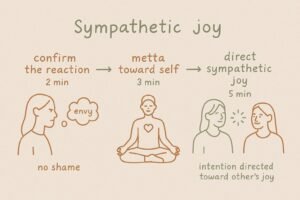
STEP 1: Confirm the reaction (2 minutes)
Bring to mind a recent moment of encountering another person’s success, happiness, or good fortune.
Was there a response somewhere in the body? Around the chest, the stomach, the throat.
Confirm it without evaluation. If envy arrived, that is the starting point for this practice.
STEP 2: Direct Mettā toward yourself first (3 minutes)
Before directing anything outward, bring intention toward the self that is carrying the reaction.
May I be gentle with how hard this is.
May I meet this reaction with care rather than shame.
The movement toward another’s joy is only possible from a stable position. That position starts here.
STEP 3: Direct sympathetic joy toward the person (5 minutes)
From that position, turn toward the person’s joy itself.
Confirm the fact: this person is experiencing something good. That fact exists independently of what it produces in you.
May your joy be full.
May what you have found continue to flourish.
If resistance remains, that is where the practice is. The intention is the operation — not the feeling that follows it.
Session 3: The Neural Circuit of Envy, Schadenfreude, Relative Deprivation and Zero-Sum Thinking, and What Sympathetic Joy Opens
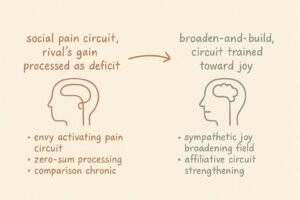
Another person’s success should not produce pain. That it does has a precise explanation — one that runs from the neural circuit that registers it, through the social architecture that amplifies it, to the cognitive bias that makes it feel like loss.
Envy’s neural basis was documented by Hidehiko Takahashi and colleagues, publishing in Science (2009). Their finding was that envy activates the anterior cingulate cortex — a region involved in social pain processing. Another person’s success is processed through a circuit that registers it as social pain. The evolutionary context for this is legible: in environments where resources were scarce and status determined survival, a rival’s gain represented a relative loss in one’s own position. Takahashi’s research showed a further finding that extends this picture: the same participants who showed stronger envy toward a successful other showed stronger Schadenfreude — pleasure at that person’s subsequent misfortune — when their fortunes reversed. Envy and Schadenfreude are the two faces of the same circuit. The experience of finding another person’s success difficult, and feeling something like relief at their setback, is not a moral failure. It is the circuit operating as designed.
Why that circuit runs so persistently in contemporary life is where two sociological and cognitive observations provide the structural explanation. Robert Merton’s concept of relative deprivation, developed in Social Theory and Social Structure (1949), describes how dissatisfaction and envy arise not from absolute conditions but from comparison with a reference group — what matters is not what one has but who one is measuring against. Before the widespread adoption of social media, reference groups were geographically and socially bounded. Social platforms have expanded the reference group to include, effectively, everyone — making the most successful version of any peer category continuously visible and available for comparison. This structural change has made relative deprivation chronic rather than episodic. Research on zero-sum thinking adds the cognitive layer: the tendency to process another person’s gain as one’s own loss — a bias that evolved as an adaptive response to genuinely scarce resources — continues to activate automatically in contexts where it no longer applies. A friend’s promotion does not reduce the available promotions for everyone else. Zero-sum thinking processes it as if it does. Merton’s structural account explains why the comparison is always being made; the zero-sum tendency explains why the comparison so often registers as loss.
Barbara Fredrickson’s Broaden-and-Build Theory provides the mechanism for how sympathetic joy intervenes in this structure. Fredrickson’s research, published in American Psychologist (2001), showed that positive emotional states broaden attentional scope and accumulate as psychological resources over time. Envy narrows the field to a single axis — self versus other, gain versus loss. The positive affect that sympathetic joy generates expands that field: another person’s success becomes processable as evidence that good things exist and are achievable, rather than as a signal of relative deficit. Fredrickson’s theory further shows that this broadening accumulates — each instance of sympathetic joy builds the psychological resources that make the next instance more available. The practice is not simply a single act of generosity toward another person’s happiness. It is the incremental strengthening of a circuit that runs counter to the default.
That this circuit is trainable is supported by Olga Klimecki’s compassion training research. Klimecki and colleagues, publishing in Cerebral Cortex (2013), showed that compassion training strengthens the affiliative system circuitry — the medial prefrontal cortex and ventral striatum — and maintains positive affect even in the presence of others’ suffering. Sympathetic joy practice engages the same affiliative circuitry, directed toward another person’s happiness rather than their pain. The direction differs; the circuit overlaps. The state of not yet being able to fully meet another person’s joy with genuine warmth is not a failure of character. It is the circuit before training. Klimecki’s research shows that this changes.
Conclusion: The Circuit That Runs the Other Way

Envy was the nervous system doing what it was built to do. Relative deprivation and zero-sum thinking kept the comparison running in an environment designed to supply it without end.
The joy was always available. The comparison circuit just got there first.
When Mettā meets one’s own difficulty, Karuṇā meets the suffering of others, and sympathetic joy meets the happiness of others, the four directions of care are quietly complete.
KEY TERMS
Muditā
The Pāli term for sympathetic joy — the capacity to respond to another person’s happiness, success, or flourishing with genuine warmth rather than comparison or competition. Where Karuṇā responds to suffering, Muditā responds to joy — engaging the same affiliative system circuitry in the opposite emotional direction. In contemporary practice contexts, Muditā is often identified as the most difficult of the four to cultivate, precisely because the social environments in which it is practiced are structurally organized around comparison.
Neural Circuit of Envy
Hidehiko Takahashi and colleagues’ finding, from Science (2009), that envy activates the anterior cingulate cortex — a region involved in social pain processing. The same research documented the Schadenfreude response as the circuit’s counterpart: stronger envy toward a person predicts stronger pleasure at their subsequent misfortune. Envy and Schadenfreude are the two faces of a single circuit. The finding provides the neural basis for understanding sympathetic joy as a circuit intervention rather than a moral effort.
Relative Deprivation and Zero-Sum Thinking
Robert Merton’s concept of relative deprivation, from Social Theory and Social Structure (1949) — dissatisfaction arising from comparison with a reference group rather than from absolute conditions — combined with research on zero-sum thinking, the cognitive tendency to process another’s gain as one’s own loss. Social media has expanded the reference group to global scale, making relative deprivation chronic. Zero-sum thinking processes the resulting comparisons as loss even when they are not. Together, these two frameworks describe the social and cognitive architecture within which sympathetic joy is most needed and most difficult.
Broaden-and-Build Theory
Barbara Fredrickson’s theory, from American Psychologist (2001), that positive emotional states broaden attentional scope and accumulate as psychological resources. Applied to sympathetic joy: the positive affect generated by Muditā practice expands the field from the envy circuit’s self-versus-other axis, making another person’s success processable as evidence of possibility rather than as a signal of deficit. Each practice instance builds the resources that make the next more available.