
Introduction: Why “Just Accept It” Doesn’t Work

Noticing the change in the mirror. Movement that is slower than it used to be. Memory with a different texture than before.
I should accept this. And yet the acceptance doesn’t come. The cycle repeats.
This inability to accept is not a failure of will. Resistance to aging has cognitive and existential structure. Telling someone to accept what they have not yet understood the structure of does not work.
This article explains why the resistance happens — and then what aging deepens. Knowing both is what allows compassion to function as a shift in perspective rather than as resignation.
Session 1: The Resistance Was a Natural Cognitive Response

When the body changes, the self-concept tries to respond to that change.
But the self-concept resists disruption. When the stable sense of this is who I am is threatened by change, resistance arises. This is not a character problem. It is the cognitive process by which the self-concept attempts to maintain coherence.
Resistance to aging has a deeper layer as well. Growing older brings mortality into awareness. The cultural emphasis on youth functions as a collective defense against that awareness — a way of managing the existential discomfort that aging, by its nature, surfaces. Beneath the feeling of I don’t want to grow old is an existential anxiety that runs deeper than preference.
Knowing that structure is the first condition for directing compassion toward it.
Session 2: Directing Mettā Toward the Self That Is Aging
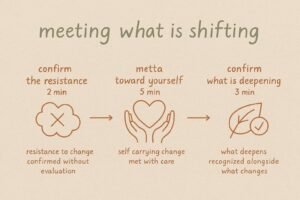
STEP 1: Confirm the resistance (2 minutes)
Bring to mind a recent moment of noticing a change in the body or in capacity.
What arrived? Sadness, urgency, anxiety, resistance.
Confirm the response without evaluating it. Something in me is resisting this. That confirmation is enough for this step.
STEP 2: Direct Mettā toward yourself (5 minutes)
Toward the self that is carrying this change, direct quiet intention.
May I be with this change without requiring it to be different.
May I meet what is shifting with some gentleness.
When the resistance arrives, direct intention toward the part that is resisting as well:
May I be kind to the part of me that finds this difficult.
STEP 3: Confirm what is deepening (3 minutes)
Within the change — is there something that has also deepened?
Clarity about what matters. A different quality of attention toward people. Warmth that comes more naturally than it once did.
Toward whatever is deepening, direct quiet recognition:
May I notice what is growing, not only what is changing.
Session 3: Identity Friction, Mortality Awareness, the Reordering of Time, and What Aging Deepens
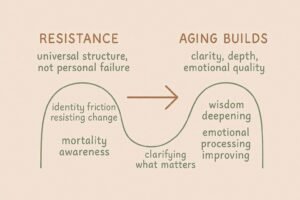
Resistance to aging has structure. So does what lies on the other side of it. The frameworks that follow address each layer in turn — from the cognitive mechanics of the resistance, to the existential depth beneath it, to what the research shows aging actually builds.
Susan Krauss Whitbourne’s Identity Process Theory describes the cognitive structure of how aging is experienced. In research developed across Identity and the Life Course (1986) and The Aging Individual (1996), Whitbourne showed that people respond to age-related changes through two processes: assimilation — incorporating change into the existing self-concept while minimizing its significance — and accommodation — updating the self-concept to reflect the change. Neither process alone is adaptive; over-reliance on assimilation produces denial, while over-reliance on accommodation destabilizes the sense of self. The experience of I cannot accept this is the friction generated when assimilation cannot keep pace with change — a natural response of a self-concept attempting to maintain coherence, not a failure of attitude or willpower.
Why that resistance cannot be overcome by will alone is what Terror Management Theory explains. Jeff Greenberg, Sheldon Solomon, and Tom Pyszczynski, publishing in Journal of Personality and Social Psychology (1986), showed that much of human behavior and belief functions as a defense against mortality awareness. Aging is one of the most immediate triggers of that awareness — physical change returns the fact of finitude to attention repeatedly and without request. Cultural valorization of youth, and the widespread impulse to conceal or resist aging, function as collective defenses against the existential discomfort that aging surfaces. The I don’t want to grow old feeling has, beneath the preference, an existential layer that operates below conscious deliberation. Recognizing this does not remove the anxiety — but it relocates the resistance from personal weakness to universal human structure.
What becomes available when that defense begins to soften is described by Laura Carstensen’s Socioemotional Selectivity Theory. In Psychological Review (1999), Carstensen showed that as the time horizon shortens, people shift their motivational priorities toward emotionally meaningful goals and relationships — away from information acquisition, status, and expansion, and toward emotional depth, close connection, and present-moment engagement. The counterintuitive finding from Carstensen’s research is a U-shaped curve of subjective wellbeing: a decline in early adulthood, followed by recovery and increase through middle and later life. Aging is not simply accumulating loss — it is, in measurable terms, a process of clarifying what actually matters.
The neural basis for how emotional processing changes with age is described by Mara Mather’s research on the Positivity Effect. Mather and colleagues, publishing in Psychology and Aging (2005), documented that older adults show a reliable shift toward attending to positive information over negative — a pattern that contrasts with younger adults’ tendency toward negative information processing. This is not a cognitive deficit or a form of denial. Mather’s research identified it as an adaptive neural change involving reduced amygdala reactivity to negative stimuli and improved prefrontal regulation of emotional response. Carstensen’s motivational account of why the shift occurs and Mather’s neural account of how it operates together describe a coherent picture: aging changes the quality of emotional processing in ways that are both motivationally driven and neurologically instantiated.
That aging also deepens certain cognitive capacities is described by Raymond Cattell and John Horn’s distinction between fluid and crystallized intelligence — fluid intelligence declines with age, while crystallized intelligence is maintained and often increases — and by Monika Ardelt’s Three-Dimensional Wisdom Model. Ardelt’s model, developed in Psychological Inquiry (2004), integrates cognitive depth, reflective capacity, and emotional maturity into a form of understanding that deepens with experience rather than declining with it. When Mather’s positivity effect and Ardelt’s wisdom model are read together, aging emerges as a process in which both emotional processing and integrative understanding move in a deepening rather than a declining direction — a picture substantially different from the cultural narrative of loss.
Conclusion: What Was on the Other Side of the Resistance

The resistance was not a failure to accept. It was the self-concept maintaining coherence, and beneath it, the oldest human defense against the awareness of finitude.
Compassion does not dissolve that structure. It creates enough space to look past it.
The shorter the horizon, the clearer what was always worth attending to.
KEY TERMS
Identity Process Theory
Susan Krauss Whitbourne’s framework, developed across Identity and the Life Course (1986) and The Aging Individual (1996), describing the two cognitive processes through which people respond to age-related change: assimilation, which incorporates change into the existing self-concept, and accommodation, which updates the self-concept to reflect change. The experience of being unable to accept aging is the friction generated when assimilation cannot keep pace with change — a coherence-maintenance response, not a character failure.
Terror Management Theory
Jeff Greenberg, Sheldon Solomon, and Tom Pyszczynski’s theory, from Journal of Personality and Social Psychology (1986), that much human behavior functions as a defense against mortality awareness. Aging triggers that awareness repeatedly; cultural valorization of youth is a collective defense against the existential discomfort aging surfaces. Relocating resistance from personal weakness to universal human structure is the practical contribution of this framework to aging research.
Socioemotional Selectivity Theory
Laura Carstensen’s theory, from Psychological Review (1999), that a shortening time horizon shifts motivational priorities toward emotionally meaningful goals and relationships. The U-shaped wellbeing curve — declining in early adulthood, recovering and rising through middle and later life — is among its most cited findings. Aging clarifies what matters rather than simply removing what existed.
Positivity Effect
Mara Mather and colleagues’ finding, from Psychology and Aging (2005), that older adults show a reliable shift toward positive information processing — an adaptive neural change involving reduced amygdala reactivity and improved prefrontal emotional regulation. Provides the neural basis for the motivational shift that Carstensen’s theory describes. Together, the two frameworks describe aging as a process that changes the quality of emotional processing in both motivationally driven and neurologically instantiated ways.
Crystallized Intelligence and Wisdom
Raymond Cattell and John Horn’s distinction between fluid intelligence — which declines with age — and crystallized intelligence — which is maintained and often increases — establishing that aging’s cognitive effects are not unidirectional. Monika Ardelt’s Three-Dimensional Wisdom Model, from Psychological Inquiry (2004), describes the integration of cognitive depth, reflective capacity, and emotional maturity as a form of understanding that deepens with experience.