
Introduction: Functioning and Not Depleted Are Two Different Things

The day is finished, and something is heavy. Things were accomplished, but what’s present is fatigue rather than satisfaction. Or there is no clear sense of being tired at all — just continuous forward motion, one thing after the next.
This is not a willpower problem. It is a nervous system carrying accumulated load.
Words of acknowledgment directed toward yourself are not emotional consolation for this state. They are a minimal intervention for reactivating the affiliative system when the threat system has been running too long.
Session 1: What “Pushing Through” Actually Is

The stress response is designed as a short-term adaptive system. A threat arises, the system activates, the threat passes, and the system returns to baseline. This cycle, functioning as intended, is not harmful.
What contemporary life tends to produce instead is a continuous stream of demands that don’t resolve. Deadlines that become new deadlines. Relationship tension that persists. Performance expectations that reset rather than close. The stress response activates repeatedly, with insufficient recovery between activations. The cumulative effect of this pattern on the nervous system, immune system, and cardiovascular system is what neuroscientist Bruce McEwen named allostatic load — the measurable biological cost of sustained adaptation.
Under high allostatic load, the threat system remains chronically active. In this state, attempts to practice Mettā — to generate friendly intention toward oneself — encounter a specific obstacle: the affiliative system is suppressed by the dominant threat system. The effort has limited reach. Words of acknowledgment are designed as an entry point into this state — a minimal activation of the affiliative system that doesn’t require the threat system to have already quieted. Research on self-compassion suggests that minimal entry-point practices of this kind tend to be most useful precisely when the system is most depleted — when more sustained effort feels inaccessible.
Session 2: Three Steps
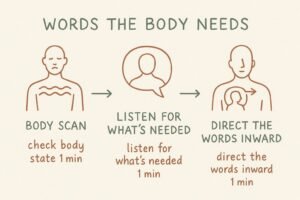
Before sleep, during a break, or once at any point in the day.
STEP 1: Check the body’s current state (1 minute)
Close the eyes and quietly scan the body.
Is there tension in the shoulders or neck?
Has the breath become shallow?
Is there any compression in the chest or abdomen?
Don’t evaluate the state — just confirm it. Tension is present, or it isn’t. That’s the observation.
STEP 2: Listen for the words that are needed (1 minute)
Ask internally: what would I want to hear right now? Then wait, rather than constructing an answer.
You’ve been working hard.
Today was genuinely difficult.
It’s alright to stop.
That was enough.
Wait for words that come from the body rather than the thinking mind. If nothing comes, that’s fine too.
STEP 3: Direct the words inward (1 minute)
Take whatever arrived in STEP 2 and direct it slowly toward the interior. If no words came, return attention quietly to wherever tension was found in STEP 1 — and simply rest attention there.
No evaluation. No assessment of whether it worked. Just the directing.
Session 3: Allostatic Load, Inner Speech and Emotional Regulation, and the Structural Reason Self-Care Gets Skipped
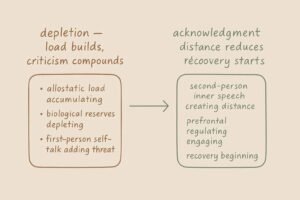
The reason words of acknowledgment function as more than emotional comfort has several distinct layers.
Bruce McEwen’s concept of allostatic load, developed through research from the 1990s onward, reframed chronic stress from a psychological phenomenon to a measurable biological one. The body adapts to stress by deploying physiological resources — cortisol, adrenaline, inflammatory cytokines. Each deployment has a cost. When the stress response activates repeatedly without sufficient recovery, these costs accumulate across the nervous system, immune system, and cardiovascular system in ways that can be detected through blood markers, neural imaging, and physiological measurement. Pushing through is not a metaphor. It describes a state in which the body is drawing down on biological reserves faster than they are being replenished. McEwen’s work reframes the need for self-directed care not as self-indulgence but as recovery intervention — the restoration of a system that has been operating under sustained load. *The End of Stress as We Know It*, co-written with Robert Lasley, offers an accessible account of this research.
The mechanism by which language changes emotional state involves what psychologist Lev Vygotsky described as inner speech — the internal verbal activity through which we regulate thought and feeling. Vygotsky argued that inner speech is not simply silent talking but a condensed, abbreviated form of language that plays a central role in self-regulation. Contemporary neuroscience has confirmed that inner speech engages prefrontal regions involved in emotional regulation, and has added a finding that Vygotsky could not have anticipated: the grammatical person of inner speech matters. First-person self-talk (I am exhausted, I failed) and second-person self-talk (you’ve been working hard, you did what you could) produce different effects on emotional regulation. Second-person inner speech — addressing oneself as if speaking to another person — generates psychological distance, reduces threat system activation, and is associated with better emotional outcomes in stressful situations. STEP 2’s question — what would I want to hear right now — deliberately generates this second-person frame. The question positions the self as both the speaker and the recipient of care, which is structurally different from the first-person self-criticism that tends to dominate under depletion.
The sociological dimension of this practice is worth naming. Arlie Hochschild’s documentation in The Second Shift of the double burden — paid labor plus unpaid care work, with the latter largely invisible and socially unacknowledged — describes a structural constraint on the time and energy available for self-directed care. The cumulative effect is not simply a personal pattern. The tendency to push through exhaustion rather than attend to it is, in many cases, a rational response to genuine resource scarcity produced by unequal distribution of care labor. Recognizing this structural dimension matters for practice: the barrier to self-acknowledgment is not only psychological. Shifting the frame from I am bad at taking care of myself to I am operating in conditions that make self-care systematically difficult reduces the self-critical layer that compounds depletion.
Conclusion: The Recovery Happens During, Not After
Once today. Before sleep, or in a gap between demands.
Check what the body is carrying. Listen for the words that are needed.
Direct them inward.
The words weren’t a reward for what you accomplished. They were maintenance for the system that makes accomplishment possible.
KEY TERMS
Allostatic Load
Bruce McEwen’s term for the cumulative biological cost of sustained adaptation to stress. The stress response deploys physiological resources — cortisol, adrenaline, inflammatory cytokines — and repeated activation without sufficient recovery accumulates measurable costs across the nervous system, immune system, and cardiovascular system. Reframes chronic exhaustion from a psychological experience to a physiological state. Positions self-directed care as recovery intervention rather than self-indulgence. *The End of Stress as We Know It* (McEwen and Lasley) provides an accessible introduction.
Inner Speech and Emotional Regulation
Lev Vygotsky’s concept of inner speech as a central mechanism of thought and self-regulation — not silent talking but a condensed form of language engaged in emotional management. Contemporary research has confirmed that the grammatical person of inner speech matters: second-person self-talk (you’ve been working hard) generates psychological distance and reduces threat system activation more effectively than first-person self-talk (I am exhausted). STEP 2’s framing — what would I want to hear right now — deliberately generates this second-person perspective.
Care Asymmetry
Arlie Hochschild’s documentation in The Second Shift of the double burden carried by many people — paid labor plus unpaid care work — and its structural effect on the time and energy available for self-directed care. The tendency to skip self-acknowledgment is not only a psychological pattern. It is partly a rational response to genuine resource constraints produced by unequal care labor distribution. Recognizing this structural dimension shifts the frame from personal failure to structural prediction — a reframe that reduces the self-critical layer compounding depletion.
Self-Compassion Under Depletion
Research on self-compassion suggests that entry-point practices — minimal activations of the affiliative system that don’t require the threat system to have already quieted — tend to be most useful when more sustained effort feels inaccessible. When the threat system is dominant, conceptual attempts at self-acceptance have limited reach. Minimal entry-point interventions — including body-based contact (see Guide 3) and second-person inner speech — engage the affiliative system more directly under these conditions. The practice in this guide is designed as an entry point for states in which more sustained practice feels inaccessible.
Defusion
See Guide 5. When this is weakness or I don’t deserve to rest until I’ve done more arrives as a verdict, recognizing it as a thought rather than an accurate assessment — and returning attention to the body scan in STEP 1 — is defusion applied to the productivity-oriented self-criticism that acknowledgment practice consistently encounters.