
Introduction: “It Doesn’t Feel Right” Is Where to Begin

May I be happy.
Something about it feels distant. A faint awkwardness. The words and the self on the receiving end of them separated by a thin layer of something.
This is not a sign that the practice is wrong for you. When a phrase doesn’t land, it is not a problem of sensitivity or resistance. It is a structural problem: the connection between language and emotional circuitry has not yet been made.
Finding your own words is the process of making that connection.
Session 1: What Is Happening When a Phrase Doesn’t Land

Language carries meaning, but whether it reaches the emotional circuitry is a separate question.
The meaning of may I be happy is immediately understood. But understanding the meaning and connecting to the emotional processing associated with it are different operations. For language to reach emotional circuitry, it needs to pass through self-referential processing — the recognition that this is about me, addressed to me. When that passage doesn’t occur, the words are processed as meaning but don’t register as felt experience.
The sense of awkwardness or disconnection is a signal that this passage hasn’t happened. Not a failure of practice. The words arrived, but without an address. Finding your own words is writing it.
Session 2: Three Steps
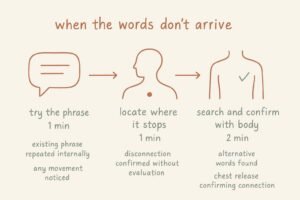
STEP 1: Try the existing phrase and notice what happens (1 minute)
There is no wrong response here — noticing that something doesn’t land is as useful as noticing that it does.
May I be happy.
May I be at ease.
No need to say it aloud. Repeat it internally and notice whether anything moves.
If there is any warmth at all, the phrase is already working. If there is a sense of it not arriving — that is the starting point.
STEP 2: Locate where it stops (1 minute)
If it doesn’t land, where does it stop?
Maybe the words feel too formal — addressed to someone slightly other than you. Maybe the meaning is clear but the texture is absent. Whatever the quality of the disconnection, confirm it without evaluation. That texture is the information for the next step.
STEP 3: Search for different words and confirm with the body (2 minutes)
Using the disconnection as a guide, look for alternatives.
If happy feels remote — may I just be settled for a while.
If at ease runs hollow — may tonight be a little lighter than today.
Or simply — may I be alright.
When a candidate arrives, repeat it and check the body’s response. A slight release in the chest, a loosening somewhere — that signal is the confirmation of connection.
Session 3: Cognitive Dissonance, Self-Referential Processing, and How Language Reaches the Emotional Circuitry
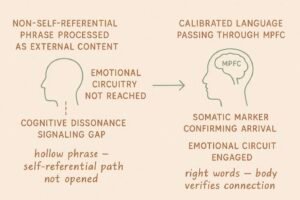
Leon Festinger’s cognitive dissonance describes the internal friction generated when information is processed that conflicts with one’s current sense of self. The slight awkwardness of may I be happy — the sense of it running hollow or addressing someone slightly other than you — is the friction produced by a gap between the language and the present self-concept. This is not resistance to the practice. It is the cognitive system responding honestly to language that has not yet been calibrated to its recipient. The discomfort signals that the phrase is not yet self-referential — not that the door is closed. Festinger’s original research is collected in A Theory of Cognitive Dissonance (1957).
Why self-referential calibration matters is what research on self-referential processing explains. A consistent finding in cognitive neuroscience is that information processed as self-relevant engages a broader and deeper network of neural circuitry — including emotional processing regions — than information processed as externally relevant. The medial prefrontal cortex, a key node in the self-referential network, shows differential activation depending on whether incoming information is registered as pertaining to the self. Language that does not pass through self-referential processing reaches the emotional circuitry less deeply — it is processed as content without becoming felt experience. Finding words that carry the sense of being genuinely addressed to the self is the operation that opens this pathway.
The act of searching for those words has its own effect, independent of what is found. Psychologist Lisa Feldman Barrett’s research on emotional granularity showed that the ability to apply precise language to emotional experience correlates with greater flexibility in emotional regulation. The difference between something feels off and there is a specific tightness just below the sternum is a difference in processing resolution. Barrett’s work, developed in How Emotions Are Made (2017), suggests that the act of finding accurate language for an emotional state is itself an intervention — it raises the resolution at which the experience is being processed. Searching for the phrase that fits is not preparation for the practice. It is already the practice.
The bodily response when a phrase lands is not a subjective preference signal. Neuroscientist Antônio Damásio’s somatic marker hypothesis, developed in Descartes’ Error (1994), showed that bodily responses — shifts in chest sensation, changes in breathing, a release of muscular tension — function as evaluative markers in emotional processing and decision-making. The slight loosening when a phrase lands is a body-level confirmation that the language has passed through self-referential processing and connected with the emotional circuitry. Checking the body’s response is not an optional finishing touch. It is the verification step — the confirmation that the address has been written and the letter has arrived.
Conclusion: The Address Just Hadn’t Been Written Yet

They arrived without a name on them. The self-referential pathway wasn’t open yet. The letter stopped at the surface.
Finding your own words is writing the address. When the body responds, the letter has arrived.
KEY TERMS
Cognitive Dissonance
Leon Festinger’s framework for the internal friction generated when information conflicts with the current self-concept. The awkwardness of an existing Mettā phrase is the automatic response of the cognitive system to language not yet calibrated to its recipient — not resistance to the practice, but the system being honest. Festinger’s foundational work appears in *A Theory of Cognitive Dissonance* (1957).
Self-Referential Processing
The cognitive neuroscience finding that self-relevant information engages a broader, deeper neural network — including emotional processing regions — than externally relevant information. Language that does not pass through self-referential processing reaches the emotional circuitry less deeply. Finding words that carry the genuine sense of being addressed to the self opens this pathway. The medial prefrontal cortex is a key node in the self-referential network.
Emotional Granularity
Lisa Feldman Barrett’s term for the capacity to apply precise language to emotional experience, shown to correlate with greater flexibility in emotional regulation. The act of finding accurate language for an emotional state raises the resolution of its processing — making the search for the right phrase itself an intervention, not a preparation. Developed in How Emotions Are Made (2017).
Somatic Marker Hypothesis
Antônio Damásio’s observation, from Descartes’ Error (1994), that bodily responses function as evaluative markers in emotional processing and decision-making. The slight release in the chest when a phrase lands is a body-level confirmation that language has connected with the emotional circuitry — not a subjective preference signal, but a verification that self-referential processing has occurred.