
Introduction: The Irritation Is an Automatic Response to Being Stopped

The line at the register isn’t moving. The train isn’t coming. The elevator number isn’t changing.
The irritation that arrives in that moment is not a character flaw or a failure of patience. It is an automatic response — what happens when a cognitive system that was moving toward a goal is suddenly interrupted.
Knowing that structure changes what the same waiting time looks like.
Session 1: What the Irritation Actually Is

The forward motion was real. There was somewhere to be, something to complete, a sequence that was already underway. Then it stopped — not because of anything chosen, but because something external cut across it.
The irritation that follows is not disproportionate. It is the cognitive system doing exactly what it was designed to do: detect the interruption and generate a signal. The signal means an obstacle has appeared in the path of a goal. It does not mean the wait is intolerable, or that patience has run out. It means the system registered a stop.
That signal arrives in the body before it arrives as a thought. The tightening in the chest, the tension that moves into the shoulders, the breath that shortens slightly — these are the shape of the detection, not the shape of a character flaw. Knowing what produced them makes it possible to observe them differently. The reaction is something the system generated. It is not something you are.
What happens next is a choice the system doesn’t make automatically. Attention can stay inside the reaction — or it can move. The practice in the next session works with that moment: after the reaction has been confirmed, attention is redirected outward. The irritation doesn’t need to be resolved first. It just needs to be seen for what it is.
Session 2: The Minute Inside the Wait
STEP 1: Observe the irritation as a reaction (1 minute)
At the moment of recognizing I’m being made to wait, something has already happened somewhere in the body.
Tension in the chest. Shoulders tightening. Breathing becoming slightly shallow.
Rather than evaluating it as I’m irritated, observe it as there is a reaction here, and it is this. Confirm without assessment.
STEP 2: Put the phone away (15 seconds)
With the reaction still present, put the phone in a pocket.
No need to put it away permanently. Just set it aside for this stretch of time.
STEP 3: Move attention outward (2 minutes)
Shift attention from the internal reaction toward the surrounding space.
The back of someone standing in line. The posture of people waiting on the platform. Not staring at anyone in particular — just confirming what is already in the visual field.
This person has also been through a day. That is enough to confirm.
Toward someone in the field of vision, direct intention quietly:
Session 3: Goal Interruption, Attentional Redeployment, and the Moment the DMN Overlaps with Other-Understanding
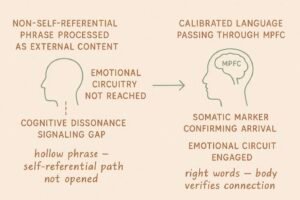
Psychologist Nico Frijda’s account of emotion, developed in The Emotions (1986), identified goal interruption as one of the primary mechanisms by which emotional responses are generated — the cognitive system’s automatic report that an ongoing action sequence has been blocked. Moving toward a destination, working through a list of tasks — when that action sequence is suddenly cut off, the cognitive system detects an obstacle and generates a frustration response. This is not the system malfunctioning. It is operating exactly as designed. The irritation when the register line stops moving is not information about your character. It is a report from the goal-pursuit system: an obstacle has been detected. Knowing this shifts the relationship to the reaction — it becomes something the system produced, rather than something you are.
James Gross’s attentional redeployment, one of the strategies in his process model of emotion regulation, offers the framework for what to do with that reaction. Gross’s research showed that redirecting attention before an emotional response has fully consolidated influences the emotional state that results. Opening a phone when irritation arrives keeps the reaction contained inside while adding a layer of stimulation on top of it. Redirecting attention toward the people in the surrounding space is a different operation — it moves the processing outward, opening a pathway away from the internal reaction rather than adding to it. The direction of the shift is what distinguishes the two.
What happens when attention moves outward is where neuroscience adds a layer that is less obvious. The default mode network (DMN) — the neural network that activates when goal-directed action stops — overlaps substantially with the network underlying theory of mind: the capacity to infer other people’s intentions, emotions, and mental states. When standing in a line and letting the gaze settle loosely on the people nearby, the brain is already running other-understanding processes. That person might be tired. That one might be in a hurry. This inference isn’t being deliberately initiated — the circuitry is already operating. Waiting time naturally satisfies the conditions under which the other-understanding network activates. The pause that felt like dead time turns out to have been preparation.
In a crowd of strangers, directing compassion toward people as a group rather than merging emotionally with any individual is a design that cognitive research supports. Emotional identification with a specific person carries a high cognitive cost that does not scale across a crowd. Holding the quiet intention that someone nearby be well — without needing to feel what they feel — operates independently of emotional state and does not require that merger. With the DMN and theory-of-mind network already running in the pause, directing may you be at ease toward someone in the visual field is not working against the grain of what the brain is doing. It is following that movement to its natural conclusion. The attention was already moving in that direction. The intention gives it somewhere to arrive.
Conclusion: The Attention Was Already in Motion

When the forward movement was interrupted, the cognitive system detected an obstacle and generated a reaction. When attention moved outward, the brain was already running its other-understanding circuitry.
The mind was already moving toward them. The intention just gave it somewhere to arrive.
KEY TERMS
Goal Interruption
The automatic cognitive and emotional response generated when ongoing goal-directed behavior is blocked. Identified by Nico Frijda in The Emotions (1986) as one of the primary mechanisms by which emotional responses are generated. Waiting-time irritation is the goal-pursuit system reporting an obstacle — not information about patience or character. Knowing its structure changes the relationship to it: something the system produced rather than something you are.
Attentional Redeployment
One of the strategies in James Gross’s process model of emotion regulation, developed across studies collected in Handbook of Emotion Regulation (2007). Redirecting attention before an emotional response has fully consolidated influences the resulting emotional state. Moving attention toward the surrounding space rather than inward or toward a screen is an operation that opens a processing pathway away from the internal reaction.
DMN and Theory of Mind Overlap
The default mode network, which activates when goal-directed action stops, overlaps substantially with the neural network underlying theory of mind — the capacity to infer others’ intentions, emotions, and mental states. In waiting conditions, when the gaze settles loosely on nearby people, other-understanding processes are already running without deliberate initiation. Waiting time naturally creates the neural conditions in which Mettā practice can follow the direction the brain is already taking.
Directed Compassion
The distinction between emotional identification with a specific individual — which requires merging with another’s felt experience and carries a high cognitive cost — and holding a quiet intention that someone be well, which operates independently of emotional state. In a waiting context, with the DMN and theory-of-mind network already active, directing quiet intention toward those nearby follows the grain of what the brain is already doing rather than working against it.