
Introduction: There Are Places Stillness Alone Cannot Reach

You have probably noticed it, even if you didn’t have a name for it. Mindfulness asks you to observe. Mettā asks you to produce something. The instructions look similar. The posture is identical. But the effort feels different — less like settling, more like reaching. That difference is not a matter of technique. It is a matter of which circuit is being asked to do the work.
The effects of mindfulness meditation have become widely documented over the past decade. Directing attention to the present, observing thought, creating a pause before reaction — these are established effects. But there is a circuit that mindfulness does not train. Mettā works directly on that circuit.
Session 1: What the Two Practices Are Each Training

Most people who have tried both practices describe the difference before they can explain it. Mindfulness settles something. Mettā generates something. The first feels like turning down the volume. The second feels like tuning a different instrument entirely.
What accounts for that difference is not metaphor. It is anatomy.
The central training target of mindfulness meditation is attentional control. Repeatedly activating the attention-regulation circuitry of the prefrontal cortex strengthens the capacity to observe the flow of thought and deliberately redirect attention. You get better at noticing where the mind has gone and choosing where to bring it back.
The central training target of Mettā meditation is emotion generation. Actively generating the intention of loving-kindness repeatedly activates an emotion-processing network that includes the insula, anterior cingulate cortex, and nucleus accumbens. This is not observation. It is production — the deliberate activation of a circuit that mindfulness, in its standard form, does not reach.
Observing and generating warmth use different circuits. That difference explains the difference in what each practice produces over time.
Session 2: Activating the Mettā Circuit
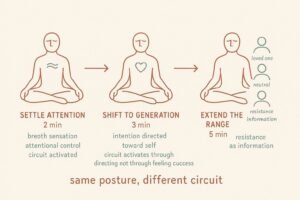
STEP 1: Settle attention (2 minutes)
Close the eyes and bring attention to the breath. The sensation of air entering, the sensation of air leaving. This is the mindfulness operation — activating the attentional control circuit. Let this settling happen before moving anywhere else.
STEP 2: Shift to emotion generation (3 minutes)
From that settled attention, generate intention toward yourself. May I be at ease.
This is not observation. It is generation. Many people expect warmth to arrive automatically at this point — and when it doesn’t, assume they are doing something wrong. They are not. If warmth does not arrive immediately, placing the intention is the operation. The circuit activates through the act of directing, not through the feeling of success. Notice the shift from attentional regulation to something being actively produced — however faint that something may be.
STEP 3: Extend the range (5 minutes)
Move through a loved one, a neutral person, a difficult person. Generate the same intention toward each. May you be at ease.
As the object changes, the input to the circuit changes. Notice how what is generated differs — in texture, in ease, in resistance. The difficult person is not a test of whether the practice is working. The resistance itself is information about where the circuit is being asked to stretch.
Session 3: Same Posture, Different Brain — Emotion Generation Circuits, the Reward System, Experience-Dependent Plasticity, and the Competition Between Threat and Affiliative Systems
Why Mettā trains a different circuit than mindfulness, and why repeated practice produces structural change, is a question comparative meditation research and neuroscience have answered at different levels of resolution — one identifying which circuits are involved, the other explaining why repetition changes them.
Comparative meditation research has established that mindfulness-based and Mettā-based practices show different patterns of neural activation. Mindfulness practice is most strongly associated with activity in the dorsolateral prefrontal cortex — the region involved in selecting and sustaining attention — while Mettā practice is associated with activation of an emotion-processing network that includes the insula, anterior cingulate cortex, and nucleus accumbens. The insula processes interoceptive sensation and resonance with others’ emotional states; the anterior cingulate is involved in emotional regulation and social cognition. Two practices performed in the same physical posture are using substantially different neural real estate — a finding that raises fundamental questions about treating “meditation” as a single category with uniform effects. Richard Davidson and colleagues’ program of research, documented in part in The Emotional Life of Your Brain (2012), has been central to establishing these distinctions and examining whether practice can shift individual differences in emotional circuitry.
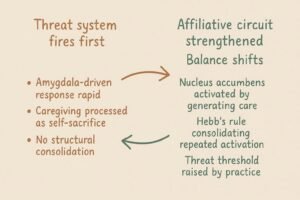
One circuit that Mettā engages distinctively is the reward system. Research on the neural correlates of prosocial motivation has shown that the nucleus accumbens — a central structure in the brain’s reward circuitry — activates during the generation of intention to benefit others, in a pattern comparable to its activation by food, social approval, and material reward. The standard account of the nucleus accumbens had positioned it as a receiver of external rewards; the finding that generating care toward others produces comparable activation suggests that Mettā practice strengthens a circuit in which caregiving is processed as intrinsically rewarding rather than as self-sacrifice. A circuit in which directing warmth toward others is itself rewarding is a circuit that is self-reinforcing — sustained not by discipline alone, but by what the practice itself produces.
Why repetition produces lasting structural change is where experience-dependent plasticity provides the mechanism. Neural circuits strengthen with use; the principle known as Hebb’s rule — neurons that fire together wire together — describes how repeated co-activation of neural pathways leads to structural consolidation. Research comparing long-term meditators with novices has found increased cortical thickness in the insula and changes in resting-state activity of the emotion-processing network in long-term practitioners — changes that persisted outside of practice sessions. The structural changes are not artifacts of the practice session. They are changes to the circuit itself.
How that structural change affects everyday emotional response is where Paul Gilbert’s framework of threat and affiliative system competition provides a complementary explanation. Gilbert’s research, foundational to Compassion-Focused Therapy and developed in The Compassionate Mind (2009), describes the human emotion-regulation system as composed of three interacting systems: the threat-detection system, the drive system, and the affiliative system. The amygdala-driven threat system is evolutionarily ancient, responds rapidly, and is prone to activation in response to ordinary contemporary stressors for which it was not originally calibrated. The affiliative system — associated with safety, connection, and care — operates through oxytocin pathways and the vagal system. Mettā practice, by repeatedly activating affiliative-system circuitry, shifts the relative balance between threat and affiliative activation in response to the same stimulus. Whether the threat system or the affiliative system fires first depends on which circuit has been more thoroughly strengthened.
Conclusion: Beyond Where Stillness Reaches

Mindfulness trains attention. That is a documented change with documented effects — and it is not a small thing. But attention and warmth are not the same operation, and stillness does not automatically generate the latter.
What Mettā trains is the circuit that generates emotion, processes care as reward, and develops the capacity to meet threat with an affiliative response that has been equally prepared. That circuit does not strengthen through observation alone. It strengthens through repetition of the thing itself.
KEY TERMS
Experience-Dependent Plasticity
The foundational neuroplasticity principle that neural circuits strengthen with use. Known as Hebb’s rule: neurons that fire together wire together. Mettā practice repeatedly activates the emotion generation circuit, meeting the conditions under which structural consolidation occurs. Research on long-term meditators has documented this as increased cortical thickness in the insula and persistent changes in resting-state network activity — changes that persist outside of formal practice sessions.
Emotion Generation Circuit
The network — including the insula, anterior cingulate cortex, and nucleus accumbens — that Mettā practice primarily activates, in contrast to the prefrontal attentional control circuit primarily trained by mindfulness. Established through comparative meditation research. Same posture, different neural destination. Davidson’s broader research program examines how individual differences in these circuits shape emotional style, and whether practice can shift them.
Nucleus Accumbens and the Care-Reward Circuit
Research on the neural correlates of prosocial motivation has found that the nucleus accumbens — central to the brain’s reward system — activates during the generation of intention to benefit others, in a pattern comparable to its activation by conventional rewards. Mettā practice strengthens a circuit in which directing warmth toward others is processed as intrinsically rewarding, providing a self-reinforcing basis for sustained practice rather than one dependent on external motivation or discipline.
Threat and Affiliative Systems
Paul Gilbert’s framework, foundational to Compassion-Focused Therapy and developed in The Compassionate Mind (2009), describing the emotion-regulation system as composed of threat, drive, and affiliative subsystems. The amygdala-driven threat system is prone to over-activation in contemporary environments. Mettā practice strengthens the affiliative circuit, shifting the balance between threat and affiliative activation — not by suppressing the threat system, but by developing the capacity to meet it with an equally well-trained response.