
Introduction: The Brain Doesn’t Entirely Know Whose Hand It Is
The particular settling that happens when someone puts a hand on your shoulder.
That experience is produced by the contact itself. A gentle pressure on the skin is processed as a social signal — a cue that you are in the presence of something safe. And here is the fact that tends to surprise people: this processing happens, at least partially, along the same neural pathway whether the hand belongs to someone else or to you.
The self-hug is a practice before it is a gesture. It uses this pathway deliberately.
Session 1: The Skin Is a Social Organ
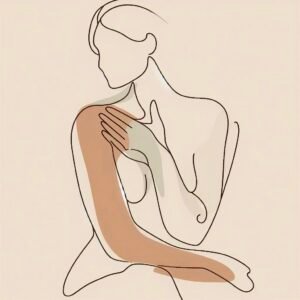
There are two distinct processing pathways for touch.
The first handles discriminative touch — the precise identification of what is being touched, where, and with how much pressure. The second handles affective touch — the social and emotional quality of contact. The receptors responsible for the second pathway are called C-tactile afferents (CT fibers), and they respond most strongly to slow, gentle, stroking contact at approximately one to ten centimeters per second. Fast contact and firm pressure produce almost no response in these fibers. They are specialized sensors for social touch.
CT fiber activation connects to the insular cortex, associates with oxytocin release, and engages the affiliative system — the neural circuit linked to bonding, safety, and felt connection. And CT fibers activate partially in response to self-touch as well. The signal is not identical to what another person’s contact would produce. But it uses the same pathway, and it produces some of the same downstream effects.
This is why the self-hug functions as more than a symbolic act of self-kindness. The nervous system is being given actual input through an actual sensory pathway.
Session 2: One Minute
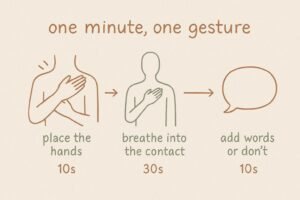
This works in an office, at home, or anywhere with thirty seconds of privacy.
Settle (10 seconds)
Close the eyes, or soften the gaze downward. One full exhale. Bring attention inward.
STEP 1: Place the hands (10 seconds)
Rest the right palm gently on the chest — over the heart. Left hand on the right upper arm or shoulder. No pressure needed. Just place them. Notice the warmth of the hands transmitting through the fabric.
STEP 2: Breathe into the contact (30 seconds)
Direct attention to what the hands can feel.
Inhale: the chest expands, the hand rises slightly
Exhale: the chest releases, the hand settles
Receive the breath and the contact simultaneously. No effort required beyond staying with the sensation.
STEP 3: Add words, or don’t (10 seconds)
If words arise, let them. If not, the contact and breath are sufficient.
This is hard right now
I’m here
This is enough
The words are supplementary. The touch is the practice.
Session 3: CT Fibers, the Body as Attachment Figure, and Why Physical Warmth Routes Around the Thinking Mind
The idea that touching yourself could change your emotional state seems, at first, like it might be wishful thinking. The neuroscience suggests otherwise.
Swedish neuroscientist Åke Vallbo and colleagues identified C-tactile afferent fibers as a distinct class of touch receptors present in the skin of all mammals studied. Unlike the fast-conducting fibers that handle discriminative touch, CT fibers are unmyelinated — they conduct slowly, and they respond selectively to gentle, moving contact within a specific velocity range. This specificity is the key finding: CT fibers are not general-purpose touch sensors. They appear to have evolved specifically to process social grooming — the slow, gentle contact through which primates confirm affiliation and safety with members of their group. The activation of CT fibers connects directly to the insular cortex, bypassing the spinal cord relay that discriminative touch uses, and engages neural circuits associated with social bonding, interoception, and emotional processing. The skin, in this light, is not merely a boundary organ. It is part of the social nervous system.
The partial activation of CT fibers through self-touch — confirmed in research by India Morrison and colleagues — is what makes the self-hug neurophysiologically meaningful rather than merely symbolic. The effect is not equivalent to contact from another person; there is attenuation, likely because the brain predicts self-generated touch and partially cancels its own signal. But the pathway is the same, and the attenuation is partial rather than complete. Some of the social signal gets through.
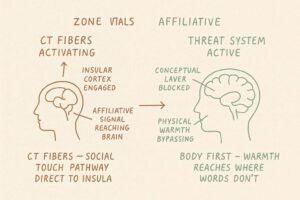
Paul Gilbert’s Compassion Focused Therapy emphasizes this physical route for a specific reason. When the threat system is active — under self-criticism, stress, or social pain — the conceptual layer of self-compassion has limited reach. Thinking I should be kinder to myself while the threat system is running tends to be overridden by the urgency of the threat response. Physical warmth and gentle contact engage the affiliative system more directly, bypassing the conceptual layer that the threat response has already compromised. This is why the sequence in Session 2 begins with placing the hands before introducing any words — the body is given input first, and words are offered into a physiological state that has already begun to shift.
John Bowlby’s attachment theory introduced the concept of the secure base — a trusted presence whose availability enables both exploration and rest. Bowlby described this dynamic primarily in terms of infant-caregiver attachment, but subsequent research established that the secure base dynamic operates throughout the lifespan. More recently, work on self-compassion has examined whether a stable, affiliative orientation toward oneself can function as an internalized secure base — a source of felt safety that does not depend on the availability of another person. The self-hug is one way to make this internal secure base tangible: the warmth of the hands, the rise and fall of the breath, the physical fact of being present with oneself. Not a substitute for connection with others, but a resource that remains available when others aren’t.
Conclusion: One Minute, Both Hands

Today, when something feels heavy — place the hands.
Right palm on the chest, left hand on the shoulder. Slowly.
Receive the breath and the contact.
That’s the whole practice.
The touch was yours. The nervous system didn’t entirely care.
KEY TERMS
C-Tactile Afferents (CT Fibers)
A class of unmyelinated skin receptors identified by Åke Vallbo and colleagues, specialized for slow, gentle, stroking contact at approximately one to ten centimeters per second. Unlike discriminative touch fibers, CT fibers connect directly to the insular cortex and engage circuits associated with social bonding and emotional processing. Evolutionarily understood as the neural substrate for social grooming in mammals. Activate partially in response to self-touch — providing the neurophysiological basis for why gentle self-contact produces measurable changes in emotional state rather than functioning purely as symbolic gesture.
Discriminative vs. Affective Touch
Two distinct processing pathways in the somatosensory system. Discriminative touch identifies what, where, and how much — fast, precise, location-specific. Affective touch processes the social and emotional quality of contact — slow, distributed, CT-fiber-mediated. The self-hug targets the affective touch pathway deliberately. The quality of contact — slow, gentle, sustained — is what determines which pathway is engaged.
Secure Base and Internal Attachment
John Bowlby’s concept of the secure base: a trusted presence whose availability enables both exploration and rest. Research has extended this concept beyond infant-caregiver attachment to include internalized secure base functions in adults — including the possibility that a stable, affiliative orientation toward the self (self-compassion) can provide felt safety independent of another person’s availability. The self-hug is a practice for making this internal secure base physically present rather than merely conceptual.
Physical Route to the Affiliative System
Paul Gilbert’s CFT emphasis on the direct access that physical warmth and gentle contact provide to the affiliative system — bypassing the conceptual layer that the threat system has already compromised. When self-criticism or stress is active, thinking about self-compassion has limited reach. Gentle physical contact engages the affiliative system more directly. This is why the practice begins with placing the hands before introducing words: the body receives input first.
Defusion
See Guide 5. When this is embarrassing or touching yourself can’t actually do anything arrives as a verdict during the practice, recognizing it as a thought rather than an accurate assessment — and returning attention to the warmth of the hands and the movement of the breath — is defusion applied to the skepticism that embodied self-compassion practices reliably generate.