
Introduction: You Can’t Stop the Comparison. You Can Change Where It Lands

Someone’s post appears on the screen, and something shifts — a subtle contraction, a sense of being slightly less than a moment ago. A colleague’s performance is mentioned in a meeting, and something in the chest tightens.
Trying to stop this doesn’t work.
Social comparison is a default operation of the brain — not a character flaw, not a habit that willpower can simply override. But there is a difference between the comparison arising and the comparison concluding *therefore I am insufficient*. The first is automatic. The second is where intervention is possible.
Session 1: Why Comparison Doesn’t Stop

Social psychologist Leon Festinger proposed in 1954 that humans use comparison with others as a primary tool for self-evaluation. In domains where objective standards don’t exist — how successful am I, how happy, how good at what I do — the brain turns to social comparison as a substitute measurement system. This is an evolutionary design: in ancestral environments, knowing one’s social position relative to others had direct survival relevance.
The problem is that contemporary information environments have been built to exploit this circuit in a specific direction. Algorithms prioritize content that captures attention — which means content showing the most striking success, happiness, and achievement. What any given user sees is not a statistical sample of other people’s lives. It is a curated stream of other people’s highlights, optimized for maximum engagement. The comparison impulse is natural. The reference points it is being given are systematically skewed upward.
The practice here is not to eliminate the comparison impulse — that effort is largely futile. It is to observe the impulse when it arises, and redirect attention before the comparison completes its circuit to a conclusion about your own worth.
Session 2: Three Steps
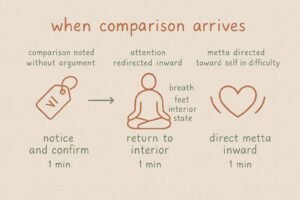
This begins the moment comparison is noticed — while scrolling, after hearing about someone else’s success, whenever the sense of I am less arrives.
STEP 1: Notice and confirm (1 minute)
Confirm that comparison is happening, without criticism.
An upward comparison is occurring.
A “not enough” feeling has arrived.
I am measuring myself against this person right now.
Don’t try to stop the feeling or argue with the comparison. Just identify what is happening — the way you’d note that it has started raining. The noticing itself is the first interruption of the automatic circuit.
STEP 2: Return attention to the interior (1 minute)
Move attention from the comparison object — the other person’s state, success, or appearance — to your own internal experience.
The breath: the sensation of this particular inhale and exhale.
The body: the contact of feet with the floor, the temperature of the hands.
The interior state: what is actually present right now, as sensation.
Comparison is a state in which attention is directed outward, toward someone else’s position. Returning attention to your own body redirects the flow without requiring the feeling to change first.
STEP 3: Direct Mettā toward yourself (1 minute)
With attention returned to the interior, bring the orientation from Metta Guide 0 — friendly intention toward existence — toward yourself, right now, in this moment of difficulty.
Someone is here who is struggling with comparison.
May this feeling ease.
May I be at ease.
Not a performance of positivity. Just the same basic warmth you might extend toward anyone who was having a hard moment — directed inward.
Session 3: Social Comparison Theory, the Upward Comparison Asymmetry, and Why Comparison Registers as Pain
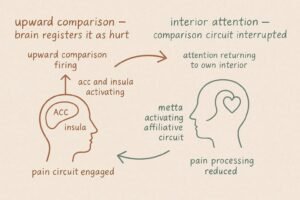
The reason comparison doesn’t stop and the reason it produces suffering are two distinct mechanisms, and understanding both changes the relationship to the experience.
Leon Festinger’s social comparison theory describes a structural feature of human cognition: in the absence of objective standards, people use comparison with others to evaluate themselves. This is not pathological — it is the brain’s solution to a genuine measurement problem. But the theory also identifies an asymmetry: people show a stronger tendency toward upward comparison — comparing with those who appear to be doing better — than toward downward comparison. Upward comparison can motivate improvement, but it consistently produces a secondary effect: the sense of relative insufficiency. The brain generates a position fix, and the position fix reads as lower than. Festinger’s original insight — that this is a feature of cognitive architecture rather than a personal failing — remains the most useful reframe available for working with comparison.
Neuroscience has since confirmed that social comparison can register as literal pain. Hidehiko Takahashi and colleagues’ neuroimaging research, published in Science (2009), found that upward comparison — particularly when it produces envy — activates the anterior cingulate cortex and anterior insula, regions associated with the processing of both social and physical pain. The ventral striatum, associated with reward processing, shows activation when comparison suggests relative advantage. The same brain regions involved in processing physical hurt are recruited when the comparison concludes unfavorably. This is why comparison is experienced as exhausting rather than merely annoying: the repeated activation of pain-processing circuitry across a session of scrolling produces genuine neural fatigue. The tiredness is not emotional weakness. It is a neurological outcome.
The design of social media platforms amplifies this dynamic in a specific and documentable way. Algorithms optimize for engagement, and engagement is maximized by content that is striking — unusually successful, unusually beautiful, unusually happy. The result is that the reference class available for upward comparison is not a representative sample of human experience. It is the extreme upper tail of a distribution, presented as if it were the norm. Sherry Turkle’s Alone Together and Jean Twenge’s iGen document this dynamic from different angles — the former focusing on how digital connection reshapes intimacy and self-perception, the latter on generational data about the psychological effects of social media exposure.
Epictetus, in the opening lines of the Enchiridion, offered a distinction that maps precisely onto this situation: some things are within our power, and some are not. Other people’s success, appearance, and status fall in the second category. Our response to that information, the direction of our attention after it arrives, our orientation toward ourselves in the moment of comparison — these fall in the first. STEP 2’s instruction to return attention to internal sensation is a practical enactment of this distinction: moving from what cannot be controlled to what can be engaged with.
Conclusion: The Coordinate System Is Not the Territory

When the comparison impulse arrives — don’t try to stop it.
Notice it. Return attention inward. Direct some warmth toward the person who is here, having this experience, right now.
That sequence is the practice.
The comparison was never about them. It was your brain trying to locate you — in the only coordinate system it knows.
KEY TERMS
Social Comparison Theory
Leon Festinger’s 1954 framework describing the human tendency to use comparison with others as a self-evaluation tool in the absence of objective standards. The comparison impulse is a structural feature of cognition, not a personal failing. The theory identifies an asymmetry between upward comparison (with those who appear to be doing better) and downward comparison — with upward comparison being both more frequent and more likely to produce a sense of relative insufficiency.
Upward Comparison Asymmetry and Platform Design
The tendency toward upward comparison is amplified by social media algorithms optimized for engagement — which systematically surface the most striking success, happiness, and achievement. The reference class available for comparison is the extreme upper tail of human experience, not a representative sample. Comparison fatigue is partly a neurological response to repeated upward comparison against a skewed reference set. Sherry Turkle’s Alone Together and Jean Twenge’s iGen address the psychological consequences of this dynamic from different perspectives.
Social Pain Processing
Hidehiko Takahashi and colleagues’ finding, from Science (2009), that upward comparison activates the anterior cingulate cortex and anterior insula — regions associated with the processing of both social and physical pain. The experience of comparison fatigue reflects genuine neural activation of pain-processing circuitry, not emotional weakness. The ventral striatum shows activation when comparison suggests relative advantage, placing social comparison at the intersection of reward and pain processing — which accounts for its compulsive quality.
Epictetus: What Is and Isn’t Within Our Power
The Stoic distinction from the Enchiridion: other people’s status, success, and appearance are not within our power. Our response, the direction of our attention, and our orientation toward ourselves in the moment of comparison are. STEP 2’s return to internal sensation is a practical enactment of this distinction — redirecting from what cannot be controlled to what can be engaged with.
Defusion
See Guide 5. When I really am behind where I should be or everyone else has figured this out except me arrives as a conclusion rather than a thought, recognizing it as a thought — and returning attention to the physical sensation of the present moment — is defusion applied to the comparative verdict that social comparison reliably generates.