
Introduction: “While Doing Something Else” Is Not the Compromise Version

The sense that there is no time to meditate tends to arise when practice is designed around dedicated time.
But compassion practice does not require a quiet room or a fixed slot in the day. The three minutes of making coffee, the first bite of a meal, the moment of passing someone on the way to work — attaching intention to actions that already exist is the design of this practice.
“While doing something else” is not a reduced version. The more established habits already exist, the more readily a new intention takes hold. Both behavioral science and neuroscience have something to say about why.
Session 1: How the Connection Works

An existing habit becomes the anchor — making coffee, starting a meal, stepping out the front door. The more reliably it repeats, the more stable the foundation. At the moment that action begins, a small intention is placed alongside it. A phrase, or simply a direction. May whoever is here be at ease — attached to the act of picking up the cup.
With enough repetition, the connection reverses. The action no longer needs to be reminded. It calls the intention up on its own. The anchor becomes the trigger — and at that point, no effort of will is required.
Session 2: Three Situations to Try
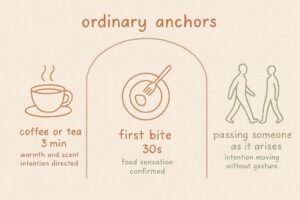
It can feel slightly odd at first — placing intention inside something as ordinary as making coffee or walking past a stranger. That strangeness tends to fade quickly. The practice is smaller than it sounds.
Making coffee or tea (about 3 minutes)
The moment of picking up the cup is the anchor.
While the water is being poured, direct quiet intention toward whoever is present in this moment — yourself, or someone else.
May you be at ease.
The moment when attention is already on the sensation — the aroma, the warmth — becomes the opening for the intention.
The first bite of a meal (30 seconds)
The moment just before eating is the anchor.
The color of the food, its smell, the weight of it in the hand — confirm the sensation, then take the first bite.
Toward the people involved in bringing this food here, or toward yourself about to receive it, direct intention quietly.
May you be well.
Passing someone while moving through the world (as it arises)
Whoever enters the visual field is the anchor.
Confirm their presence. Direct intention while passing.
May you be at ease.
No change in eye contact or expression is needed. Only the intention moves.
Session 3: Habit Stacking, the Default Mode Network, and How a Gesture Becomes a Trigger
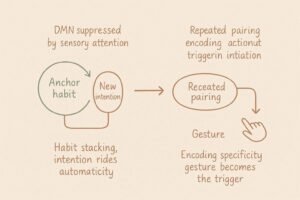
Behavioral scientist BJ Fogg’s habit stacking, developed in Tiny Habits (2019), begins with an observation about why efforts to build new habits through willpower so often fail. What Fogg’s research showed is that attaching a new behavior to an already-established habit — an anchor habit — allows the new behavior to borrow the stability of the existing neural pathway. The anchor habit is already running automatically; the new behavior rides that automaticity rather than trying to generate its own. Making coffee activates every morning without deliberate initiation. Attaching a compassion intention to that activation means the intention activates with it. Most failures of practice are not failures of motivation. They are failures of design — the absence of a stable anchor to attach to.
What happens in the moment the anchor fires is described by neuroscience from a different angle. Highly automated repeated actions — making coffee, walking, eating — tend to activate the default mode network (DMN) during execution. The DMN is associated with self-referential thought, rumination about the past, and projection into the future. Directing intentional attention to the action itself — to the sensation of the cup, the smell of the coffee, the temperature at the hands — suppresses DMN activity and orients processing toward present sensation and intention. The sensory check is the mechanism of the shift, not a preparatory step before the real practice begins.
Embodied cognition research has consistently shown that sensory attention influences emotional state. The relationship between bodily sensation and emotional processing runs in both directions: physical inputs — warmth in the hands, the texture and smell of food, the sensation of feet meeting ground — affect emotional state when attention is brought to them. Placing compassion intention alongside sensory attention is not incidental layering. It is a design that uses the bidirectional relationship between body and mind: sensation functions as the vessel that holds the intention in place while it is being directed. The framework draws on work from philosophers including Merleau-Ponty and cognitive scientists including Francisco Varela, Eleanor Rosch, and Evan Thompson, whose The Embodied Mind (1991) brought these ideas into cognitive science.
With sufficient repetition, the direction of the connection reverses. What memory research describes as encoding specificity — Endel Tulving’s finding that retrieval is most effective when the conditions at recall match the conditions at encoding — is the mechanism by which specific sensations and actions automatically call up the mental states repeatedly associated with them. After the action of making coffee has been paired with compassion intention enough times, the action begins to trigger the intention without conscious initiation. This is the state habit stacking is working toward: the anchor calling up the intention automatically, the gesture becoming the trigger.
Conclusion: The Action Was Already There

No new time needed to be found.
The coffee was already part of the morning. The meal was already part of the day. What this practice adds is not a new slot in the schedule — it is a direction. The anchor was already running. The intention just needed to attach.
KEY TERMS
Habit Stacking
BJ Fogg’s design principle, developed in Tiny Habits (2019): attaching a new behavior to an existing established habit allows the new behavior to borrow the stability of the anchor’s neural pathway, bypassing the need for willpower. Most failures of practice are failures of design — the absence of a stable anchor — rather than failures of motivation or commitment.
Default Mode Network (DMN)
The neural network that activates during automated action and is associated with self-referential thought, rumination, and future projection. Intentional attention to present sensation suppresses DMN activity and orients processing toward what is currently happening. The sensory check during a daily action is the mechanism by which the mind is brought back from wandering.
Embodied Cognition
The cognitive science framework describing the bidirectional relationship between bodily sensation and emotional and cognitive state. Physical inputs — warmth, texture, smell, the sensation of movement — influence emotional processing when attention is brought to them. In “while doing” practice, sensation functions as the vessel that holds intention in place. The field draws on work from philosophers including Merleau-Ponty and cognitive scientists including Francisco Varela, Eleanor Rosch, and Evan Thompson, whose The Embodied Mind (1991) brought the framework into cognitive science.
Context-Dependent Memory
The memory mechanism by which specific environments, sensations, and actions automatically retrieve the mental states repeatedly associated with them. Grounded in Endel Tulving’s encoding specificity principle — the finding that retrieval is most effective when the context at recall matches the context at encoding. After sufficient repetition of pairing a gesture with an intention, the gesture begins to trigger the intention without conscious initiation — the endpoint that habit stacking is designed to reach.