
Introduction: What the Brain Does the Moment Something Goes Wrong

An important presentation, and the words stop coming. A careless mistake, noticed too late. Something said that shouldn’t have been.
And then, immediately, the voice: again. why can’t you just get it right. what is wrong with you.
Would you say any of this to a friend who’d just had the same experience? Almost certainly not. But to yourself, it arrives automatically.
This asymmetry is not a character flaw. It has a structural explanation. And once the structure is visible, the intervention becomes clear.
Session 1: Why We Are Harder on Ourselves Than on Anyone Else

The human brain is exquisitely sensitive to social evaluation. In evolutionary context, being excluded from the group was a genuine survival threat. Failure — particularly failure that others might witness — activates the threat detection system that evolved to manage exactly this risk.
Self-criticism is this system operating. It generates vigilance, scans for what went wrong, and drives correction — an adaptive function in the environment it evolved for. In contemporary life, it tends to fire at a level disproportionate to the actual risk.
What Paul Gilbert’s research makes clear is that the brain does not distinguish between an external threat and an internal critic. Self-criticism activates the threat system in the same way that external danger does — even when the source of criticism is the self. The threat system, once activated, suppresses the affiliative system: the circuit associated with oxytocin, social bonding, and felt safety. Self-criticism and self-warmth are not simply different tones. They activate competing neural systems.
Speak to yourself the way you’d speak to a friend works not because it is a kind thing to do, but because it routes around the threat system by activating the affiliative system instead. The intervention is a circuit switch, not a sentiment.
Session 2: Three Steps
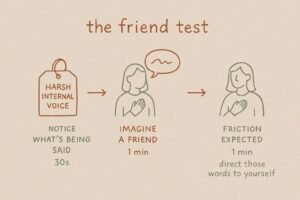
This begins the moment self-criticism is noticed — after a failure, during a difficult moment, or whenever the internal voice turns harsh.
STEP 1: Notice what’s being said (30 seconds)
Register the actual words the internal voice is using.
A “you always do this” thought is here
A “you’re not good enough” verdict has arrived
Don’t engage with the content. Just identify what kind of thought is present — the way you’d note the weather outside. That noticing is the first move away from the threat system.
STEP 2: Imagine a friend in the same situation (1 minute)
Place a person you care about in exactly the situation you’re in. Same mistake, same circumstances, same outcome.
What words would you use with them?
What tone?
Would you criticize, or would something else come?
This is not a feel-good exercise. It is a perspective-taking operation — shifting the evaluative frame to make visible the standard you’ve been applying to yourself and whether it would survive contact with a real person you care about.
STEP 3: Direct those words toward yourself (1 minute)
Take whatever came in STEP 2 and apply it inward.
Today was hard. You were tired, or stretched thin, or just human.
This kind of thing happens. It happened today. That’s the whole story.
What you can learn from this — that part is still available.
It may feel awkward. The threat system is still active, and the affiliative system is being asked to come online against resistance. Some friction is expected. The attempt itself is the intervention.
Session 3: Self-Compassion’s Three Components, Common Humanity, and the Evolutionary Origin of the Double Standard
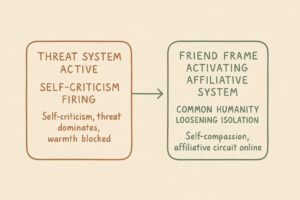
The reason speak to yourself like a friend works has a psychological structure that is worth knowing.
Kristin Neff’s framework for Self-Compassion identifies three components that work together. Self-kindness: responding to one’s own failures and limitations with warmth rather than harsh judgment. Mindfulness: holding painful emotions in balanced awareness — neither over-identifying with them nor suppressing them. And the third component, which tends to be the least obvious and the most structurally important: Common humanity.
When something goes wrong, a specific secondary suffering tends to arrive alongside the primary difficulty: the sense that this is happening to me specifically, that other people don’t struggle like this, that my failure marks me as uniquely deficient. This sense of isolation amplifies the original pain considerably. Common humanity is the recognition that failure, imperfection, and difficulty are not personal aberrations but universal features of human experience. Everyone fails. Everyone falls short. Everyone has days when the words don’t come. The friend imagined in STEP 2 would fail in exactly this way given the right circumstances — and knowing that changes something about how the failure feels. Neff’s research has consistently shown that self-compassion correlates positively with learning efficiency, emotional regulation, resilience, and motivation — and that self-criticism correlates negatively with all of these. The counterintuitive finding — that being hard on yourself does not produce better outcomes — is among the most replicated in the field. Self-Compassion: The Proven Power of Being Kind to Yourself remains the most widely read account of this research.
Paul Gilbert’s Compassion Focused Therapy (CFT) provides the neural architecture behind the intervention. The threat system and the affiliative system are in competitive relationship: activation of one tends to suppress the other. Self-criticism keeps the threat system running — not because the situation is genuinely dangerous, but because the evaluative content signals danger regardless of its source. The affiliative system — associated with oxytocin, felt safety, and social warmth — is suppressed as long as the threat system dominates. Warm self-directed language activates the affiliative system and, through competition, reduces threat system activation. The mechanism is not sentiment overriding reality. It is one neural system being activated in order to suppress another. Gilbert’s The Compassionate Mind develops the full model.
The evolutionary dimension explains the double standard. The brain’s sensitivity to social evaluation — to how one appears to others, to one’s standing in the group — evolved because social status genuinely mattered for survival in ancestral environments. Self-criticism may have functioned as a pre-emptive measure: criticizing oneself before others could, maintaining vigilance about social performance, managing reputation proactively. This function was adaptive in its original context. In contemporary life, the same system fires at a level calibrated for survival conditions that no longer apply. Recognizing self-criticism as a design feature rather than a character flaw changes the relationship to it — not as something to defeat, but as something to understand and work with.
Conclusion: The Exception You’ve Been Making

Next time the voice arrives — notice what it’s saying.
Then ask what you’d say to a friend in the same situation.
Then say that instead.
The awkwardness is not a sign it isn’t working. It’s the sound of two systems competing.
You already know how to speak to someone who’s struggling. You’ve just been making an exception for yourself.
KEY TERMS
Self-Compassion: Three Components
Kristin Neff’s framework for relating to one’s own failures and limitations. Self-kindness (warmth rather than harsh judgment), Mindfulness (balanced awareness of painful emotions), and Common humanity (recognition that failure and imperfection are universal rather than personal aberrations). The third component — Common humanity — addresses the isolation that amplifies suffering after failure, and is often the least intuitive but most structurally important of the three. Self-Compassion: The Proven Power of Being Kind to Yourself is the primary written account.
Common Humanity
One of the three components of Self-Compassion. The recognition that failure, difficulty, and imperfection are not personal defects but universal features of human experience. The sense of isolation that accompanies failure — this is happening to me specifically, others don’t struggle like this — significantly amplifies the original pain. Common humanity dissolves this isolation by locating the experience within the broader shared reality of being human. The perspective-taking operation in STEP 2 is a direct enactment of this recognition.
Threat System and Affiliative System
Paul Gilbert’s CFT framework describing two competing neural systems. The threat system (associated with fight-flight responses, cortisol, and vigilance) activates under conditions of perceived danger — including social evaluation failure. Self-criticism keeps this system running regardless of the source of the criticism. The affiliative system (associated with oxytocin, social bonding, and felt safety) is suppressed when the threat system dominates. Warm, friendly self-directed language activates the affiliative system and competitively reduces threat system activation. Gilbert’s The Compassionate Mind develops the full model.
Perspective-Taking and the Self-Evaluation Asymmetry
The cognitive operation of imagining a friend in one’s own situation. Research consistently shows that the evaluative standards people apply to themselves are significantly harsher than those they apply to others in identical situations. Perspective-taking makes this asymmetry visible and applies a more accurate standard to self-evaluation. The function is not to generate false comfort but to correct a systematic distortion in self-directed cognition.
Defusion
See Guide 5. When being kind to yourself is just making excuses or this won’t actually change anything arrives as a verdict during the practice, recognizing it as a thought rather than an accurate assessment — and returning attention to STEP 2 — is defusion applied to the resistance that self-compassion practice reliably generates, particularly in people with strong self-critical habits.