
Introduction: They Feel Like the Same Thing. They Aren’t

May this person be happy. And: May this person’s suffering ease.
Both feel like warmth directed toward another person. Both look like care. But if you pay close attention while doing them, the felt quality is different. One opens outward. The other moves toward something specific.
The brain is doing different things in each case. The practices in this series are built around that difference — not as a conceptual distinction to memorize, but as something you can verify directly, in your own experience, in the next few minutes.
Session 1: Two Different Movements
Mettā is friendly intention toward existence
It doesn’t require the other person to be suffering. It doesn’t require any particular condition to be present. It is a basic orientation of warmth toward someone — or something — simply because they exist. In English it is often translated as loving-kindness or benevolence. The direction is: may you be well, may you be at ease, may you be happy. The quality tends to feel open, expansive, unconditional.
Karuṇā is a response to suffering
It activates when pain or difficulty is present — in another person, or in oneself. It is not a general attitude but a specific movement: something in us orients toward the suffering and wants it to ease. In English it is translated as compassion. The direction is: may your suffering lessen, may you be free from this difficulty. The quality tends to feel more directed, more focused, moving toward a specific point.
Both are forms of care. They arise from the same underlying capacity for warmth. But they are triggered differently, feel different in the body, and — as neuroscience has confirmed — activate different circuits in the brain.
Session 2: Checking the Difference Directly
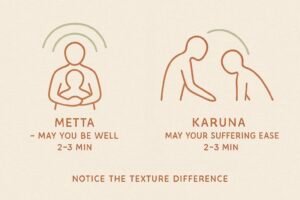
PART 1: The quality of Mettā (2–3 minutes)
Bring someone to mind. A person you know, or someone you’ve seen recently — it doesn’t matter who. A friend, a colleague, a stranger on the street.
Don’t think about how they’re doing or what they might be going through. Just hold the fact of their existence quietly in awareness.
Then, slowly and internally:
May you be well.
May you feel at ease.
May you be happy.
No need to say this aloud. Feel the meaning of the words as you hold them, and observe what happens internally. Is there any shift in the chest, the breath, the quality of attention? Don’t evaluate — just notice.
PART 2: The quality of Karuṇā (2–3 minutes)
Now bring to mind someone who is going through something difficult right now. Someone tired, someone grieving, someone under pressure. Make it specific — a real person in a real situation.
Rather than turning away from their difficulty, let yourself acknowledge it: this person is in pain right now. Not to fix it, not to solve it — just to receive that fact.
Then, internally:
May your suffering ease.
May you find relief from what you’re carrying.
Compare this to PART 1. Is the felt quality different? Something opening, versus something moving toward? Neither is better — just notice whether there is a difference, and what it is.
PART 3: The comparison (1 minute)
Hold both experiences side by side for a moment. Same warmth, same care — but is the texture different? Whether you notice a clear difference or not, that is your observation for today.
Session 3: The Two-Layer Care System, Neural Circuit Differences, and an Evolutionary Explanation
The distinction between these two forms of care is not a philosophical refinement. It has a structural basis in how the brain evolved.
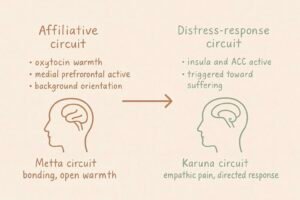
Psychologist Paul Gilbert, in developing Compassion Focused Therapy (CFT), proposed what he calls the two-layer care system: two distinct neural circuits for care that evolved in mammals for different purposes. The first is an affiliative care circuit — associated with oxytocin, social bonding, and the felt sense of warmth and safety in connection with others. This circuit operates in conditions of relative ease and safety; it generates the quality of open, unconditional goodwill. The second is a distress-response care circuit — activated when the suffering or vulnerability of another is detected. This circuit is linked to empathic pain processing and produces the more directed, responsive quality of compassion. Both circuits are present in every human nervous system. They are activated by different conditions, produce different phenomenological qualities, and have different functional purposes. Gilbert’s *The Compassionate Mind* develops this framework in full and remains one of the more rigorous accounts of compassion as a biological and psychological phenomenon.
Neuroscientist Richard Davidson and colleagues have provided imaging evidence consistent with this distinction. In studies comparing loving-kindness meditation (Mettā practice) and compassion meditation (Karuṇā practice), different patterns of brain activation were observed. Mettā practice showed stronger involvement of medial prefrontal regions associated with positive affect and social cognition. Compassion practice showed more pronounced activation of the insula and anterior cingulate cortex — regions associated with the empathic processing of pain. The subjective difference in felt quality that practitioners report corresponds to measurable differences in neural activity. Davidson’s work in this area is summarized accessibly in The Emotional Life of Your Brain, co-written with Sharon Begley.
The evolutionary logic behind the two-layer structure is straightforward. The capacity for unconditional warmth toward others — corresponding to Mettā — is linked to circuits that evolved for social bonding, group cohesion, and the maintenance of affiliative relationships. It operates as a background orientation, a kind of default warmth that sustains social connection. The capacity for responding to suffering — corresponding to Karuṇā — is linked to circuits that evolved for detecting and responding to vulnerability within the group: the injured, the distressed, the threatened. It is a triggered response rather than a background orientation. Both capacities served survival. They served it in different ways, under different conditions, and they retain those distinct functional signatures in the modern human nervous system.
Aristotle, writing on friendship in the Nicomachean Ethics, distinguished between wishing well to another — a stable orientation of goodwill regardless of circumstances — and being moved by another’s misfortune toward wanting to relieve it. The first he associated with the highest form of friendship; the second with a specific responsive emotion. Two and a half millennia before neuroscience could image the circuits involved, the phenomenological distinction was being carefully described. The language is different. The territory is the same.
Conclusion: Different Tools for Different Moments
The practices in this series draw on both of these movements — sometimes one, sometimes the other, sometimes both together.
Neither is more advanced or more valuable. They are suited to different situations. When no particular suffering is present, Mettā arises naturally — a warm orientation toward whoever is there. When pain or difficulty is visible, Karuṇā responds to it. Knowing the difference makes it possible to use each more precisely.
The distinction doesn’t need to be held as a concept. It can be held as a felt sense — the difference between opening and moving toward, between warmth that expands and warmth that focuses.
Both are forms of care. They just start from different places — and go different directions.
KEY TERMS
Mettā
The Pali term for friendly intention or unconditional goodwill — an orientation of warmth toward existence itself, independent of the other person’s condition. Translated into English as loving-kindness or benevolence. Activates as a background orientation rather than a triggered response. Associated with affiliative care circuits, social bonding, and the felt sense of open, expansive warmth. The direction: may you be well, may you be happy.
Karuṇā
The Pali term for compassion — the responsive movement toward suffering when it is present. Triggered by the detection of pain or difficulty in another person or oneself. Associated with the insula and anterior cingulate cortex — regions involved in empathic pain processing. The direction: may your suffering ease, may you be free from this difficulty. More focused and directional in quality than Mettā, arising in response to a specific condition rather than as a general orientation.
The Two-Layer Care System
Paul Gilbert’s framework describing two evolutionarily distinct neural circuits for care in mammals: an affiliative circuit generating unconditional warmth and social bonding (corresponding to Mettā), and a distress-response circuit activated by the detection of suffering (corresponding to Karuṇā). Different triggers, different phenomenological qualities, different functional purposes — but both present in every human nervous system. Central to Gilbert’s Compassion Focused Therapy (CFT). Developed fully in The Compassionate Mind.
Neural Circuit Differences in Loving-Kindness vs. Compassion Practice
Richard Davidson and colleagues’ finding that Mettā practice and Karuṇā practice activate measurably different brain regions. Mettā practice shows stronger involvement of medial prefrontal regions associated with positive affect; Karuṇā practice shows more pronounced activation of the insula and anterior cingulate cortex, associated with empathic pain processing. The subjective difference in felt quality corresponds to a structural difference in neural activity. Summarized in The Emotional Life of Your Brain (Davidson and Begley).
Defusion
See Guide 5. When I don’t feel anything or this distinction seems too subtle to matter arrives during the practice, recognizing it as a thought rather than an accurate assessment — and returning attention to the actual felt quality of PART 1 or PART 2 — is defusion applied to the skepticism that conceptual practice tends to generate.