
Introduction: Silence Is Not a Failure of Connection

You’re at the table with family. No conversation. Just the quiet weight of people eating.
The discomfort arrives: I should say something. Why don’t we ever talk? Then comes the interpretation: the silence means something is wrong. With the relationship, with the evening, with us.
But this interpretation — silence equals disconnection — rests on an assumption: that connection is primarily linguistic. The silent table may not be a moment when connection has failed. It may be a moment when a much older form of connection is quietly doing what it has always done.
Session 1: What Sharing a Meal Actually Is

The act of eating together has functioned as a bonding mechanism across every human culture that has been studied.
Anthropologists call this commensality: the practice of eating together, and the social meaning it carries. Who eats with whom defines who belongs with whom. Refusing to share a meal is a form of social rejection; accepting the shared table is a form of social recognition. From Malinowski’s fieldwork in the Trobriand Islands to Mary Douglas’s analysis of food taboos, the pattern holds: shared eating creates and confirms bonds in ways that operate parallel to, and sometimes more powerfully than, verbal exchange. The family dinner table is a daily enactment of one of the oldest bonding practices in human social life. The conversation that accompanies it is relatively recent. The sharing itself is ancient.
Session 2: Three Steps
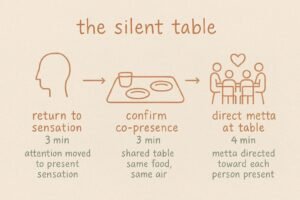
STEP 1: Return to sensation (3 minutes)
When the evaluation there’s no conversation arrives, move attention away from the interpretation and toward present sensation.
The weight of the body in the chair.
The temperature and texture of what’s in hand.
The taste, smell, and texture of the food itself.
From nothing is happening to this is what is happening right now. The shift is in the direction of attention, not in the situation.
STEP 2: Confirm the co-presence (3 minutes)
Once internal attention has settled, expand awareness slightly outward.
The fact that this table is shared.
The fact that the same food is being eaten.
The fact that the same air is being breathed in the same room.
These are not performances of connection. They are connection — in its most literal, physical form. Confirm them without evaluation.
STEP 3: Direct Mettā toward those present (4 minutes)
From the position of confirmed co-presence, direct quiet intention toward whoever is at the table.
Toward a partner who is quiet and tired: You got through another day. You’re here.
Toward a child eating without looking up: This person is carrying something from their day too.
Toward everyone present: May this be enough. May this be peaceful.
The intention itself is the practice — words are neither needed nor asked for.
Session 3: The Anthropology of Commensality, Proxemics, and What Is Happening Before Anyone Speaks
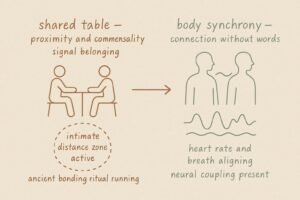
The reason the silent table is not an absence of connection has explanations from anthropology, cultural studies, and neuroscience — each pointing at the same phenomenon from a different angle.
The consistent finding across cultures and historical periods is that eating together carries social weight independent of what is said during the meal. Refusing food offered by a host communicates rejection. Sharing food with an enemy signals a suspension of hostility. Eating together at a family table, even in silence, activates a social script of belonging and mutual recognition that has been in operation across human societies for as long as there have been shared fires to cook over. What feels like an uneventful silent dinner is, from this perspective, a successful performance of one of social life’s most ancient bonding rituals.
Edward Hall’s work in proxemics — the study of how physical distance encodes social relationship — offers a complementary lens. Hall identified four distance zones in human interaction: intimate, personal, social, and public, each associated with a distinct quality of relationship and a distinct set of sensory information being exchanged. The family dinner table places people within intimate distance — the zone ordinarily reserved for the closest relationships, where breath, warmth, and subtle physical cues are perceptible. Being within intimate distance with another person, sharing the same physical task, is itself a form of communication. The body is receiving information about the other person’s presence — their warmth, their breathing, the minor sounds and movements of eating — that bypasses language entirely. The silence is not emptiness. It is a channel running at full capacity.
Neuroscience adds a layer that helps explain why shared physical presence produces the felt sense of connection even without words. Research on physiological synchrony — the gradual alignment of heart rate, breathing patterns, and neural activity between people in shared physical space — has shown that this synchrony occurs in the absence of verbal communication. Uri Hasson and colleagues at Princeton have documented neural coupling between people sharing an experience, and related research has shown that people in close physical proximity — particularly those in established relationships — show measurable physiological alignment over time. The settling quality that often accompanies being with family, even in silence, may reflect this synchrony operating. What human cultures have practiced as commensality for millennia — gathering bodies around shared food — turns out to have a neurophysiological substrate that functions independently of language.
Conclusion: The Meal Was Already the Message

Tonight, when the table is quiet — before the evaluation arrives, confirm what is actually happening.
The same food. The same space. The same people, close enough to hear each other breathe.
From there, direct whatever warmth is available toward whoever is present.
The meal was shared before the first word was spoken. It will still be shared after the last silence falls.
KEY TERMS
Commensality
The anthropological term for the practice of eating together and the social bonds it creates — independent of verbal exchange. Documented across cultures from Malinowski’s fieldwork in the Pacific to Mary Douglas’s structural analysis of food taboos: who eats with whom defines social belonging. The family dinner table is a daily enactment of one of the oldest bonding practices in human social life. The silent shared meal is not a failed version of a conversational one. It is the original form.
Proxemics
Edward Hall’s framework for how physical distance encodes social relationship. The family dinner table places people within intimate distance — the zone ordinarily reserved for the closest relationships, where warmth, breath, and physical presence are perceptible and communicative. Being within this distance, sharing a task, is itself a form of exchange. The silence contains information that language is not required to carry.
Physiological Synchrony
The gradual alignment of heart rate, breathing, and neural activity between people sharing physical space — occurring without verbal communication. Research by Uri Hasson and others has documented neural coupling during shared experience. The settling quality of being with familiar people in silence may reflect this synchrony. What commensality has practiced for millennia, neuroscience is beginning to describe at the level of mechanism.
Defusion
See Guide 5. When we never talk properly or this silence means something is wrong with us arrives as a conclusion, recognizing it as a thought — not an accurate reading of the situation — and returning attention to STEP 1’s sensory confirmation of what is actually present is defusion applied to the evaluative response that silence at the family table reliably generates.