
Introduction: Being Alone and Feeling Lonely Are Two Different Experiences
A quiet room on a weekend afternoon. An evening with nothing scheduled.
The same situation can feel like spacious stillness on one occasion and like uncomfortable emptiness on another. The difference doesn’t come from what’s happening externally. It comes from the quality of the relationship with the person who is present — which is you.
Psychology has names for these two states. Loneliness is the experience of perceived social isolation — processed as a threat, producing a specific kind of pain. Solitude is a voluntarily inhabited quality of being alone — characterized by a different neural signature entirely. Same physical situation. Different internal relationship. Different brain processing.
The gap between the two is not a matter of circumstances. It is a matter of how familiar you are with your own company.
Session 1: Where Loneliness Comes From

Social psychologist John Cacioppo’s research established that loneliness — the felt sense of social isolation — is processed by the brain as a social threat. Perceived disconnection from others activates the threat system, heightens vigilance, and biases the interpretation of ambiguous social information toward the negative. The neural substrate for this processing overlaps partially with the circuitry for physical pain, which is why loneliness has a distinctive bodily quality rather than being a purely abstract feeling.
The critical finding in Cacioppo’s work is that this threat response is triggered not by the objective quantity of social contact but by its perceived quality. It is entirely possible to feel lonely in a crowded room and not lonely when alone. The signal the brain is responding to is not there are no people present but I do not feel sufficiently connected — and the connection being registered includes the connection to oneself.
When the discomfort of being alone is driven primarily by an unfamiliar or uncomfortable relationship with one’s own presence, more external social contact is not the solution. The intervention is developing the capacity for solitude — which is a different thing from tolerating isolation.
Session 2: Three Steps
STEP 1: Locate the loneliness as body sensation (2 minutes)
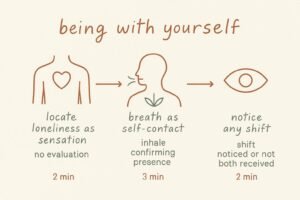
When the sense of loneliness or restlessness arrives, observe where it is in the body and what it actually feels like.
A coolness or hollowness in the chest.
A floating, unanchored sensation in the limbs.
A tight or vacant quality in the abdomen.
Don’t try to change the sensation. Simply confirm: this sensation is here right now. That confirmation — without evaluation — is the beginning of a different relationship to it.
STEP 2: Use the breath as contact with yourself (3 minutes)
Turn attention to the breath.
On the inhale — confirm that you are here. The breath is always present; attending to it is a form of contact with your own existence.
On the exhale — receive the current state as it is. Not approval, not performance. Just receiving what is already here.
This is the practice of being with yourself. Not comfortable with yourself necessarily — just present with yourself.
STEP 3: Notice any shift in quality (2 minutes)
After a few minutes, check whether the initial quality of loneliness has changed in any way. If something has shifted, receive it. If nothing has changed, receive that too.
The point is not to convert loneliness into solitude within a single session. It is to practice attending to the actual present state rather than reaching immediately for something to fill it.
Session 3: The Neuroscience of Loneliness vs. Solitude, the DMN and Self-Integration, and What Pascal Observed in 1654
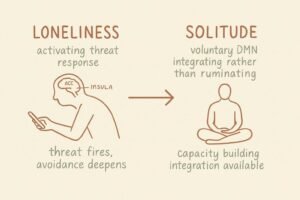
The reason loneliness and solitude feel so different despite involving the same physical situation has a structural explanation.
John Cacioppo and William Patrick’s research, summarized in *Loneliness: Human Nature and the Need for Social Connection*, established that loneliness activates a distinct threat-response profile: heightened cortisol, increased inflammatory markers, disrupted sleep architecture, and a perceptual bias toward social threat. These are the same physiological signatures as other threat states — which is why chronic loneliness has measurable health consequences comparable to other chronic stressors. The pain-processing overlap is not metaphorical. Neuroimaging studies have shown partial overlap between the circuits processing social rejection and those processing physical pain — the anterior cingulate cortex and insular cortex appearing in both. Cacioppo’s central finding — that this response is driven by perceived quality rather than objective quantity of social connection — reframes the loneliness problem. If the signal is about felt connection rather than presence of others, then building a more stable connection to one’s own presence is a legitimate and direct intervention.
The neuroscience of solitude points in a different direction. Voluntary time alone — solitude rather than imposed isolation — is associated with specific activation patterns in the default mode network, the circuit encountered in Guide 53 of the foundations series. In the absence of external task demands, the DMN supports self-referential processing: the integration of experience, the consolidation of values, the processing of emotional material. Research on voluntary solitude, including work by Reed Larson, has shown that time alone tends to support better emotional regulation and mood stabilization over time — with the key modifier being voluntary. The DMN activity associated with imposed isolation tends toward rumination; the DMN activity associated with chosen solitude tends toward integration. The difference is not in the network but in the relationship to the state.
Blaise Pascal wrote in the Pensées in 1654: all of humanity’s problems stem from man’s inability to sit quietly in a room alone. The observation predates neuroscience by three centuries, but it maps with some precision onto what Cacioppo and DMN researchers have since confirmed through measurement. The discomfort of being alone is not produced by aloneness itself. It is produced by an undeveloped or uncomfortable relationship with one’s own presence — by the unfamiliarity of one’s own company. Pascal arrived at this through introspection alone.
Sherry Turkle’s Alone Together documents how the architecture of always-on digital connection systematically erodes the capacity for solitude. The smartphone in the pocket means that any moment of discomfort — any flash of loneliness or restlessness — can be immediately addressed with external stimulation. The short-term result is relief. The long-term result is that the practice of sitting with one’s own discomfort, and discovering that it is survivable and even transformable, never develops. The tolerance for solitude decreases precisely because it is never practiced. Reaching for the phone at the first sign of loneliness is the behavioral equivalent of never learning to sit with an uncomfortable emotion — the avoidance prevents the development of the capacity.
Conclusion: The Practice Is Staying

Next time loneliness arrives — before opening anything, pause.
Check where the sensation is in the body. Turn attention to the breath. Stay with yourself for a few minutes.
Not to fix the feeling. Just to be present with it, and with the person who is having it.
The discomfort wasn’t the solitude. It was the unfamiliarity of your own company.
KEY TERMS
Loneliness vs. Solitude
John Cacioppo and William Patrick’s distinction between loneliness (perceived social isolation, processed as threat, with measurable physiological correlates including cortisol elevation and inflammatory markers) and solitude (voluntarily inhabited aloneness, associated with integrative DMN processing). The key variable is not the presence or absence of others but the perceived quality of connection — including connection to oneself. Loneliness: Human Nature and the Need for Social Connection develops the full research picture.
Default Mode Network and Solitude
The DMN — active during rest from external tasks (see Guide 53) — supports self-referential processing: integration of experience, consolidation of values, emotional processing. In voluntary solitude, DMN activity tends toward integration rather than rumination. The same network operates differently depending on whether the aloneness is chosen or imposed. Solitude is not empty time. It is time in which a specific and important form of self-processing occurs.
Pascal’s Observation
From the Pensées (1654): all of humanity’s problems stem from the inability to sit quietly in a room alone. A pre-scientific observation that maps onto both Cacioppo’s loneliness research and DMN neuroscience with considerable precision. The discomfort of being alone is not produced by aloneness itself — it is produced by an undeveloped relationship with one’s own presence. Pascal arrived at this through introspection alone.
Digital Connection and the Erosion of Solitude
Sherry Turkle’s finding in Alone Together that always-on connectivity systematically prevents the development of solitude capacity by providing immediate external relief from discomfort. The avoidance of loneliness through digital stimulation prevents the discovery that the feeling is manageable and transformable. Tolerance for solitude decreases precisely because it is never practiced.
Defusion
When I can’t stand being alone or this emptiness needs to be filled arrives as an urgent verdict, recognizing it as a thought rather than an accurate assessment — and returning attention to the body sensation in STEP 1 — interrupts the avoidance impulse that loneliness reliably generates. A thought about the state is not the state itself. Noticing the difference is the operation.