
Introduction: The Workplace Is Where Mettā Gets Difficult — and Useful

You can choose your friends. Family you’re born into, but there’s usually love as the foundation. Colleagues are neither. They are people assigned to share a goal with you — unchosen, and without the relational infrastructure that makes sustained closeness feel natural.
Spending long hours, in close quarters, with people you didn’t select, whose interests partly compete with yours, while managing your emotional responses throughout — this is genuinely hard. It is also, for exactly that reason, one of the most valuable contexts in which to practice Mettā.
The difficulty is not incidental. It is the point.
Session 1: Why Workplace Relationships Are Draining

Human cooperation evolved primarily in two contexts: kinship (where genetic relatedness makes cooperation self-reinforcing) and repeated reciprocal exchange (where the expectation of future cooperation makes current cooperation rational). The modern workplace is neither. It asks for sustained cooperation with non-kin strangers whose future presence in your life is uncertain. This is, from an evolutionary standpoint, a relatively novel and structurally difficult arrangement.
Much of the daily drain comes not from tasks but from the interpretation of other people’s behavior. A colleague doesn’t respond to a message. Someone disagrees in a meeting. A facial expression reads as dismissive. Each of these ambiguous signals gets interpreted — and under conditions of chronic low-level stress, the default interpretation tends toward negative intent. They’re ignoring me. They’re against me. They don’t respect me. These interpretations are often unverified. But once made, they produce real physiological responses and real behavioral consequences.
Mettā practice works in this context by intervening in this default interpretation system — replacing the ambient assumption of neutral-to-hostile intent with a deliberately held friendly orientation. Not naively. Not without discernment. Just as a baseline from which to operate.
Session 2: Three Practices
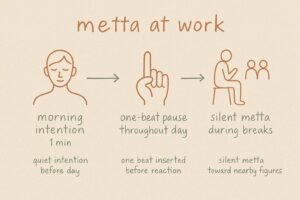
No special time required. These fold into what is already happening.
PRACTICE 1: Morning intention setting (1 minute)
Before starting work, or in the final minute of the commute, set a quiet intention.
Internally:
Today, I and my colleagues are each carrying something. May we get through it without causing each other unnecessary harm.
The words can be changed. The structure — beginning the day with a deliberate orientation rather than defaulting into reactivity — is what matters.
PRACTICE 2: The one-beat pause (throughout the day)
When a colleague’s behavior produces an immediate interpretation, insert one beat before acting on it.
This person is also trying to manage something today.
I don’t actually know what their intention was.
This is not suspension of judgment indefinitely. It is the addition of one alternative possibility to the interpretation, before the default attribution solidifies.
PRACTICE 3: Silent Mettā (during breaks, in transit)
During a break or while moving between spaces, direct quiet intention toward whoever is nearby or in mind.
May you be well.
May you feel at ease.
May you be at peace.
Start with someone easy. Move toward neutral, then difficult. No sound required. No performance required.
Session 3: Psychological Safety as a Collective Emergence, Hostile Attribution Bias, and the Evolutionary Difficulty of Unchosen Cooperation
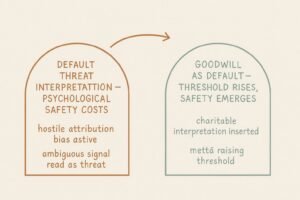
Understanding why Mettā practice functions in the workplace changes what the practice is actually doing.
Amy Edmondson’s research on psychological safety — the quality of a team environment in which members feel safe to take interpersonal risks — has produced one of the most replicated findings in organizational psychology: psychological safety correlates strongly with team learning, innovation, and performance. The finding that tends to get less attention is the mechanism. Psychological safety is not something an organization provides from the top down. It is an emergent property — it arises from the accumulated internal attitudes and behaviors of individuals within the team. One member who defaults to charitable interpretation of ambiguous signals, who brings curiosity rather than criticism to disagreement, who extends basic goodwill as an operating assumption — this person’s internal orientation produces behavioral changes that affect how others in the space respond. Edmondson’s The Fearless Organization is the most comprehensive account of this research. The implication for Mettā practice is direct: the internal attitude cultivated through PRACTICE 1 and PRACTICE 2 is not only a personal mental health intervention. It is a contribution to the relational environment of the team.
The cognitive mechanism that Mettā practice intervenes in is what psychology calls hostile attribution bias — the tendency to interpret ambiguous social signals as evidence of negative intent. Research has documented that this bias strengthens under conditions of social threat and chronic stress, which is precisely the condition many workplace environments produce. When a colleague’s delayed response is automatically read as deliberate dismissal, when a disagreement in a meeting is automatically experienced as personal attack, the social environment becomes increasingly costly to navigate — not because the behaviors are unambiguous, but because the interpretation system is running on a threat-activated default. Mettā practice does not eliminate the need for discernment or appropriate responses to genuinely problematic behavior. It raises the threshold at which the threat interpretation system fires — which is where much of the daily drain actually originates.
The evolutionary background is worth knowing. Cooperative behavior in humans evolved primarily through two mechanisms: kin selection (cooperation among genetic relatives) and reciprocal altruism (cooperation among individuals who expect continued future interaction). Robert Axelrod’s foundational work in The Evolution of Cooperation demonstrated through game theory and empirical research that cooperative strategies stabilize under conditions of repeated interaction and the expectation of future encounter. The modern workplace violates the conditions under which cooperation evolved to be natural: the people are not kin, the future of the relationship is often uncertain, and the interests are partially competitive. That workplace relationships feel effortful is not a personal failing. It is the structure predicting exactly that outcome. Understanding this makes the deliberate cultivation of friendly orientation — through a practice like Mettā — recognizable as a genuine intervention against a real structural difficulty, rather than a soft or optional personal improvement.
Conclusion: The Difficulty Is the Practice

Today, choose one person at work.
Set the morning intention. Direct one silent Mettā toward that person at some point in the day.
That’s enough.
You didn’t choose these people. That’s exactly what makes practicing with them valuable.
KEY TERMS
Psychological Safety
Amy Edmondson’s term for the quality of a team environment in which members feel safe to take interpersonal risks. Strongly correlated with team learning, innovation, and performance. Critically: psychological safety is not provided by the organization — it emerges from the accumulated internal attitudes and behaviors of individuals within the team. One person’s internal orientation affects the relational environment. The Fearless Organization provides the comprehensive research account. Mettā practice at the individual level is a direct contribution to this emergent quality.
Hostile Attribution Bias
The tendency to interpret ambiguous social signals as evidence of negative intent — strengthened by chronic stress and perceived social threat. Research has documented that much workplace drain originates not in unambiguous bad behavior but in the interpretation of ambiguous behavior through a threat-activated default. Mettā practice intervenes in this default interpretation system by establishing a friendly orientation as the operating baseline, raising the threshold at which ambiguous signals are processed as threats.
The Evolutionary Difficulty of Unchosen Cooperation
Human cooperative behavior evolved in contexts of kinship and repeated reciprocal exchange. The modern workplace asks for sustained cooperation with non-kin strangers whose future presence is uncertain — conditions that fall outside the evolutionary context in which cooperation stabilized naturally. Robert Axelrod’s The Evolution of Cooperation provides the foundational account. The structural difficulty of workplace relationships is not a personal failing. It is the design predicting exactly this outcome. Deliberate practice is the intervention.
Mettā in Social Context
The extension of Mettā — friendly intention toward existence — from the personal and dyadic into the social environment. Practicing Mettā toward colleagues in a shared space is not only an internal mental state. Through its effects on interpretation, behavior, and relational signaling, it participates in shaping the collective environment. The progression from self → close others → neutral others → difficult others is the established sequence in Mettā practice, with the workplace providing all four categories simultaneously. See Metta Guide 0.
Defusion
See Guide 5. When I can’t genuinely wish well to that person or this is just pretending arrives as a verdict, recognizing it as a thought rather than an accurate assessment — and returning to PRACTICE 1’s intention setting — is defusion applied to the skepticism and resistance that Mettā practice toward difficult others reliably generates.