
Introduction: “I’m Exhausted” Is Your Body Trying to Tell You Something

Mid-afternoon at your desk. The thought arrives: I’m so tired. And almost immediately, a second thought follows: I shouldn’t be. I need to push through.
We treat fatigue as an obstacle — something to override, suppress, or apologize for. But what if the signal itself is the point? What if “I’m tired” isn’t a complaint, but information?
Today’s practice takes one minute and requires nothing beyond a chair. No lying down, no special equipment, no prior experience. Just a willingness to listen to what’s already being said.
Session 1: Why a Body Scan? Because the Body Is Always in the Present

The mind time-travels. The body doesn’t. Whatever the body is experiencing — tension, heaviness, the particular fatigue of holding a posture for too long — it’s happening now, in real time, in specific locations.
Prolonged desk work creates sustained, localized muscular tension that accumulates largely below conscious awareness. The autonomic nervous system, running in sympathetic mode for hours, doesn’t announce itself. It just quietly tightens things. The body scan is an act of directed listening — moving attention systematically through the body to register what’s actually there, rather than what we assume or ignore.
This shift toward parasympathetic engagement doesn’t require dramatic intervention. It begins with noticing. And noticing begins with deciding, for one minute, to treat the body as a source of information rather than something to be managed.
Session 2: One Minute, Four Stages
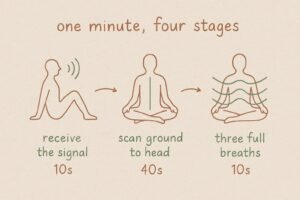
STEP 1: Receive the signal (10 seconds)
Sit back slightly in your chair. Lengthen your spine — not rigidly, just with some intention. And instead of reacting to the fatigue, acknowledge it: the body is sending a signal. That’s all this step requires. No fixing yet. Just reception.
There may be an immediate pull to push past this — to treat the tiredness as something to overcome rather than register. That pull is the habit. This step is the interruption.
STEP 2: Scan from the ground up (40 seconds)
Close your eyes gently and move your attention slowly upward through the body.
First ten seconds: feet, calves, thighs. The contact with the floor. The state of the muscles — held, released, somewhere in between.
Next ten seconds: abdomen, chest, back. The movement of breath. The subtle pressure of clothing. What’s moving, what isn’t.
Next ten seconds: shoulders, neck, face. Where is tension held? Where is the jaw set? What would it mean to soften, even slightly?
Final ten seconds: the crown of the head, then outward to the whole body at once. One continuous system. All of it here.
STEP 3: Three breaths through the whole body (10 seconds)
Bring your attention to the breath and let it reach a little further than usual — not just the lungs, but the shoulders, the hands, the places the scan just visited. Inhale into all of it. Exhale, and let whatever wants to release begin to do so.
This step may feel unfamiliar if visualization doesn’t come naturally. That’s fine. The instruction isn’t to imagine something vividly — just to let the breath be slightly more intentional than usual. Three breaths with a little more attention behind them. That’s the whole practice.
Session 3: Why Fatigue Is a Prediction, Not a Verdict
The conventional understanding of fatigue is straightforward: the body has used resources, and the depleted state generates the feeling of tiredness. But neuroscience has complicated this picture considerably — in ways that matter for how we relate to exhaustion.
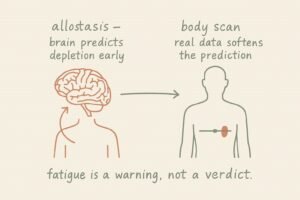
The more current framework involves a concept called allostasis. Where homeostasis describes the body’s effort to maintain stable internal conditions, allostasis describes something more dynamic: the brain’s continuous effort to anticipate what the body will need, and to adjust resources proactively rather than reactively. The brain is not a passive monitor of the body’s state. It is a predictive system, constantly modeling what’s coming and preparing accordingly.
Within this framework, fatigue is reframed. The feeling of exhaustion is not simply a readout of resource depletion — it’s the brain’s predictive signal that resource depletion is approaching and that behavioral change is warranted. The signal arrives before the crisis, not after. This is adaptive design: the warning comes early enough to act on.
What this means practically is significant. When you pause to conduct a body scan during a moment of fatigue, you are giving the brain’s predictive system access to actual sensory data — the real-time state of the muscles, the breath, the tension patterns in the shoulders and jaw. Research on interoception suggests that this kind of deliberate body awareness allows the brain to update its predictions based on current conditions rather than running on prior assumptions. In many cases, the actual physical state is less depleted than the predictive model assumed — and the fatigue signal softens accordingly.
The systematic scan activates the insula, which integrates internal bodily signals into a coherent picture of present-moment physical state. What begins as a vague sense of being tired often resolves, through the scan, into something more specific: tension in a particular muscle group, shallow breathing, a jaw held tighter than necessary. Vague fatigue is hard to address. Specific physical conditions — a tight shoulder, a shortened breath — respond to direct attention.
Fatigue is not the enemy. It’s the most honest signal the body sends.
Conclusion: The Body Has Been Talking. This Is How You Listen.

This practice doesn’t ask fatigue to disappear. It asks for one minute of actual contact with what the body is reporting — before the override reflex kicks in, before the second cup of coffee, before the decision to push through without checking what’s being pushed through. “I noticed tension in my shoulders and my breath was shallow” is a complete outcome. The noticing is the intervention.
The signal was always accurate. The only thing missing was someone paying attention to it.
KEY TERMS
Allostasis
The brain’s predictive resource-management system — continuously anticipating what the body will need and adjusting proactively. Distinct from homeostasis, which describes reactive maintenance of stable conditions, allostasis operates ahead of demand. Fatigue, within this framework, is a predictive signal — an early warning that resource depletion is approaching — rather than simply a readout of current depletion. The implication is that the feeling of exhaustion can precede actual physical crisis, and can be modulated by updated sensory information.
Interoception
The capacity to consciously register signals originating inside the body — heart rate, muscle tension, breath depth, hunger, fatigue. The body scan is interoceptive training in its most direct form: systematic, directed attention to physical sensation, progressively moving through the body’s regions. Stronger interoceptive awareness is associated with more accurate self-regulation and faster recovery from stress states.
Insula
A region of the cerebral cortex involved in integrating internal bodily signals into conscious experience. Active during deliberate body awareness practices, the insula transforms diffuse physical states — vague fatigue, generalized tension — into specific, locatable sensations that the nervous system can work with. The difference between “I feel terrible” and “my shoulders are held and my breath is shallow” reflects insula-mediated interoceptive processing.
Autonomic Nervous System
The regulatory system governing sympathetic activation and parasympathetic recovery. Prolonged desk work sustains sympathetic dominance below conscious awareness — quietly tightening muscles, elevating alertness, suppressing digestion. Deliberate body attention and conscious breathing shift the balance toward parasympathetic engagement, initiating the conditions for genuine recovery rather than continued override.
Defusion
A core skill in Acceptance and Commitment Therapy (ACT). The capacity to observe thoughts as passing mental events rather than facts requiring immediate response. When the thought *I shouldn’t be this tired* or *I’m failing* arises during the scan, noticing it — “there’s that judgment” — without acting on it, and returning attention to the physical sensation, is defusion applied to self-criticism. The judgment is present. It does not have to direct the next move.