
Introduction: Why “Not Knowing” Is So Exhausting

Waiting for an announcement. Standing at a career crossroads. Reading the news without being able to identify what, exactly, is producing the unease. A formless anxiety spreads through the chest without a clear object to attach to. And yet the response is to keep searching for one.
Much of the exhaustion doesn’t come from the uncertainty itself. It comes from the effort to do something about it.
Session 1: The Effort to Solve Anxiety Keeps It Running

When diffuse anxiety persists, the cause is often not the uncertain situation but the response to it.
When anxiety arises, the brain begins searching for resolution. A loop of what-if thinking begins — imagining worst-case scenarios as a way of feeling prepared. But the loop doesn’t resolve the uncertainty. The future remains open regardless of how thoroughly it is rehearsed. The more the thinking continues, the more the anxiety is fed, until the fact of feeling anxious becomes its own source of anxiety.
Attempts to stop feeling anxious follow the same structure. Distraction, busyness, deliberate not-thinking — these create temporary distance but the anxiety that returns is often stronger. The avoided experience doesn’t disappear; the act of avoidance reinforces the signal that what was avoided was dangerous.
When anxiety persists, the situation is rarely the primary driver. The ongoing effort to manage, resolve, or escape the anxiety is what keeps it in place.
Session 2: Practice — Carrying Anxiety Rather Than Fighting It
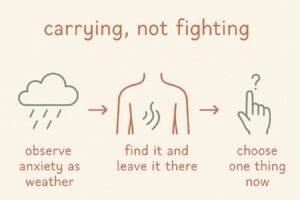
This practice is not aimed at eliminating anxiety. It is about changing the relationship with the anxiety — from something to be defeated into something that can be carried while life continues.
STEP 1: Observe the Anxiety as Weather
When an anxious thought arrives, step back before being pulled into its content.
My mind is running the anxiety storm right now.
Rather than processing the thought’s content as fact, observe it as a phenomenon the mind is generating. Weather changes. You are not the weather. The shift from being inside the thought to watching it from slightly outside creates the first gap in the automatic response chain.
Body and Leave It There
Rather than pushing the anxiety away, locate where it is in the body. The pressure across the chest. The unsettled quality in the stomach. The tension held in the shoulders. Name what is there.
There is a heaviness around the chest right now.
Don’t attempt to remove it. Simply confirm that it exists. Direct three slow exhales toward the area where the sensation is. The sensation may shift or it may not. Either is acceptable. The practice is not about making the sensation disappear — it is about extending, gradually, the time it is possible to remain with it without fighting.
STEP 3: Choose One Thing That Can Be Done Now
Even without resolving the uncertainty, the smallest action aligned with something genuinely valued remains available right now.
I don’t know how this will turn out. What is one thing I can do today regardless?
Anxiety about a career: thirty minutes reading something in a field that matters. Anxiety about a relationship: one message sent today. The action can be small. The capacity to move while uncertainty remains is itself what builds tolerance for it over time.
Session 3: The Fight Was Making It Worse
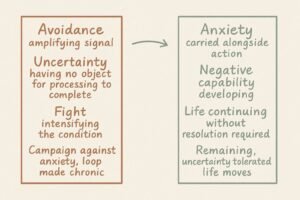
What the Effort to Solve Anxiety Actually Produced
Psychologist Steven Hayes, in developing the theoretical framework for Acceptance and Commitment Therapy, identified experiential avoidance — the pattern of attempting to eliminate or escape unwanted internal experiences — as a primary mechanism through which psychological suffering is maintained and extended. The attempt to avoid an internal experience amplifies the signal that the experience is significant and dangerous. When anxiety is treated as something to be resolved, the brain allocates increased monitoring resources to it. The monitoring raises the anxiety. The raised anxiety intensifies the monitoring. This loop — not the original anxiety, but the fight against it — is what transforms a transient difficult feeling into a chronic condition. The problem was not the anxiety. It was the campaign against it.
Why Uncertainty Specifically Resists Resolution
Psychologist Michel Dugas’s research on intolerance of uncertainty identifies a specific feature of how the brain processes the state of not knowing. Pain, grief, and disappointment are difficult experiences with identifiable objects — and the brain has processing pathways through which they move over time. Uncertainty has no object. There is nothing for the processing to complete against. The brain keeps searching for the problem to be solved and keeps encountering only the absence of resolution. Dugas’s research further demonstrates that people with high intolerance of uncertainty find avoidance strategies not merely ineffective but counterproductive: the more the state of not-knowing is avoided, the more sensitized the system becomes to it. When the avoidance mechanism is directed specifically at uncertainty as its target, the result is a loop that intensifies with each attempt to escape it. The tools designed to manage uncertainty make uncertainty harder to tolerate.
The Capacity to Remain
In a letter written in 1817, the poet John Keats named a quality he observed in people capable of genuine creative and intellectual work: the ability to remain in uncertainty, mystery, and doubt without an irritable reaching after fact and reason. He called it negative capability. It is not resignation. It is not indifference. It is an active capacity to stay inside a state of not-knowing without demanding that it resolve into certainty before anything further can happen. The opposite of experiential avoidance is not the forced acceptance of what is unpleasant — it is the discovery that unpleasant experience can be present while life continues to move. The opposite of intolerance of uncertainty is not certainty — it is the developing ability to remain inside uncertainty without the remaining itself becoming an emergency. Negative capability is not a disposition some people have and others lack. It is what becomes available when the fight is recognized as the problem and the fighting, at least for a moment, is allowed to stop.
Conclusion: The Uncertainty Was Always Going to Stay

The experiential avoidance loop will keep running against tomorrow’s anxiety. The intolerance of uncertainty will keep treating the state of not-knowing as an unresolved threat. The structure does not change.
But the question am I fighting the anxiety or carrying it can be asked on any uncertain night, before any unresolved decision. Anxiety present in the chest, one small action taken anyway — that combination is not a failure to resolve the uncertainty. It is what moving through it actually looks like.
Uncertainty was never the problem. The demand for certainty was.
KEY TERMS
Experiential Avoidance
Steven Hayes’s term for the pattern of attempting to eliminate or escape unwanted internal experiences — thoughts, feelings, physical sensations — which paradoxically maintains and extends psychological suffering. Avoidance amplifies the signal that what is being avoided is dangerous, increases monitoring of the avoided experience, and transforms transient difficult feelings into chronic ones. The primary mechanism through which the effort to solve anxiety keeps anxiety running.
Intolerance of Uncertainty
Michel Dugas’s research finding that the state of not-knowing is processed by the brain as a specific, unresolvable threat — distinct from other forms of discomfort that have identifiable objects and processing pathways. Because uncertainty has no object for the processing to complete against, the brain keeps searching for resolution and keeps encountering its absence. Avoidance strategies directed at uncertainty become counterproductive: the more not-knowing is avoided, the more sensitive the system becomes to it.
Negative Capability
John Keats’s 1817 term for the capacity to remain in uncertainty, mystery, and doubt without an irritable reaching after fact and resolution. Not resignation or indifference, but an active ability to stay inside a state of not-knowing without demanding that it resolve before anything further can happen. The conceptual destination toward which both the acceptance of difficult experience and the tolerance of uncertainty point — what becomes available when the fight against uncertainty is recognized as the source of the problem.
Psychological Flexibility
The ACT framework’s term for the capacity to move in the direction of one’s values while difficult internal experiences are present — without requiring those experiences to be resolved or removed first. The goal is not the absence of anxiety but the ability to carry it while continuing to act. Neither defeat of the anxiety nor surrender to it, but a third position in which the anxiety is present and life continues.
Defusion
The capacity to notice that the anxious thought — the storm the mind is running — has fused with one’s experience of reality, and to observe it as a generated phenomenon rather than a direct report of what is true. The shift from being inside the thought to watching it from slightly outside creates the first interval in which a response other than automatic avoidance becomes available.