
Introduction: The Moment You Try to Stop It

When an emotional wave arrives, most people do the same thing. They try to suppress it. I shouldn’t be angry right now. Don’t be anxious. Stay calm.
And sometimes that attempt makes the emotion stronger. The harder the push against it, the more present it becomes. This is not a failure of willpower. It is a structural problem — suppression as an operation produces the opposite effect on the nervous system.
Being overwhelmed by emotion and trying to suppress emotion look like opposites. They run on the same circuit. This article traces that structure, and describes a third option that neither suppression nor overwhelm makes available.
Session 1: Why Emotion Gets Louder When Pushed Against

When emotion arrives intensely, two things happen in sequence.
The first is a nervous system problem. When an emotionally significant input arrives — criticism, conflict, unexpected failure — the brain processes it through a pathway that bypasses the prefrontal cortex. The body has already responded before rational evaluation has had a chance to intervene. *By the time I realized, I was already raising my voice. By the time I noticed, I was already in tears.* This is not the reasoning brain failing to show up. It is the circuit running exactly as it was built to run.
The second problem follows from the first. Once the emotional response has been triggered, the attempt to suppress it — I should not be feeling this — instructs the nervous system to monitor the emotion continuously. Monitoring sustains presence. The thing being suppressed must be watched, and watching keeps it active. The effort to make the emotion smaller makes it harder to leave.
Neither driven by emotion nor severed from it — using what emotion contains as information for choosing how to act. Not a special capacity. A different way of running the same signal.*
Session 2: Using Emotion as Information
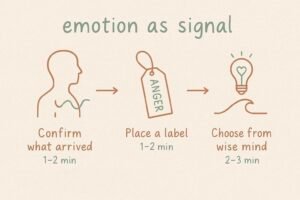
STEP 1: Confirm what has arrived (1–2 minutes)
When an emotional wave comes, the first move is neither suppression nor analysis. It is confirmation.
Is there a response somewhere in the body? Around the chest, the throat, the stomach. Without trying to stop it, confirm that it is there.
Something has arrived.
STEP 2: Place a label (1–2 minutes)
Give the emotion a short label. The operation is not analyzing the content of the emotion but identifying the category it belongs to.
This is anger.
This is strong anxiety.
This is the feeling of having been hurt.
Precision is not required. The purpose is a single step: from being inside the emotion to observing that it is present. That distance, however small, changes what is available next.
STEP 3: Choose from Wise Mind (2–3 minutes)
Wise Mind is neither governed by the emotion nor cut off from it — it treats the emotion as a signal carrying information about what matters. After placing the label, bring one question inward:
What is this emotion trying to communicate?
Emotion carries a signal beneath its intensity. Anger often marks where a boundary was crossed. Anxiety often marks where something matters. The suppression attempt was preventing that signal from being read. Receive what is there — then choose one action informed by it.
Session 3: The Amygdala Hijack, the Ironic Process, the Two-Process Model of Regulation, and the Third Option
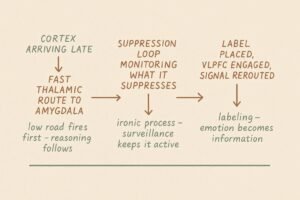
Why emotion overrides reasoning before suppression can intervene, and why suppression then makes the problem worse, is a sequence neuroscience, cognitive psychology, and emotion science have each described at a different point in the same chain.
The starting point is Joseph LeDoux’s research on the two pathways by which emotional stimuli reach the amygdala: a direct route from the thalamus — fast, coarse, and bypassing cortical evaluation — and a slower route through the cortex that allows for more refined processing. The fast route initiates bodily and emotional responses before the prefrontal cortex has completed its assessment. The voice changes, the body tightens, the words come out — and only afterward does the reasoning brain catch up with what happened. LeDoux’s framing reorients the problem: the experience of being overtaken by emotion is not evidence of emotional weakness. It is evidence of a circuit that was built for speed in environments where rapid response to threat determined survival. The amygdala’s priority access is a design feature, not a flaw.
Once that response has been triggered, the attempt to suppress it produces a compounding problem that Daniel Wegner documented in Journal of Personality and Social Psychology (1987). Wegner’s ironic process theory arose from a deceptively simple experimental finding: instructing participants not to think about a white bear caused the image to appear more frequently than in participants who were given no such instruction. The mechanism is structural. Suppression requires monitoring — the suppressed content must be continuously checked for its absence, and that monitoring keeps it active in working memory. Applied to emotional states, the instruction I should not be feeling this initiates a surveillance process that sustains the emotion’s presence. The attempt to reduce the emotion’s intensity through suppression produces the opposite result precisely because it cannot stop watching what it is trying to eliminate.
Wegner identified the cognitive mechanism of suppression’s failure. James Gross’s process model of emotion regulation, from Psychological Review (1998), identifies the structural reason it was always going to fail. Gross distinguishes between antecedent-focused regulation, which intervenes before an emotional response has fully deployed, and response-focused regulation, which attempts to control the expression or experience of emotion after it has already been triggered. Suppression is the prototypical response-focused strategy. Gross’s research showed that suppression reduces emotional expression without reducing emotional experience — the internal state continues at full intensity while additional cognitive and physiological resources are consumed managing the suppression itself. The ironic monitoring Wegner described and the resource cost Gross documented are two descriptions of the same structural problem: intervening after the emotional response has fully activated is expensive, and it does not do what it is intended to do.
The exit from this sequence is where Marsha Linehan’s Wise Mind concept and Matthew Lieberman and colleagues’ affect labeling research address the same circuit from different directions. Linehan defines Wise Mind as the dialectical integration of Emotion Mind, in which feeling dominates judgment, and Reasonable Mind, in which emotion is severed from processing. Wise Mind neither suppresses emotion nor is governed by it — it uses what emotion contains as information for action. Lieberman’s finding in Psychological Science (2007), that applying a verbal label to an emotional state reduces amygdala activation and increases activity in the right ventrolateral prefrontal cortex, shows how this integration operates neurally. The labeling operation connects the fast low road LeDoux described to the slower cortical processing that suppression was attempting to force. It is not suppression and it is not surrender. It is the signal being routed differently — through a pathway that makes the emotion’s information available without the cost of trying to eliminate it.
Conclusion: The Emotion Did Not Need to Be Stopped

The amygdala activated before reasoning could intervene. Suppression sustained what it was trying to eliminate. The cost was high, and the emotion remained.
Wise Mind does not require the emotion to be absent. It requires the emotion to be readable — its signal received, its information used, its presence neither fought nor followed without question.
The amygdala got there first. Suppression made it worse. The label is what opens the third option.
The emotion was never the problem. The instruction to eliminate it was.
KEY TERMS
Amygdala Hijack
The term was introduced by Daniel Goleman to describe the neural mechanism Joseph LeDoux had identified — and it is Goleman’s framing that has remained in wide circulation. LeDoux’s research describes the fast thalamo-amygdala pathway — the “low road” — through which emotionally significant stimuli reach the amygdala before cortical evaluation is complete. The finding reframes emotional overwhelm: the prefrontal cortex does not fail to intervene; the circuit’s architecture simply gives the amygdala priority access. LeDoux’s research established the neural foundations of emotional memory and fear conditioning, and his two-pathway model has generated decades of subsequent work on how the speed differential between cortical and subcortical processing shapes emotional experience and regulation.
Ironic Process Theory
Daniel Wegner’s finding, from Journal of Personality and Social Psychology (1987), that deliberate attempts to suppress a thought or emotional state paradoxically increase its frequency of occurrence. The mechanism is the monitoring process suppression requires: to verify the absence of the suppressed content, it must be continuously checked, and that checking sustains its activation. Applied to emotional regulation, the instruction not to feel something initiates a surveillance loop that maintains the emotion’s presence rather than diminishing it. The theory provides the cognitive basis for understanding why suppression-based approaches to emotional management tend to intensify rather than resolve the states they are directed at.
Process Model of Emotion Regulation
James Gross’s framework, from Psychological Review (1998), distinguishing antecedent-focused regulation — intervention before the emotional response has fully deployed — from response-focused regulation, which attempts to control emotion after it has already been triggered. Suppression, as a response-focused strategy, reduces emotional expression without reducing emotional experience, generating cognitive and physiological costs without achieving its intended effect. Gross’s model identifies the timing of regulatory intervention as the primary determinant of both effectiveness and cost, and has become the dominant theoretical framework in emotion regulation research across clinical, developmental, and social psychology.
Wise Mind
Marsha Linehan’s concept of the dialectical integration of Emotion Mind — feeling dominating judgment — and Reasonable Mind — emotion severed from processing. Wise Mind neither suppresses emotional experience nor is governed by it; it treats emotion as information to be used in choosing how to act. The concept is the organizing principle of DBT’s mindfulness skills, and its operational basis overlaps with Lieberman’s affect labeling research: both involve moving from automatic emotional reactivity toward a regulated engagement that preserves the signal while changing how it is processed.
Affect Labeling
Matthew Lieberman and colleagues’ finding, from Psychological Science (2007), that applying a verbal label to an emotional state reduces amygdala activation and increases activity in the right ventrolateral prefrontal cortex. Where suppression attempts to eliminate the emotional signal through monitoring, labeling routes the signal through cortical processing without requiring its elimination — connecting the fast low road LeDoux described to the slower pathway that makes the emotion’s information available for deliberate use. The finding provides the neural basis for understanding why the observational stance central to DBT, ACT, and contemplative practice produces measurable changes in emotional reactivity.