
Introduction: Try to Describe the Smell of Coffee — Without Using the Word Coffee

Go ahead. Take a moment.
Most people find they can get surprisingly far with color — “it’s dark, almost brown somehow.” With sound — “low, a little rough at the edges.” But with smell, the words run out almost immediately. And not because the experience is vague. The experience is vivid. The language just isn’t there.
This isn’t a personal limitation. It’s a feature of how the olfactory system is wired — and understanding it changes what it means to actually pay attention to a scent.
Today’s practice is about receiving what language can’t follow.
Session 1: Why Smell

Smell is the hardest sense to put into words, and the reason is architectural.
Visual, auditory, and tactile information all route through the thalamus before reaching the cortex — passing through a relay station that connects them, among other things, to the language processing areas. Smell doesn’t. Olfactory signals travel from the olfactory bulb directly to the amygdala and hippocampal entorhinal cortex — the brain’s centers for emotion and memory — without a thalamic relay. The experience completes before language processing has a chance to engage.
This is why smell is the most direct route to the present moment available to the senses. There’s no linguistic mediation between the scent and the experience of it. There’s also no linguistic mediation available to describe it afterward.
And smell is not static. What arrives at the nose changes over time — the sharp first impression, the expanding middle register, the quiet residue that lingers when the rest has gone. A scent is a temporal event, not a fixed object. Following it over time is following it as one.
Session 2: Three Steps
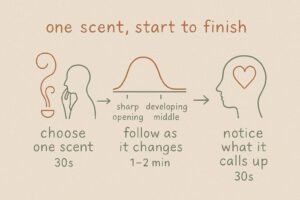
STEP 1: Choose one scent (30 seconds)
From whatever is present in the environment — coffee, rain, food, flowers, the particular smell of this specific place — select one. Not to identify it or evaluate it. Just to follow it. Hold a light internal intention: this one, from start to finish.
STEP 2: Follow the scent as it changes (1–2 minutes)
Receive the chosen scent as a moving phenomenon rather than a fixed impression.
The opening — what arrives first, and what quality it has: sharp or soft, bright or heavy
The development — what shifts as the seconds pass, what emerges that wasn’t there at the start
The finish — what remains as the intensity drops, what the scent leaves behind
Don’t try to name what you’re noticing. Stay with the changing sensation itself.
STEP 3: Notice what the scent calls up (30 seconds)
If something surfaces — a memory, an emotion, a physical response, a sense of somewhere else — acknowledge it without chasing it. It arrived without being invited. That’s enough to notice.
Session 3: Why Smell Resists Words — and Why That Makes It the Most Direct Sense
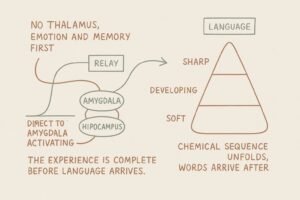
Researchers refer to the consistent difficulty of describing odors in words as olfactory verbalization deficit: humans perform significantly worse at naming and describing scents than at describing stimuli in other sensory modalities, even when those odors are fully familiar and immediately recognizable. The neuroanatomical explanation is the same one that makes smell distinctive in other ways. Visual, auditory, and somatosensory signals pass through the thalamus, which distributes them to cortical regions including the language areas.
Olfactory signals bypass this relay entirely, projecting from the olfactory bulb directly to the amygdala and hippocampal formation. By the time a scent reaches conscious awareness, it has already been processed by structures that handle emotion and memory — not by structures that handle naming and description. The experience is complete before language arrives. This is why “it smells like coffee” is the best most people can do: the word is a label attached after the fact, not a description of the experience itself.
This same architecture produces what is sometimes called the Proustian memory effect — named for Marcel Proust’s account in In Search of Lost Time, in which the smell of a madeleine dipped in tea unlocks an involuntary, overwhelmingly vivid memory of childhood. What Proust described wasn’t remembering in the ordinary sense. It was something that happened to him — a memory that arrived fully formed, with its emotional texture intact, before he had consciously decided to recall anything. The amygdala and hippocampus, receiving olfactory input through their direct neural pathway, can activate emotionally charged memories without the mediation of voluntary recall or language. The scent doesn’t remind you of something. It takes you there. The instruction to notice what the scent calls up is an invitation to observe this activation as it happens, rather than simply being carried by it.
A third dimension of olfactory experience is its temporal architecture. A scent is not a single stimulus. It is a mixture of molecules with different molecular weights and volatility profiles, arriving at the olfactory receptors at different rates. Lighter, more volatile molecules reach the receptors first — the sharp, bright initial impression. Heavier molecules with lower volatility arrive later and linger longer — the warmer, more persistent base. Perfumers formalize this as top notes, middle notes, and base notes, but the structure exists in every complex scent: the first impression of fresh coffee is not the same as what remains in the room twenty minutes later. Following a scent over time is following a chemical sequence as it unfolds — the practice is tracking something that is genuinely changing, not projecting change onto something fixed.
What can’t quite be captured in any of these frameworks is the specific quality of the experience itself — what it is like to smell this particular thing, right now. Philosophers use the term qualia for this: the subjective character of an experience, the “what it’s like” that resists reduction to physical description or linguistic account. Olfaction is where this question becomes most concrete. You can list every chemical compound in a cup of coffee. You cannot, from that list, convey what coffee smells like to someone who has never encountered it. The practice of following a scent without trying to name or explain it is, in a quiet way, an acknowledgment of this limit — and a decision to stay inside the experience rather than reaching for the description.
Conclusion: The Middle Note Was Always There

Once today. One scent, followed all the way through. Find it, stay with the opening, follow the change, and receive what remains — without reaching for the word that would close it down.
The description was never going to arrive in time anyway. The practice is what’s left when you stop waiting for it.
The scent was always this layered. You were just passing through too quickly to catch the middle.
KEY TERMS
Olfactory Verbalization Deficit
The consistent difficulty humans have in naming and describing odors compared to stimuli in other sensory modalities, even for familiar and immediately recognizable scents. Produced by the olfactory system’s direct projection to the amygdala and hippocampus, bypassing the thalamic relay that connects other senses to language processing areas. The experience is complete before language engages — which is why the best available description is usually just the name of the thing.
Proustian Memory Effect
The involuntary activation of emotionally vivid memories by olfactory stimuli, without conscious intention to recall. Named for Marcel Proust’s account of a childhood memory unlocked by the smell of a madeleine. The mechanism is the direct neural pathway from the olfactory bulb to the amygdala and hippocampal formation — structures that store emotionally encoded memories and can activate them without voluntary or linguistic mediation. The scent doesn’t remind. It retrieves.
Temporal Architecture of Scent
The time-dependent unfolding of a complex scent, produced by differences in molecular weight and volatility among its constituent compounds. Lighter molecules arrive first and dissipate quickly; heavier molecules arrive later and persist. Formalized in perfumery as top, middle, and base notes, but present in every complex natural scent. Following a scent over time is tracking a genuine chemical sequence, not a subjective impression.
Qualia
The philosophical term for the subjective, first-person character of an experience — what it is like to have it, as distinct from any physical or functional description of it. Olfaction is where this concept becomes most tangible: the chemical composition of coffee can be fully specified without conveying what coffee smells like. Receiving a scent without trying to name or explain it is a practical engagement with this limit.
Olfactory Direct Pathway
The neural route by which olfactory signals travel from the olfactory bulb directly to the amygdala and hippocampal formation, bypassing the thalamic relay that other sensory modalities pass through. This architectural shortcut produces two specific consequences examined in this guide: the difficulty of verbal description, because language processing areas are not on the direct route; and the involuntary activation of emotionally encoded memory, because the amygdala and hippocampus receive the signal before conscious processing is complete.
Defusion
A core skill in Acceptance and Commitment Therapy (ACT): the capacity to observe thoughts and impulses as passing mental events rather than tasks. When what is that smell exactly arrives as an analytical impulse mid-practice, recognizing it as a thought rather than a requirement — and returning to the sensation itself — is defusion applied to the specific habit of reaching for language when experience would do.