
Introduction: Drowsiness Opens a Layer That Wakefulness Keeps Closed
Ten minutes in, and the eyelids are already heavy. Drowsiness arrives during meditation, and most people treat it as failure.
But drowsiness is an entry point — into a boundary state between waking and sleep where the ordinary conditions of awareness shift. Things become visible there that full wakefulness tends to suppress.
Fighting drowsiness closes this entry point. Surrendering to it closes it too. Observing drowsiness as it happens is the only way to stay inside it long enough to find out what it contains.
Session 1: Why Drowsiness Arrives During Practice

There is a neurological explanation for why drowsiness appears so reliably during meditation.
Wakefulness is sustained largely by external stimulation — movement, sound, conversation, screens. These continuously activate the brain’s arousal systems. Meditation deliberately reduces external input. As that input decreases, the sleep pressure that was being held back by stimulation surfaces. Drowsiness during meditation is not a sign that something has gone wrong. It is a predictable neurophysiological response to doing exactly what the practice asks: reducing stimulation.
There is a second factor. The default mode network, which becomes active during meditation, also shows increased activity during the transition into sleep. This neurological overlap places meditation and drowsiness in structural proximity. The two states share some of the same neural territory.
The question is not whether drowsiness will arrive. It is what happens when it does.
Session 2: Four Approaches
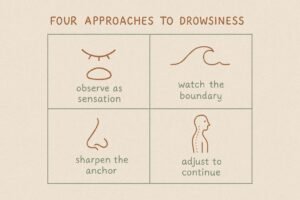
When drowsiness arrives, treat it not as the end of the practice but as the beginning of a different observation.
APPROACH 1: Observe drowsiness as physical sensation
Rather than registering drowsiness as a vague heaviness, explore it as a collection of specific bodily events.
How does the weight of the eyelids actually feel?
Where in the body does the fogginess of the head reside, and what is its texture?
Which muscles release first as posture begins to soften?
How does a yawn unfold — from its beginning through its peak and into its dissolution?
Drowsiness examined this closely turns out not to be a single state but a continuously changing process.
APPROACH 2: Observe the boundary itself
Watch the movement between receding awareness and the moment of returning.
How does the pull toward sleep begin?
What changes in the moment of snapping back?
Is there a rhythm to this movement — a pattern in how far the tide goes out before it returns?
Neither state is the object here. The transition between them is.
APPROACH 3: Sharpen the anchor
When drowsiness is strong, narrow attention to a more precise sensory target.
The temperature change of air at the nostrils
The faint contact sensation at the fingertips
The fine detail of a distant sound
A more precise anchor is easier for flagging attention to hold.
APPROACH 4: Adjust posture and environment
Make practical adjustments in order to continue observing — not to eliminate the drowsiness.
Lengthen the spine, open the eyes slightly
Take one deliberate deep breath, let cooler air in
Stand if necessary, and continue from there
The adjustment is in service of the observation, not a replacement for it.
Session 3: Why Dalí Fell Asleep in a Chair on Purpose — and What the Edge Contains
The value of observing drowsiness is not in overcoming it. It is in what the state of drowsiness makes available.
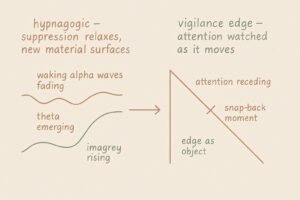
The boundary territory between waking and sleep has a name in neuroscience: the hypnagogic state. In this state, the logical, sequential processing that dominates full wakefulness begins to relax. Vivid imagery, altered bodily sensation, distortions in the sense of time — these emerge as alpha and theta waves mix in patterns distinct from both waking and sleep. The hypnagogic state is not a degraded version of wakefulness. It is a different mode of processing, in which material that waking-state suppression normally keeps below the threshold of awareness becomes accessible.
The most frequently cited examples of this state being used deliberately come from Dalí and Edison. Dalí reportedly sat in a chair holding a key in his hand, allowing himself to doze — and the moment sleep arrived, the key would fall to the floor, the sound waking him just at the boundary. Edison used a similar method with steel balls. Both were working with the hypnagogic state as a resource rather than an obstacle — a zone where the loosening of ordinary cognitive constraints made certain kinds of thinking available. These accounts appear regularly in creativity research as examples of intentional access to hypnagogic processing, and they are worth knowing not as curiosities but as illustrations of what the boundary state actually offers.
Cognitive psychology’s research on sustained attention and vigilance provides another frame. Attention does not maintain constant intensity — it fluctuates, with periodic lapses that become more pronounced as drowsiness increases. What drowsiness makes possible, from this angle, is an observation that is difficult under ordinary conditions: watching attention itself as it moves. Not attention directed at an object, but attention observed at the moment it recedes and the moment it returns. The boundary between these two moments — the edge where presence pulls back and then comes forward again — is available as a direct object of observation only when the fluctuation is happening. Drowsiness creates the fluctuation. The practice is to watch the edge.
Contemplative traditions have recorded detailed observations about what practitioners encounter in the boundary between waking and sleep — the quality of awareness there, what becomes visible, what the returning moment feels like. Neuroscience has recently been able to identify the neural correlates of this state and describe its physiological signature. The map of experience came first. The mechanism that accounts for it arrived later.
Conclusion: The Edge Is the Observation
Drowsiness is not a failure of concentration — it is a shift in the conditions of awareness, opening a layer that ordinary wakefulness keeps closed. The impulse to fight it back, or to give in entirely, both close the same door. Staying at the edge requires neither resistance nor surrender. It requires observation.
The drowsiness wasn’t interrupting the practice. It was opening a layer the practice doesn’t usually reach.
KEY TERMS
Hypnagogic State
The boundary consciousness between waking and sleep — characterized by a mixture of alpha and theta wave activity distinct from both full wakefulness and sleep. Logical, sequential processing relaxes; vivid imagery, altered bodily sensation, and time distortion emerge. Not a degraded form of wakefulness but a different processing mode in which material normally suppressed by waking-state constraints becomes accessible. Dalí and Edison both used deliberate methods to access and work within this state, accounts that appear regularly in creativity research as examples of intentional hypnagogic practice.
Sustained Attention and Vigilance
The cognitive psychology finding that attention does not maintain constant intensity but fluctuates periodically — with lapses becoming more pronounced as drowsiness increases. This fluctuation, which is typically treated as a problem to be managed, becomes an object of observation in this practice: watching attention recede and return makes the structure of attention itself available for direct examination in a way that full wakefulness rarely permits.
DMN and Sleep Transition
The default mode network — active during meditation — also shows increased activity during the transition into sleep. This neurological overlap places meditation and drowsiness in structural proximity. The reduction of external stimulation that meditation requires also reduces the arousal input that keeps sleep pressure suppressed. Drowsiness during practice is the design working as intended, not failing.
Experiential Avoidance Applied to Drowsiness
The impulse to eliminate drowsiness — to fight it back into full wakefulness — is a form of experiential avoidance: the tendency to escape unwanted internal states in ways that intensify attention to them and extend their duration. Treating drowsiness as an object of observation is the structural opposite: redirecting attention from resistance to the changing qualities of the experience itself.
Defusion
A core skill in Acceptance and Commitment Therapy (ACT): the capacity to observe thoughts as passing mental events rather than facts requiring immediate response. When I’m falling asleep — this session is a failure arrives as a verdict, recognizing it as a thought rather than an accurate assessment — and returning attention to the physical sensation of drowsiness as it actually is right now — is defusion applied to the self-critical response that difficulty in practice consistently generates.