
Introduction: Knowing It and Experiencing It Are Not the Same Thing

Everything changes. Almost everyone already knows this.
But knowing something as a proposition and confirming it directly in the present moment are entirely different experiences.
When an uncomfortable emotion has been present for a while, the knowledge that this will pass rarely helps much. But for someone who has repeatedly observed the changing nature of sensation — who has watched things arrive, shift, and dissolve — a different option becomes available. Not remembering that change happens, but recognizing change as it is happening.
This guide is a practice for developing that recognition.
Session 1: Why Knowing Isn’t Enough

Cognitive psychology distinguishes between conceptual knowledge and procedural knowledge. Knowing how to ride a bicycle in words and actually being able to ride one are different capacities, stored differently in the brain, developed through different processes.
Everything changes is conceptual knowledge. Recognizing change as it occurs in sensation is a procedural capacity — one that develops only through repeated, direct observation. Neurologically, these are not the same thing.
There is a second mechanism worth understanding. ACT (Acceptance and Commitment Therapy) describes a pattern called experiential avoidance — the tendency to try not to feel unwanted internal experiences: sensations, emotions, thoughts. The consistent finding across ACT research is that this avoidance is counterproductive. Trying not to feel something increases attention to it, extending its duration and intensity. Resistance holds in place what would otherwise pass.
Observing change is the opposite of this avoidance. Not trying to alter the experience, but turning attention toward its changing nature. That shift in direction is where the change in relationship begins.
Session 2: Three Steps
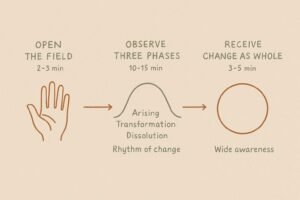
Find a quiet space and sit comfortably. The focus here is not the content of individual sensations but change itself as a process.
STEP 1: Open the field of observation (2–3 minutes)
Place attention on the palm of one hand, or on the breath.
Rather than looking for any particular sensation, hold the whole area in a wide, receptive awareness. Whatever arrives — receive it. Whatever is already there — notice it. No agenda beyond that.
STEP 2: Observe the three phases of change (10–15 minutes)
Direct attention not to what sensations are, but to how they move.
Arising: How does a sensation enter awareness? Suddenly, or gradually? Does it seem to come from somewhere, or simply appear?
Transformation: Once present, does it stay the same? Does its intensity shift? Its quality? Its location? What does the moment of transition from one sensation to another feel like?
Dissolution: How does a sensation end? Does it disappear abruptly, or fade? What, if anything, remains after it has gone?
The names of sensations are not important here. The rhythm of change, the speed of change, the texture of change — these are the objects of observation.
STEP 3: Receive change as a whole (3–5 minutes)
Lift attention from individual sensations and receive the entire process — arising, transforming, dissolving — as a single, continuous movement. Not this sensation, then that one. The movement itself, held in wide awareness.
Session 3: Why Resistance Holds Things in Place — and What Observation Does Instead
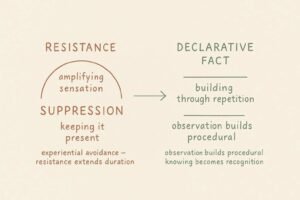
There is a psychological explanation for why knowing that things change doesn’t function the way direct observation does — and for why observation works differently than understanding.
As the research behind experiential avoidance has consistently shown, attempts to escape or suppress unwanted internal experiences are counterproductive. Trying not to feel an uncomfortable sensation increases attention to it. Suppressing an emotion extends its duration. The effort to push something away keeps it present longer than simply allowing it to be there. The mechanism is attentional: resistance is a form of sustained focus on the thing being resisted. Observing the changing nature of sensation does something structurally different — it redirects attention from the content of experience to its movement, which changes the relationship to it without requiring the experience to change.
The distinction between declarative and procedural knowledge is a foundational finding of cognitive psychology. Declarative memory — facts, propositions, conceptual content — is stored primarily in the hippocampus and is available for conscious recall. Procedural memory — the knowledge of how to do something — is encoded through repetition in the cerebellum and basal ganglia, and operates largely below conscious awareness. Everything changes is declarative. Recognizing change as it occurs in sensation is procedural — it cannot be read out of storage but must be built through repeated practice. The two involve different memory systems, different learning processes, and different relationships to conscious attention.
William James, writing on habit and learning, made an observation that neuroscience would later confirm as synaptic plasticity: the nervous system is modified by repeated experience. What James emphasized, beyond the fact of this modification, was the quality of the repetition. Repeating something with directed attention produces different neural changes than repeating it automatically. This is the basis for why deliberate observation of change — rather than passive exposure to it — develops a different kind of recognition. The practice is not simply accumulating experiences of change. It is attending to change, repeatedly, in a way that gradually restructures how change is perceived.
Contemporary psychology names the result the conversion of declarative knowledge into procedural recognition. Neuroscience describes it as the integration of explicit and implicit memory systems. Contemplative traditions developed systematic methods for producing exactly this shift — and documented what it produces — long before either vocabulary existed. The destination they are all pointing toward is the same. The vocabularies differ.
Conclusion: Confirmation Is Different From Recollection

The knowledge that things change is available at any time — it can be recalled, repeated, believed. But belief doesn’t change the relationship to discomfort. Only recognition does. And recognition is not something that can be retrieved.
It has to be built, directly, through repeated observation of change as it actually occurs.
Resistance was the only thing that made it feel permanent. Observation is what removes the resistance.
KEY TERMS
Experiential Avoidance
The tendency to escape or suppress unwanted internal experiences — sensations, emotions, thoughts — described as a central mechanism in ACT (Acceptance and Commitment Therapy) by Hayes and colleagues. Consistently shown to be counterproductive: avoidance increases attention to the avoided experience, extending its duration and intensity. Resistance is a form of sustained focus on what is being resisted. Observing the changing nature of sensation redirects attention from content to movement — changing the relationship to experience without requiring the experience itself to change.
Declarative vs. Procedural Knowledge
The cognitive psychology distinction between knowing-that (propositional, stored in the hippocampus, available for conscious recall) and knowing-how (built through repetition, encoded in the cerebellum and basal ganglia, operating largely below conscious awareness). Everything changes is declarative. Recognizing change as it occurs in sensation is procedural — it cannot be recalled but must be developed through repeated direct observation. The neurological gap between these two is what this practice is designed to cross.
Synaptic Plasticity and the Quality of Repetition
James observed that the nervous system is modified by repeated experience — a principle neuroscience would later confirm as synaptic plasticity. His emphasis was on the quality of repetition: attending to something deliberately produces different neural changes than repeating it automatically. Deliberate observation of change, sustained across practice sessions, restructures the perceptual patterns through which change is recognized — not by adding knowledge, but by modifying the system that does the perceiving.
Direct Observation and the Shift From Knowing to Recognizing
Contemplative traditions have described with considerable precision what happens when sensation’s arising, changing, and passing is observed repeatedly and directly: conceptual understanding gives way to lived recognition — a shift that changes the relationship to experience rather than its content. Contemporary psychology names this the conversion of declarative into procedural knowledge. Neuroscience describes it as the integration of explicit and implicit memory systems. The temporal structure of this observation is examined in the preceding guide; the foundational observation it confirms — that all conditioned phenomena arise, change, and pass — is what Theravada practice has described as Anicca.
Defusion
A core skill in Acceptance and Commitment Therapy (ACT): the capacity to observe thoughts as passing mental events rather than facts requiring immediate response. When this isn’t changing or this feeling will never pass arrives as a conclusion during observation, recognizing it as a thought rather than an accurate reading of what is actually occurring — and returning attention to the sensation’s actual movement — is defusion applied to the resistance that change-observation practice consistently encounters.