
Introduction: Wandering Is Not Failure. It’s What the Practice Works With.

A few seconds into watching the breath, and you’re already somewhere else — yesterday’s conversation, tomorrow’s deadline, a thought that arrived without invitation.
Most people experience this as failure. But the moment of noticing — oh, I was thinking — is not failure. It is the practice functioning exactly as it should.
Without the noticing, you’d simply have continued thinking. The noticing is what makes return possible. And the return is the whole exercise. Thoughts are not the obstacle to this practice. They are its raw material.
Session 1: What a Wandering Mind Actually Is

The brain generates thoughts continuously. This is a feature, not a malfunction.
When the mind is not engaged with a specific task, the brain defaults automatically to self-referential thinking: revisiting past events, planning or worrying about the future, evaluating the self and others. This is the brain’s resting state — its default operation. Thoughts arising during meditation are not evidence of weak concentration. They are evidence of a brain doing what brains do when attention is not otherwise directed.
Understanding what the act of noticing actually does changes how wandering feels.
When a thought is noticed, something has already shifted. A moment earlier, the thought was the entire experience. Now there is a thought, and there is something observing the thought. These are not the same position. The shift from *I was thinking* to *I notice I was thinking* — that gap, however small, is the practice.
Session 2: Three Steps
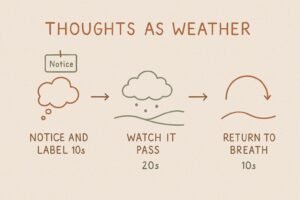
This begins the moment a thought is noticed.
STEP 1: Notice and label (10 seconds)
When you find yourself caught in a thought, confirm it quietly.
“Thinking is happening”
“This is a planning thought”
“This is a worry thought”
Don’t enter the content. Identifying what kind of thought it is — without following it — is enough.
STEP 2: Watch it pass (20 seconds)
The instinct is to engage — to follow the thought or to push it away. Neither is required. Having labeled it, simply observe.
Like a cloud moving across open sky
Like a leaf carried by the current of a river
Like a train arriving at a platform and leaving again
Don’t chase it. Don’t push it away. Watch it move through.
STEP 3: Return to the breath (10 seconds)
When the thought has passed, bring attention back to the breath.
The nostrils, the chest, the movement — wherever it was before.
Return without evaluation. No assessment of how long it took, or how many times this has happened. Simply: back.
Session 3: Why the Wandering Mind Is the Condition, Not the Obstacle
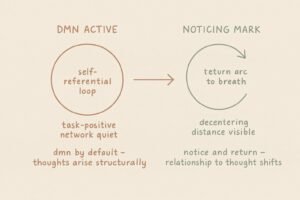
The experience of a wandering mind has a structural explanation.
Raichle and colleagues identified a network of brain regions — the medial prefrontal cortex, posterior cingulate cortex, and precuneus among them — that become consistently active when the brain is not engaged with an external task. They named it the default mode network. What it generates is self-referential thought: rumination about the past, anticipation of the future, evaluation of the self in relation to others. This is the neural substrate of the wandering mind. Thoughts don’t arise during meditation because concentration has failed. They arise because the default mode network is doing what it does by default whenever task-directed attention is not active.
The default mode network operates in a competitive relationship with what researchers call the task-positive network — the set of regions that activate during focused, externally directed attention. These two networks are mutually suppressive: when one is active, the other tends to quiet. The act of noticing a thought and returning to the breath is a direct intervention in this competition — recognizing that the default mode network has taken over and re-engaging the task-positive network. Repeated across a single session and across many sessions, this intervention appears to strengthen the connectivity between the prefrontal cortex and insular cortex that underlies attentional control. The practice is not fighting the default mode network. It is repeatedly noticing it and redirecting — which is a different thing.
Cognitive psychology describes a related capacity as decentering: the ability to observe thoughts as temporary mental events rather than accurate representations of reality or essential features of the self. The distance between I failed and I notice a thought that says I failed is small in words and significant in experience. In the first, the thought is the reality. In the second, the thought is a phenomenon being observed. Williams and colleagues at Oxford have shown that this capacity — trained directly through the kind of practice described here — correlates significantly with reduced rates of depressive relapse. It is not the content of thoughts that changes. It is the relationship to them.
William James, writing in 1890, described consciousness not as a thing but as a process — a stream, continuously flowing, in which no state repeats exactly and nothing is fixed. Individual thoughts are not objects; they are moments in a current. Decades later, neuroscience would identify the default mode network as the neural architecture underlying that stream. What both were describing — the flowing, non-fixed nature of mental life — is something contemplative traditions have articulated for far longer. The stream does not belong to any single vocabulary.
Conclusion: Every Return Is a Repetition of the Practice

The default mode network will generate thoughts throughout — during practice, outside it, for the rest of life. That is not a condition to be fixed. It is the condition the practice operates within. The wandering is what makes the noticing possible. The noticing is what makes the return possible.
The thought was never the problem. The problem was the absence of the gap between the thought and you.
KEY TERMS
Default Mode Network (DMN)
A set of brain regions — including the medial prefrontal cortex, posterior cingulate cortex, and precuneus — that activate when the brain is not engaged with an external task. Identified by Raichle and colleagues. The DMN generates self-referential thought: rumination, future anticipation, self-evaluation. Thoughts arising during meditation are DMN activity, not failures of concentration. The act of noticing and returning is a direct intervention in this network’s default operation.
Decentering
The capacity to observe thoughts as temporary mental events rather than accurate representations of reality or defining features of the self. The experiential gap between I failed and there is a thought that says I failed is the gap decentering opens. Research by Williams and colleagues at Oxford has linked the development of this capacity to significantly reduced rates of depressive relapse — suggesting that what changes is not thought content but the relationship to thought.
Stream of Consciousness
William James’s description, from 1890, of consciousness as a continuous, flowing process rather than a fixed entity. Individual thoughts are moments in a current, not objects. The default mode network was identified more than a century later as the neural substrate of this stream. What James described through introspection, neuroscience mapped through imaging. What both were pointing toward — the flowing, non-fixed nature of mental life — is something contemplative traditions have described in their own language for far longer. The stream does not belong to any single vocabulary.
Task-Positive Network (TPN)
The set of brain regions that activate during focused, externally directed attention — operating in competitive suppression with the default mode network. When one network is active, the other tends to quiet. Returning attention to the breath re-engages the task-positive network. Repeated across practice sessions, this re-engagement appears to strengthen the prefrontal and insular connectivity that underlies voluntary attentional control. The wandering is not failure; the return is training.
Defusion
A core skill in Acceptance and Commitment Therapy (ACT): the capacity to observe thoughts as passing mental events rather than facts requiring immediate response. When I keep failing at this or my mind is too busy to meditate arrives as a verdict, recognizing it as a thought rather than an accurate assessment — and returning attention to the breath — is defusion applied to the self-critical response that meditation practice consistently generates. Nearly identical in structure to decentering; arriving from a different direction at the same move.