
Introduction: The Breath Is Already Complex

It has never stopped, not once, for your entire life. And yet it is almost never noticed.
That is what breath is.
But when attention turns toward it — the temperature of air at the nostrils, the precise moment the chest begins to expand, the brief stillness between exhale and the next inhale — the complexity is far beyond what was expected.
Breath is a rich, continuously unfolding process before it is anything else. Four entry points. Each one opens it differently.
Session 1: Why Breath Works as an Object of Observation

The reason breath has been used as a focus of contemplative practice across cultures and centuries is not mysterious. It is structural.
Breath exists only in the present. It cannot be remembered or anticipated as a sensory event — it can only be felt now. Each time attention drifts and returns, it returns to the present moment automatically. The object itself enforces the return.
The second reason is more unusual. Breath sits at the boundary between the autonomic and the voluntary nervous systems. Heart rate and digestion run without conscious input and resist deliberate control. Breath does both: it continues without attention, and responds immediately when attention arrives. This dual nature makes it a uniquely direct access point to the body’s internal state — a door that opens from either side.
Each entry point that follows opens something slightly different in the same breath.
Session 2: Four Points of Observation
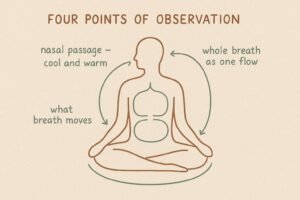
Settle the posture, close the eyes gently. The four points can be explored in sequence or one at a time. Approach with the interest of someone investigating something unfamiliar — because it is.
POINT 1: The nasal passage — where breath enters
Place attention at the rim of the nostrils.
The faint coolness of incoming air as it contacts the inner surface
The slight warmth of the outgoing breath
The brief pause between breaths — the small stillness before the next cycle begins
This is where sensation is sharpest and subtle changes are easiest to detect.
POINT 2: Chest and abdomen — what breath moves
Expand attention to the chest, abdomen, and back.
The chest slowly widening on the inhale, quietly releasing on the exhale
The abdomen rising and falling with the movement of the diaphragm
The back moving slightly with each breath — a detail that often goes entirely unnoticed
Feeling the breath through the whole body expands the field of observation considerably.
POINT 3: The quality of breath — what it reflects
Notice the character of the breath as it is, without trying to change it.
Fast or slow? Steady or variable?
Is the inhale longer than the exhale, or the same?
Shallow or deep? Easy or slightly constricted somewhere?
The breath reflects the state of the nervous system with considerable accuracy. The practice here is observation without intervention.
POINT 4: The whole — breath as a single flow
Rather than the parts, receive the breath as one continuous movement.
The arc from the beginning of the inhale through the transition to exhale and back again
A rhythm that was never interrupted, not once
The body as a single container through which this process moves
This is the most expansive of the four — attention held wide enough to contain the whole cycle at once.
Session 3: Why the Same Breath Contains More Than You’ve Ever Noticed
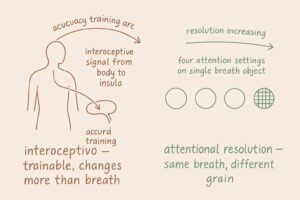
The more carefully breath is observed, the more there is to observe. There is a reason for this.
Damasio’s research established that the brain is continuously monitoring the body’s internal state — heart rate, breath, digestion, muscular tension — and that this monitoring, processed primarily through the insular cortex, forms the biological substrate of emotion, mood, and self-awareness. The technical term for this capacity is interoception: the perception of the body’s internal condition. What this research revealed, and what subsequent work by Garfinkel and colleagues has elaborated, is that interoceptive accuracy varies significantly between individuals — and that it is trainable. Repeatedly directing attention to the temperature of air at the nostrils, the timing of chest expansion, the brief pause between breath cycles: this is interoceptive training. Interoceptive accuracy correlates positively with emotion regulation, decision-making quality, and the capacity for empathy. Observing the breath changes more than the breath.
Cognitive psychology contributes a complementary frame. Attention shapes perceptual resolution: the same stimulus yields fundamentally different amounts of information depending on how attention is structured. The difference between a novice and an expert tasting wine is not sensory — it is attentional. The four observation points in this guide function as four resolution settings applied to a single object. Entering through Point 1 and entering through Point 4 produce different experiences of the same breath, not because the breath has changed, but because the structure of attention has. Each point trains a different grain of perception.
Husserl described, in the early twentieth century, what he called the intentionality of consciousness: the observation that consciousness is always consciousness of something — it is never free-floating, always directed toward an object. From this perspective, breath observation is not merely a relaxation technique. It is a repeated, direct encounter with the structure of awareness itself: attention turning toward an object, holding it, losing it, returning. The moment of noticing the coolness at the nostril — in that moment, the relationship between consciousness and its object is available as lived experience rather than abstract concept.
Conclusion: The Resolution Was Always Available

The breath was always this complex — the temperature differential, the pause, the back expanding with each inhale. None of it appeared recently. It was present and unfolding through every moment that attention was directed elsewhere.
The breath didn’t become more detailed. The attention did.
KEY TERMS
Interoception
The brain’s perception of the body’s internal state — heart rate, breath, digestion, muscular tension — processed primarily through the insular cortex. Established as the biological substrate of emotion and self-awareness through Damasio’s research. Garfinkel and colleagues have shown that interoceptive accuracy — how precisely a person can detect their own internal signals — varies between individuals and responds to training. Breath observation is a direct form of interoceptive training. The implications extend well beyond breath: interoceptive accuracy correlates with emotion regulation, decision quality, and empathic capacity.
Perceptual Resolution and Attentional Depth
The cognitive finding that the same stimulus yields different amounts of information depending on the structure of attention directed toward it. Expertise in any perceptual domain — wine tasting, musical listening, clinical diagnosis — is largely attentional rather than sensory. The four observation points in this guide function as four resolution settings for a single object. Attention trained on breath becomes capable of finer and finer distinctions within what initially appeared uniform.
Intentionality
Husserl’s foundational observation in phenomenology: consciousness is always consciousness of something — directed, never free-floating. Breath observation offers a repeated direct encounter with this structure: attention orienting toward an object, sustaining contact, losing it, returning. The moment of noticing the coolness at the nostril is not just a sensory event. It is the structure of awareness made briefly available as experience.
Ānāpāna sati
The Pali term for mindfulness of breathing — among the oldest systematically documented contemplative practices, with textual records spanning more than two and a half millennia. The structure it describes — sensation at the point of contact, awareness of bodily movement, observation of the breath’s quality, and reception of breath as a unified process — maps closely onto the four points in this guide. Neuroscience can now explain the mechanisms involved: interoceptive training, attentional regulation, autonomic influence. The map itself predates the explanation by a considerable distance.
Defusion
A core skill in Acceptance and Commitment Therapy (ACT): the capacity to observe thoughts as passing mental events rather than facts requiring immediate response. When I’m not observing correctly or my concentration keeps breaking arrives as an evaluation during practice, recognizing it as a thought rather than an accurate assessment — and returning attention to the next breath — is defusion applied to the self-critical response that sustained attention practice reliably generates.