
Introduction: The Harder You Push Against It, the Larger It Gets

When anxiety arrives, most people do the same thing. They try not to feel it. They push the thought away. They tell themselves they shouldn’t be thinking this way.
And sometimes that attempt makes the anxiety more present, not less. The harder the push against it, the more it occupies the center.
This is the same circuit as the suppression paradox — avoidance not only maintains the unwanted experience, but simultaneously depletes the energy needed for everything else.
What Acceptance and Commitment Therapy calls acceptance is the choice not to pay that double cost. Not resignation, not endurance — but stopping the operation of avoidance, and allowing a different circuit to run.
Session 1: The Two Costs Avoidance Creates

The attempt to eliminate an unwanted feeling or thought looks like reasonable self-management. It generates two problems at the same time.
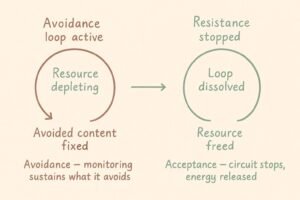
The first is that avoidance sustains its target. The instruction I should not be feeling this requires continuous monitoring — checking whether the unwanted experience is still present. Monitoring sustains presence. The thing being suppressed must be watched, and watching keeps it active. The process of trying not to feel something keeps that something at the center of awareness. This is the maintaining structure of avoidance: the more the effort intensifies, the more the avoided experience consolidates its position.
The second problem runs alongside the first. The ongoing effort to not feel, not think, not acknowledge something draws continuously on cognitive resources. That draw is not free. Energy spent on avoidance is energy not available for anything else. The effort to change what cannot be changed quietly reduces the capacity to act on what can. The two costs run together — avoidance maintains the unwanted experience while draining the resources that could go somewhere useful.
Acceptance is the response to both at once. Stopping the attempt to eliminate the unwanted experience ends the monitoring loop. The energy that was sustaining the avoidance becomes available again.
Session 2: Practicing Acceptance
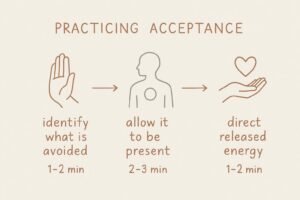
STEP 1: Identify what is being avoided (1–2 minutes)
Is there something right now that is being pushed away — something you are trying not to feel or not to think about?
Name it. Anxiety, regret, anger, physical tension — any of these.
Right now, something in me is trying not to feel this.
This confirmation is itself the first movement from avoidance toward acceptance.
STEP 2: Allow it to be present (2–3 minutes)
Without trying to eliminate it, let what has been identified simply occupy its space.
Is there a physical location for this sensation? Around the chest, the stomach, the shoulders. Confirm the location. If it had a temperature or a weight, what would that be?*
No evaluation. No attempt to change it. Just confirmation.
This is here. For now, this is here.
STEP 3: Direct the released energy (1–2 minutes)
From that position — with the avoidance effort suspended — bring one question inward.
What do I care about in this situation?
Connect whatever surfaces to one small action available today. The energy that was going into avoidance is available for this now.
Session 3: Experiential Avoidance, the Ironic Process, Cognitive Resource Depletion, and the Circuit Acceptance Opens
Steven Hayes and colleagues’ concept of experiential avoidance, introduced in Behaviour Research and Therapy (1996), showed that attempts to avoid, suppress, or alter unwanted internal experiences — thoughts, emotions, physical sensations, memories — appear to reduce discomfort in the short term while maintaining and intensifying those experiences over time. Avoidance does not resolve the problem. It structurally reorganizes the problem as something that must continue to be avoided. A consistent finding across Hayes’s research program is that the degree of experiential avoidance correlates with anxiety, depression, and broader indices of psychological distress — not what is being avoided, but the operation of avoidance itself, that functions as the primary maintaining mechanism.
Why avoidance sustains its target is where Daniel Wegner’s ironic process theory provides the cognitive mechanism. Suppression and avoidance require monitoring: to verify the absence of the suppressed content, it must be continuously checked. That monitoring keeps the avoided experience active in working memory. The instruction *not to feel something* initiates a surveillance loop that maintains the feeling’s presence. The long-term cost Hayes documented and the monitoring structure Wegner identified describe the same problem from different angles — avoidance does not release its target; it fixes it in place.
Running alongside this maintaining function is the resource cost that Roy Baumeister and colleagues documented in Journal of Personality and Social Psychology (1998). Baumeister’s research showed that self-regulation — the deliberate management of thoughts, emotions, and behavior — draws on finite cognitive resources that deplete with use. The continuous effort to not feel something, to not think about something, quietly consumes these resources. While they are being spent on avoidance, less remains available for other functions — value-based action, creative problem-solving, sustained attention to others. Avoidance and valued action compete for the same finite resource, and avoidance is running continuously.
How acceptance dissolves this structure is where Hayes’s ACT framework and the meta-analytic evidence converge. Acceptance in ACT is not evaluation — it is not deciding that the unwanted experience is good, or agreeing with its content. It is the cessation of resistance: stopping the operation that was sustaining the monitoring loop and consuming the resource. Andrew Gloster and colleagues’ meta-analysis in Journal of Contextual Behavioral Science (2020), drawing on 96 studies and approximately 17,000 participants, confirmed that psychological flexibility shows consistent positive associations with mental health, behavioral effectiveness, and subjective wellbeing. Acceptance is not passive. It is the operation that stops one circuit and frees the resources for another.
Conclusion: What Avoidance Was Costing

Experiential avoidance was maintaining the unwanted experience and depleting cognitive resources at the same time. The harder the resistance, the more fixed the target became — and the less energy remained for anything else.
Acceptance is stopping that operation. Not eliminating the unwanted experience, but confirming its presence and redirecting what was spent on resistance toward what actually matters.
The energy spent fighting what couldn’t change was the same energy needed for what could.
Acceptance was never agreement. It was the decision to stop paying a cost that was buying nothing.
KEY TERMS
Experiential Avoidance
Steven Hayes and colleagues’ concept, from Behaviour Research and Therapy (1996), describing the pattern of attempting to avoid, suppress, or alter unwanted internal experiences — thoughts, emotions, physical sensations, memories — which maintains and intensifies those experiences over time rather than resolving them. The core finding is that avoidance as an operation, independent of its specific target, functions as a primary maintaining mechanism for psychological distress. Across Hayes’s research program and subsequent work, degree of experiential avoidance correlates consistently with anxiety, depression, and broader measures of psychological dysfunction. It is the central intervention target of ACT, and its reduction is what acceptance is structurally designed to accomplish.
Ironic Process Theory
Daniel Wegner’s finding, from Journal of Personality and Social Psychology (1987), that deliberate suppression of a thought or emotional state increases its frequency of occurrence — because suppression requires monitoring the suppressed content for its absence, and that monitoring sustains its activation. Applied to experiential avoidance: the attempt to not feel something initiates a surveillance loop that keeps the feeling present. The theory provides the cognitive mechanism underlying Hayes’s clinical observation that avoidance maintains rather than resolves its target — what is being avoided cannot be released while it is continuously being checked.
Ego Depletion
Roy Baumeister and colleagues’ finding, from Journal of Personality and Social Psychology (1998), that self-regulation draws on finite cognitive resources that deplete with sustained use. The continuous effort involved in experiential avoidance — trying not to feel, not to think, not to acknowledge — consumes these resources, reducing what is available for value-based action, problem-solving, and sustained engagement with others. Subsequent large-scale replication attempts have produced more modest effect sizes than the original research, and the precise nature of the resource has been debated; the behavioral effects of sustained self-regulatory effort on subsequent performance, however, remain supported across multiple research contexts.
Psychological Flexibility
The capacity, central to ACT as developed by Steven Hayes and colleagues, to act in accordance with chosen values in the presence of difficult internal experience rather than organizing behavior around its avoidance. Acceptance functions as one of its core processes — the cessation of experiential avoidance that ends the monitoring loop and stops the resource depletion Baumeister described. The resource freed by acceptance is what makes the behavioral component of psychological flexibility possible.