
Introduction: What Hurts More Than the Change Itself

The job shifted. The relationship ended. The plan fell apart.
What arrives alongside the change is not only the difficulty of what has happened. It is a parallel track of thought: this wasn’t supposed to go this way. If I had done things differently. If that one thing hadn’t happened, by now I would be —
This comparison to a version of events that never existed generates its own suffering — quieter than the immediate impact of the change, but more persistent. It does not require the change to still be happening. It continues on its own.
The comparison is not a failure of coping. The brain maintains predictive models of how things are supposed to go, and when reality diverges from those models, it generates alternatives. The mind is doing what it was built to do. But what it is building — the absent reality — is also what is making adaptation to the present one harder.
This article traces that structure, and describes what interrupts it.
Session 1: The Two Layers of Change-Related Suffering

When change produces suffering, two distinct layers are usually present.
The first is the actual difficulty of what has changed — the relationship that is gone, the plan that no longer holds, the situation that is genuinely harder than before. This layer is real and requires real adjustment.
The second layer is generated by comparison. If that hadn’t happened, things would still be intact. If I had chosen differently, none of this would be the case. This layer does not process what is actually present. It constructs an alternative version of events and measures the current reality against it — continuously, and without resolution, because the alternative version does not exist and cannot be accessed.
The second layer frequently outlasts the first. Long after the immediate disruption of a change has passed, the comparison to what should have been continues. And it is this comparison — not the change itself — that most reliably delays adaptation. Adapting to a changed reality requires processing what is actually present. The counterfactual track keeps redirecting attention toward what is absent.
Session 2: From Comparison to the Present
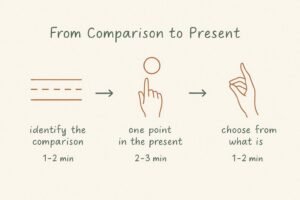
STEP 1: Identify the comparison (1–2 minutes)
Is there change-related suffering present right now?
Within that suffering, is there a counterfactual track running? If only. This wasn’t supposed to happen. By now I should have been.
Without engaging the content of those thoughts, confirm that they are there.
Something in me is measuring this against a version of events that didn’t happen.
That confirmation — without engaging the content — is the first step.
STEP 2: Place attention on one point in the present (2–3 minutes)
Without trying to stop the comparison, bring attention to one feature of what is actually present.
What is actually the case right now — not what should have been, but what is. Is there a physical location for this situation’s weight? Around the chest, the stomach, the shoulders. Confirm it without evaluation.
When the comparison returns — and it will — come back to the present point. Once is enough each time.
STEP 3: Choose one action from the present reality (1–2 minutes)
From the present reality rather than the absent one, bring one question inward.
Given what is actually the case right now, what is one thing available to do?
It does not need to be large. The function is not resolution — it is a single action chosen from the reality that exists, rather than from the one that didn’t.
Session 3: Four Findings That Explain the Persistence
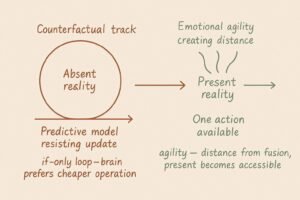
Why the comparison keeps running
Neal Roese’s synthesis of counterfactual thinking research, published in Psychological Bulletin (1997), documents the automatic tendency to construct “if only” scenarios following negative outcomes — building alternative versions of events and comparing them to what actually occurred. What Roese’s analysis identified as the central problem is the persistence of the comparison beyond any useful function. The more counterfactual thinking repeats, the more cognitive resources are directed toward the absent alternative and away from the present reality. Adapting to a change requires processing what is actually there. Counterfactual thinking continuously redirects attention toward what is not — and the comparison, finding no resolution in an alternative that cannot be accessed, sustains itself indefinitely.
Why the brain resists updating
Karl Friston’s predictive coding framework, developed across research including Neural Networks (2004), extends the account to the neural level. Friston’s framework describes the brain as a prediction machine: it maintains models of how things are expected to go and continuously minimizes the discrepancy between prediction and reality. When change generates a large discrepancy between the predictive model and actual events, the brain faces a choice between updating the model to match the new reality — a cognitively costly operation — or generating interpretations that preserve the existing model. Counterfactual thinking is the second operation: constructing the reality in which the model would still be accurate, and comparing the present situation to it. It is not a failure of reasoning. It is the nervous system preferring a cheaper operation over a more expensive one.
Why identity-threatening change is hardest to adapt to
When the change involves identity — when what has shifted is not only a situation but a sense of who one is — the structural difficulty of adaptation deepens in the way Herminia Ibarra documented in Working Identity (2003). Ibarra’s research showed that when professional or personal change is processed as an identity threat, attempts at adaptation compete directly with self-concept maintenance. The counterfactual track in identity-threatening change carries an additional function: it preserves the version of the self that the change has put in question. Ibarra identified a counterintuitive finding about how adaptation actually works: it does not proceed from a new identity decided in advance, but from action taken before the new identity is clear, with self-concept reforming around the action afterward.
What makes the transition to the present possible
Susan David’s account of emotional agility — developed in Emotional Agility (2016) and related research — describes the mechanism by which the transition from absent reality to present one becomes possible. David’s framework defines emotional agility as the capacity to disengage from fixed patterns of thought and feeling — not by suppressing them, but by relating to them with enough flexibility to choose value-based action in the present situation. The finding central to David’s research is that what impedes adaptation to change is not the intensity of the emotional response but the degree of fusion with it — the repeated pull back into the counterfactual track. Emotional agility does not eliminate the comparison. It creates the functional distance from which the present reality becomes processable alongside it.
Conclusion: The Comparison Was Never Going to Resolve

Counterfactual thinking was directing attention toward a version of events that could not be accessed. The predictive model was sustaining the comparison because updating it carried a cost the nervous system preferred to defer. The change had already happened. The comparison was the part that hadn’t.
Emotional agility does not require the comparison to stop arriving. It requires only that the present reality become the ground from which action is chosen — rather than the thing being measured against what should have been.
Resistance wasn’t protecting anything. It was just the mind comparing this moment to a version of events that never existed.
KEY TERMS
Counterfactual Thinking
Neal Roese’s account, synthesized in Psychological Bulletin (1997), of the automatic tendency to construct alternative scenarios following negative outcomes. Adaptive when it generates learning, but self-sustaining beyond that function — the comparison to an absent alternative finds no resolution and redirects cognitive resources away from the present reality. In change adaptation, this is the primary mechanism through which resistance outlasts the change itself.
Predictive Coding and Change Resistance
Karl Friston’s computational framework, developed across research including Neural Networks (2004), describing the brain’s tendency to minimize discrepancy between predictive models and reality. When change generates a large model-reality gap, the nervous system may prefer constructing an alternative reality over the higher-cost operation of updating the model — the neural basis for why comparison to what should have been persists.
Identity Threat and Adaptation
Herminia Ibarra’s finding, from Working Identity (2003), that when change disrupts the story of who one is, adaptation attempts compete directly with self-concept maintenance. The counterfactual track functions partly as self-concept preservation. Ibarra’s key reversal: adaptation proceeds not from a new identity decided in advance, but from action taken before clarity arrives, with identity reforming around it afterward.
Emotional Agility
Susan David’s framework, from Emotional Agility (2016) and related research, defining the capacity to disengage from fixed thought patterns — not through suppression, but through flexibility sufficient to choose value-based action in the present. Adaptation is impeded not by emotional intensity but by fusion with the counterfactual track. Emotional agility creates the functional distance from which present reality becomes processable.