
Introduction: Why “Just a Quick Check” Never Stays Quick

A notification arrives. The intention is to look briefly. Twenty minutes later, the original task is still waiting.
This is not a concentration problem or a failure of self-discipline. The reflexive pull toward a notification is the product of a specific conditioning structure — one that the brain’s reward circuitry is particularly susceptible to. And the cost is not limited to the time spent checking. After each interruption, the brain requires significantly more time to return to the previous state of engagement than most people account for.
The inability to stop checking and the fatigue that follows checking are not separate problems. They are two stages of the same chain. Understanding the structure of that chain is where the possibility of choosing a response — rather than simply reacting — begins.
Session 1: Why It Won’t Stop, and What It’s Accumulating

The structure through which digital notification habits form and deplete cognitive resources operates through two distinct layers.
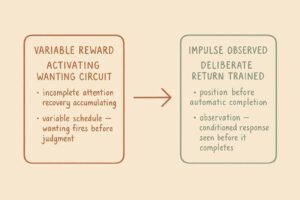
The first is the conditioning layer. Notifications are not consistently important — some matter, most do not, and the pattern is unpredictable. This unpredictability is precisely what makes them so difficult to ignore. A reward that arrives on a predictable schedule conditions behavior less powerfully than one that arrives intermittently and without pattern. The anticipation of something that might matter keeps the wanting circuit running. Trying to override this through determination addresses the wrong level — the circuit activates before the deliberate decision does.
The second layer is accumulation. Each time a notification pulls attention away from a task, the brain must execute a recovery process to return to the previous state of engagement. This recovery is not instantaneous. When interruptions arrive faster than recovery can complete — which in contemporary knowledge work is most of the time — the cognitive debt accumulates. The exhaustion at the end of a day of constant notification checking is not primarily the time spent on the phone. It is the sum of incomplete recoveries, stacked one on top of the next.
Where these two layers compound each other, digital fatigue becomes structural rather than incidental. The conditioning keeps the checking happening; the checking keeps fragmenting the attention; the fragmented attention never fully recovers before the next interruption arrives. The intervention is not the elimination of all notifications. It is the recovery of the capacity to choose whether to respond — and when.
Session 2: Choosing the Response
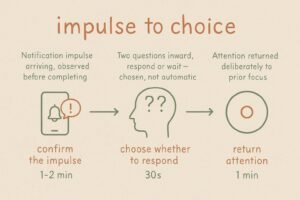
STEP 1: Confirm the impulse (1–2 minutes)
When a notification sound, vibration, or the urge to check arrives, stop before reaching for the device.
Confirm that the impulse is present.
The urge to check is here right now.
This is not a refusal. It is a single step from inside the automatic response to a position from which the response can be observed — and, from that position, chosen.
STEP 2: Choose whether to respond (30 seconds)
From that position, bring two questions inward:
Does this require a response right now?
If not, what actually happens if it waits?
Either answer is acceptable. Responding is a choice. Not responding is also a choice. The difference between an automatic reaction and a chosen response is this single moment of confirmation — the impulse noticed before it completes itself.
STEP 3: Return attention deliberately (1 minute)
After the choice — whichever it is — bring attention back intentionally to what was in focus before.
Returning now.
This deliberate return is a practiced operation, not just a practical one. Each intentional return trains the attention control circuit, and the training accumulates across repetitions.
Session 3: Four Findings That Explain the Chain
Why the pull activates before the decision does
B.F. Skinner’s variable ratio reinforcement schedule — from The Behavior of Organisms (1938) — established that behavior conditioned by unpredictable reward is more resistant to extinction than behavior conditioned by predictable reward. Kent Berridge and Terry Robinson’s incentive salience theory, from Brain Research Reviews (1998), extends this to the neural level. Notifications are not consistently rewarding; some are important, most are not, and the distribution is unpredictable. This is the structural equivalent of a variable ratio schedule — the most powerful conditioning arrangement Skinner identified. Berridge’s wanting circuit, which runs on dopaminergic activation and generates craving independently of whether the reward ultimately arrives, is what the variable schedule engages. The experience of needing to check even when the rational assessment is that nothing important has likely arrived is this circuit operating as designed. Willpower-based approaches to overriding it address the wrong level: the wanting circuit activates before the deliberate judgment does.
What the repetition of checking accumulates
Gloria Mark and colleagues’ attention fragmentation research, from the *CHI Conference* (2008), provides the cost accounting for what the repetition of conditioned checking accumulates. Mark’s team found that after a digital interruption, it takes an average of twenty-three minutes for attention to fully return to the state it was in before the interruption. A separate observation from the same research program showed that contemporary knowledge workers experience some form of interruption on average every three to five minutes — meaning that full attention recovery almost never occurs before the next interruption arrives. The cognitive debt that accumulates is not the time spent checking. It is the sum of incomplete recoveries: attention that was pulled away, began to return, and was pulled away again before the return was complete.
What fragmented attention does to wellbeing
Matthew Killingsworth and Daniel Gilbert’s experience-sampling research, from Science (2010), extends the account to what that fragmented attention state does to wellbeing. Killingsworth and Gilbert found that minds were wandering from present activity approximately 47 percent of the time, and that this state was consistently associated with lower wellbeing regardless of what the person was doing. Fragmented attention creates the structural conditions for mind-wandering: when attention cannot fully settle into what is present because it is managing a queue of incomplete recoveries, it defaults to processing what is absent — the interruption just passed, the task not yet returned to, the notification not yet checked. The unhappiness associated with notification-heavy patterns is not only fatigue. It is the sustained redirection of attention away from present experience that the fragmentation makes structurally inevitable.
Where the intervention is located
William James’s account of voluntary attention, from Principles of Psychology (1890), locates the intervention point — what changes when the chain is interrupted. James identified the capacity to direct attention deliberately — to choose where it goes rather than having it captured by whatever signal is most insistent — as the core of psychological autonomy. James was not arguing that conditioned responses could be eliminated. He was identifying a trainable capacity that runs alongside conditioning: the ability to notice the pull and choose whether to follow it. What Theravāda Buddhism described as sense restraint (Indriya-samvāra) — the practice of meeting sensory and mental stimuli with awareness rather than automatic reaction, choosing what enters and what does not — arrived at the same operational conclusion James identified: the conditioning that makes notifications difficult to ignore does not disappear. What the practice develops is the position from which the conditioned response can be observed before it completes itself.
Conclusion: It Was a Design Problem, Not a Willpower Problem

The variable reinforcement schedule had been conditioning the checking. The checking had been fragmenting the attention. The fragmented attention had been sustaining mind-wandering and eroding wellbeing. The circuit was running as it was built to run — and the difficulty of stopping it was structural, not personal.
The intervention is a single step: noticing that the impulse has arrived before the action does. That step does not require the conditioning to stop. It requires only that a position outside the automatic response becomes available — the position from which the response becomes a choice.
The notification wasn’t the problem. The variable reward schedule that made ignoring it feel impossible — that was the design.
KEY TERMS
Variable Reinforcement and the Wanting Circuit
B.F. Skinner’s variable ratio reinforcement schedule, from The Behavior of Organisms (1938), showing that unpredictable reward conditions behavior more powerfully than predictable reward — combined with Kent Berridge and Terry Robinson’s incentive salience theory from Brain Research Reviews (1998). The unpredictable importance of notifications creates the structural equivalent of a variable ratio schedule; Berridge’s wanting circuit maintains checking behavior through dopaminergic craving that runs independently of whether the reward arrives. Together, they explain why willpower-based approaches address the wrong level of the problem.
Attention Fragmentation Cost
Gloria Mark and colleagues’ finding, from CHI Conference (2008), that digital interruptions require an average of twenty-three minutes for full attention recovery, combined with the observation that contemporary knowledge workers are interrupted every three to five minutes on average. The cognitive debt that accumulates is not the time spent checking but the sum of incomplete recoveries — attention repeatedly pulled away before the return from the previous interruption was complete.
Mind-Wandering and Wellbeing
Matthew Killingsworth and Daniel Gilbert’s finding, from Science (2010), that minds wander from present activity approximately 47 percent of the time and that this state consistently predicts lower wellbeing. Fragmented attention creates structural conditions for mind-wandering by preventing attention from settling into present experience; the unhappiness associated with digital overload reflects this sustained redirection as much as it reflects fatigue from the checking itself.
Voluntary Attention and Indriya-samvāra
William James’s account, from Principles of Psychology (1890), that the capacity to direct attention deliberately — choosing where it goes rather than having it captured by the most insistent signal — is the core of psychological autonomy. Not the elimination of conditioned responses, but the trainable capacity to observe the pull before following it. Corresponds to the Theravāda Buddhist practice of sense restraint (Indriya-samvāra) — meeting stimuli with awareness rather than automatic reaction — as a description of the same capacity from a different starting point.