
Introduction: Where the Feeling of Not Being Enough Comes From

A post goes up. The response is smaller than expected. Something deflates.
Or a feed is scrolled. Someone else’s success, someone else’s life looking more complete, more recognized. Against that, the current moment feels insufficient.
Neither of these is a character weakness or an unusually strong need for approval. The feed is designed to generate upward comparison — the kind that consistently makes what one has look like less. And when the instability that comparison produces is soothed by checking for approval, the originally intrinsic motivation for being on the platform — the interest in connecting, the pleasure of sharing — begins converting into something that requires external validation to function.
This article traces that structure, and describes where the intervention is available.
Session 1: Two Layers of the Same Chain

The way social media destabilizes self-worth operates through two connected layers.
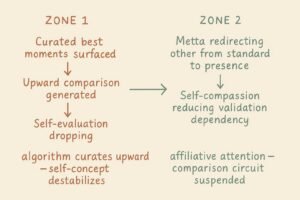
The first is a design problem. Feed algorithms prioritize content that generates the most engagement — which in practice means the most successful moments, the most polished presentations, the most impressive achievements. This is not the full range of other people’s lives. It is their curated highlights, selected and amplified by the platform’s architecture. The upward comparison that results is not a personal choice. It is structurally generated by what the algorithm surfaces.
The second layer is what happens once self-worth has been destabilized. The natural response to a drop in self-evaluation is to seek something that restores it. On a platform where approval is quantified and immediately available, checking for that approval becomes the repair mechanism. When this pattern repeats — self-worth destabilized by comparison, restored by approval, destabilized again — the originally intrinsic motivation for using the platform begins to convert. What was once engaged in for its own sake becomes engaged in for the response it generates. This conversion is the point at which the platform stops being a tool for connection and becomes a system for managing self-evaluation.
Session 2: Intervening in the Comparison Circuit
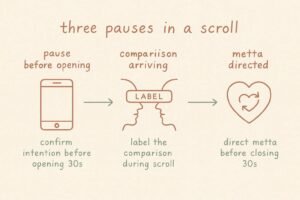
STEP 1: Confirm the intention before opening (30 seconds)
Before opening the app, pause.
What am I actually looking for right now?
Information, connection, something to do with restless energy — no answer is required. Directing the question interrupts the automatic opening and creates a single step between impulse and action.
STEP 2: Place a label when comparison arrives (during scrolling)
When the feeling of insufficiency, envy, or self-evaluation dropping arrives during a scroll, place a short label on it.
Upward comparison is running.
This is what the feed generated.
Naming the type of experience rather than reacting to its content creates a small distance between the comparison and the self-evaluation it was producing. The feeling remains present. Its claim on the self-concept loosens.
STEP 3: Direct Mettā before closing (30 seconds)
Before closing the app, bring brief intention toward the last person whose content was seen — friend or stranger.
May you be at ease.
Then toward the self:
May I be at ease with what I have.
This is not a performance of generosity. It is a single operational shift — moving the other person from the position of evaluative standard to the position of someone also carrying something. The comparison circuit processes others as measurements. This redirects the processing.
Session 3: Four Findings That Trace the Chain
How the feed structures the comparison
Leon Festinger’s social comparison theory, from Human Relations (1954), established that when objective standards for self-evaluation are unavailable, people turn to comparison with others as a substitute. Elan Vogel and colleagues extended this to the social media context in Journal of Social and Clinical Psychology (2014), with experimental findings showing that Facebook use specifically generates upward comparison — comparison with those who appear to be doing better — and produces significant decreases in self-evaluation and mood. The critical finding in Vogel’s research is that the effect depends more on whose content is seen than on how long the platform is used. Because feed algorithms prioritize the most engaging content — which is structurally the most successful, most polished, most impressive — the comparison the platform generates is not a random sample of other people’s lives. It is a curated selection of their best moments, ranked and surfaced by the platform’s engagement logic.
How approval-seeking converts intrinsic motivation
Edward Deci and Richard Ryan’s self-determination theory, from Psychological Review (1985), identifies what happens when the self-worth instability that comparison produces is repeatedly managed through approval-seeking. Deci and Ryan’s research on the undermining effect showed that intrinsically motivated activities lose their intrinsic motivation when they become consistently associated with external reward. The pleasure of documenting daily life, the interest in connecting with others — these are intrinsic motivations. When they become continuously paired with the quantified external reward of likes and comments, the intrinsic motivation gradually gives way to the external contingency. The activity is no longer engaged in for what it offers in itself but for what response it generates. Once this conversion has occurred, the platform no longer provides what it originally provided — the intrinsic satisfaction is gone, but the external reward expectation remains, requiring ever more engagement to produce the same regulatory effect on self-worth.
Why some people are more vulnerable than others
Jennifer Campbell’s self-concept clarity research, from Journal of Personality and Social Psychology (1990), identifies the variable that determines how deeply the chain takes hold. Campbell showed that people with less clearly defined self-concepts are more vulnerable to destabilization by external evaluation and change. In the social media context, lower self-concept clarity amplifies both the impact of upward comparison and the pull toward approval-seeking as a repair mechanism: when the self-concept is less stable, the feed’s generated comparisons reach further into self-evaluation, and the dependency that Deci and Ryan described deepens faster. The vulnerability to comparison and the speed of approval dependency are not fixed personality traits. They are functions of self-concept stability — a variable that changes with practice.
What Mettā attention does to the comparison circuit
Olga Klimecki and colleagues’ research, published in Cerebral Cortex (2013), identifies the neural mechanism by which redirecting attention toward others interrupts the comparison circuit. Klimecki’s findings showed that compassionate attention strengthens the affiliative system circuitry — shifting the processing of other people from competitive evaluation toward resonance. Neff and Germer’s research, published in Journal of Clinical Psychology (2013), shows the corresponding shift in self-evaluation: self-compassion reduces dependency on external validation for self-worth. Upward comparison functions by processing others as evaluative standards — as measurements against which the self comes up short. Mettā-oriented attention redirects that processing: the other person moves from standard to presence, and the self-evaluative function the comparison was performing is suspended. What Theravāda Buddhism described as Indriya-samvāra — choosing what enters awareness rather than reacting automatically to what the environment provides — is the practical basis for interrupting the chain at the point where comparison begins.
Conclusion: The Architecture Was the Problem

The upward comparison was generated by the feed’s design. The approval dependency deepened as intrinsic motivation converted into external contingency. The exhaustion was structural — the product of a chain that the platform’s design set in motion and that self-concept instability amplified.
Labeling the comparison creates distance from the self-evaluation it was producing. Mettā attention redirects what others are being processed as. Both operate at the point where the chain can be interrupted — before the comparison completes its function.
The comparison wasn’t a personal weakness. It was the architecture.
KEY TERMS
Upward Comparison by Design
Leon Festinger’s social comparison theory (Human Relations, 1954) established that people use others as self-evaluation standards when objective measures are unavailable. Elan Vogel and colleagues extended this to social media in Journal of Social and Clinical Psychology (2014), finding that platform use generates upward comparison against those who appear to be doing better — producing significant decreases in self-evaluation. The effect depends more on whose content appears than on duration of use; feed algorithms structurally surface the most polished and successful content, making the comparison architectural rather than incidental.
Undermining Effect
Edward Deci and Richard Ryan’s finding, from Psychological Review (1985), that intrinsically motivated activities lose their intrinsic quality when consistently paired with external reward. In the social media context: the intrinsic motivations of connection and self-expression convert into approval dependency through repeated association with quantified external reward. Once converted, the platform no longer provides intrinsic satisfaction, but the external reward expectation persists, requiring increasing engagement to produce the same self-regulatory effect.
Self-Concept Clarity and Comparison Vulnerability
Jennifer Campbell’s finding, from Journal of Personality and Social Psychology (1990), that lower self-concept clarity predicts greater vulnerability to destabilization by external evaluation. In the social media context, self-concept instability amplifies both the impact of upward comparison and the pull toward approval-seeking as a repair mechanism. Vulnerability to comparison and speed of approval dependency are functions of self-concept stability rather than fixed personality traits.
Mettā Attention and the Comparison Circuit
Olga Klimecki and colleagues’ finding, from Cerebral Cortex (2013), that compassionate attention strengthens affiliative processing of others — combined with Neff and Germer’s finding in Journal of Clinical Psychology (2013) that self-compassion reduces external evaluation dependency. Redirecting attention from evaluative to affiliative processing suspends the self-evaluative function upward comparison performs. Corresponds to Indriya-samvāra as the practical basis for choosing what enters awareness rather than reacting automatically to what the feed provides.