
Introduction: What the Brain Is Doing When Ideas Won’t Come

The deadline is approaching. Thinking is required. Nothing arrives. The harder the effort to concentrate, the more the thinking seems to circle without traction.
This is not a concentration problem. Every time attention switches between tasks, cognitive activity from the previous task persists in the brain — compressing the available space for new thought. And as that residue accumulates, the time available for the brain circuit that generates creative insight to do its work is progressively reduced.
There is a deeper layer. Creative insight is not produced by conscious effort. It is processed by a circuit that activates when the brain is in a relatively unloaded state — and that circuit requires the absence of attention residue to function well.
Session 1: Why Creative Thinking Depletes

The intuition that thinking harder will produce better ideas is not supported by what neuroscience shows about how creative thought is generated.
Creative insight requires both deliberate focus and what happens when the brain is not under deliberate load. The default mode network and the executive control network need to cooperate — the DMN generating free associations from long-term memory, the executive control network selecting among them. This cooperation activates more reliably when attention is stable at a single point, or when the brain has been released from active cognitive processing.
The problem is that the contemporary information environment structurally undermines this cooperation. Each switch between tasks, notifications, and messages leaves attention residue — cognitive activity from the previous task that continues running and occupies working memory capacity that would otherwise be available for new thinking. The residue accumulates. The DMN’s available operating time shrinks. The feeling of being mentally exhausted while having done nothing clearly productive, of being unable to think past the surface of a problem, reflects this accumulation rather than a personal failure of concentration.
The direction of intervention is not to try harder. It is to resolve the residue and restore the conditions under which the DMN and executive control network can cooperate.
Session 2: Creating the Space
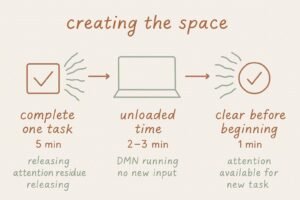
STEP 1: Complete one task before moving (5 minutes)
Are there multiple unfinished tasks currently running in the background?
Choose one. For five minutes, work on that task only — notifications off, other tabs closed. The objective is not perfect completion but a genuine sense of closure on this portion.
This part is done. It can be set down.
The sense of completion — even partial completion with a clear boundary — is what releases attention residue. The brain can move to the next task only when it has registered that the previous one has reached a stopping point.
STEP 2: Create deliberate unloaded time (2–3 minutes)
Once or twice during the day, create a period of not processing anything.
Phone down, screen closed. Look out a window, feel the breath, or simply sit.
Nothing to handle right now.
This is not a break in the conventional sense. It is the condition under which the DMN operates freely — the deliberate permission for the brain to run its background processes without additional input competing for the same capacity.
STEP 3: Clear before beginning (1 minute)
Before starting a new task or a thinking-intensive piece of work, take thirty seconds to one minute without input.
Check whether anything from the previous task is still running.
Is the last task still present?
If residue is detectable, name it briefly and set it aside consciously. That act of naming and placing functions as a release — giving the brain a signal that this thread is being held, not abandoned, and that attention is now available to move.
Session 3: Four Findings That Explain the Depletion
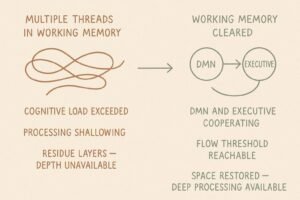
Where the residue comes from
Sophie Leroy’s account of attention residue, from Organizational Behavior and Human Decision Processes (2009), identifies the mechanism at the point of task switching. Leroy showed that after transitioning away from a task, cognitive activity related to that task persists — continuing to run in working memory even as attention is directed elsewhere. The residue is strongest when the previous task was left incomplete or concluded without time pressure, because the brain has no clear signal that the thread has been resolved. What this means practically is that switching tasks does not end the processing of the previous one. The switch is behavioral; the cognitive processing continues. As switches accumulate across a day of notifications, messages, and parallel task management, the residue layers — and the working memory capacity that would otherwise be available for new thinking is progressively occupied by threads that haven’t been released.
Why the occupation matters
John Sweller’s cognitive load theory, from Cognitive Science (1988), provides the structural account of why that occupation matters. Sweller showed that working memory has a fixed capacity — the number of elements it can actively process at any given time is limited — and that when that capacity is exceeded, the depth of processing decreases. Attention residue from multiple prior tasks running simultaneously with a new task distributes working memory across competing demands. The result is not that thinking stops but that it becomes shallower: ideas are generated at the surface level, the kind that arrives first and is easiest rather than the kind that requires sustained exploration. Creative thinking specifically depends on deeper processing — on following a line of thought past its obvious destinations — and that depth is exactly what divided working memory cannot sustain.
The circuit that becomes available
Roger Beaty and colleagues’ neuroimaging research, from Trends in Cognitive Sciences (2016), identifies the neural mechanism that becomes available when cognitive load is resolved. Beaty’s team showed that creative cognition involves cooperation between the default mode network and the executive control network — two systems that typically operate in an antagonistic relationship. The DMN generates spontaneous associations from long-term memory; the executive control network evaluates and guides the selection among them. In highly creative individuals, these two networks activate together rather than in opposition. This cooperation is most reliably engaged when attention is stable or when the brain has been released from active cognitive processing — precisely the conditions that attention residue and high cognitive load disrupt.
What the restoration of those conditions enables
Mihaly Csikszentmihalyi’s flow research — from Psychological Review (1975) and developed in Flow (1990) — describes what becomes possible when the conditions are restored. Csikszentmihalyi showed that the state of deep immersion characterized by effortless focus and high performance emerges under specific conditions: a balance between task difficulty and skill level, clear goals, and the absence of attentional fragmentation. Attention residue directly undermines the third condition — when cognitive threads from previous tasks are still running, attention cannot fully settle, and the threshold into flow is not reached. What Theravāda Buddhism described as collected attention (Samādhi) — the undistracted state in which attention rests at a single point with clarity — arrived at the same operational conclusion: not the absence of effort, but the removal of what prevents effort from going deep. Beaty’s DMN-executive cooperation and Csikszentmihalyi’s flow both require that removal. The residue was what was standing in the way.
Conclusion: The Problem Was Never the Effort

Attention residue had been compressing the available cognitive space. Accumulated load had been distributing working memory across unresolved threads. The time for the DMN and executive control network to cooperate had been structurally reduced. Ideas weren’t absent because of insufficient thinking. They were absent because the conditions for the thinking that produces them had been taken away.
The intervention was never about trying differently. It was about clearing what had accumulated — so that the circuit that generates ideas could do what it was built to do.
Creativity wasn’t blocked by the lack of effort. It was blocked by the absence of the space where it does its work.
KEY TERMS
Attention Residue
Sophie Leroy’s finding, from Organizational Behavior and Human Decision Processes (2009), that cognitive activity related to a previous task persists after switching away from it — continuing to occupy working memory and reducing performance on the new task. Residue is strongest when the previous task was left incomplete or concluded without time pressure. As task switches accumulate, residue layers, progressively compressing the cognitive space available for new thinking and preventing the working memory availability that creative processing requires.
Cognitive Load Theory
John Sweller’s account, from Cognitive Science (1988), that working memory has a fixed capacity and that exceeding it reduces the depth of processing. When attention residue from prior tasks runs alongside new work, working memory is distributed across competing demands — producing thinking that is shallower rather than absent. Creative thought specifically depends on sustained depth of processing, making high cognitive load a structural obstacle to the kind of thinking that generates original ideas rather than obvious ones.
DMN-Executive Network Cooperation
Roger Beaty and colleagues’ finding, from Trends in Cognitive Sciences (2016), that creative cognition involves cooperation between the default mode network — which generates spontaneous associations from long-term memory — and the executive control network, which evaluates and guides selection among them. This cooperation, typically antagonistic in non-creative tasks, is most reliably engaged when attention is stable or cognitive load is low.
Flow State and Its Conditions
Mihaly Csikszentmihalyi’s account, from Psychological Review (1975), that deep immersive absorption emerges under conditions of skill-challenge balance, clear goals, and undivided attention. Attention residue directly undermines the third condition — when prior cognitive threads are still active, attention cannot settle, and the threshold into flow is not reached. Accessible in Flow: The Psychology of Optimal Experience (1990).