
Introduction: The Moment You Notice You’ve Drifted Is the Moment the Training Happens

Something familiar occurs during meditation. The intention is to stay with the breath. Then, without any clear transition, the mind is elsewhere — a conversation from yesterday, something that needs to be done tomorrow, a question with no immediate answer.
The instinct is to register this as a lapse. It is the opposite. The act of noticing that attention has drifted and returning it — that specific operation — is what strengthens the attention control circuit. Drifting is not the problem. Drifting without noticing is what removes the training opportunity.
Concentration practice and Mettā practice change different circuits in different directions. Concentration practice strengthens the attention control circuit and quiets self-referential rumination. From that quieter state, Mettā practice opens the circuit oriented toward others. The two practices are not variations of the same thing. They are complementary operations on different parts of the same system.
Session 1: The Return Is What Builds the Circuit

The core mechanism of meditation’s effect on the brain is not the production of a special state. It is a simpler operation repeated many times.
In concentration practice, attention is directed to a single point — typically the breath — and when it drifts, the fact of drifting is noticed, and attention is returned. This noticing-and-returning is the training unit. The anterior cingulate cortex and prefrontal cortex — the regions that regulate where attention goes and how it is sustained — are activated by the return operation. The repetition of that activation is what changes the circuit over time.
What this means practically is that drifting is not a failure to be minimized. It is the condition that makes the return possible. A session in which attention drifts and returns twenty times is a session in which the training operation runs twenty times. A session in which attention drifts and the drift is not noticed is a session in which it runs zero times.
When the attention control circuit strengthens, two things follow. The default pattern of self-referential rumination — the continuous processing of past events, future scenarios, and evaluations of the self — begins to quiet. And in that quieter state, the second practice becomes available: Mettā meditation, which directs attention outward and opens the circuit oriented toward other people.
Session 2: Practicing Both Circuits
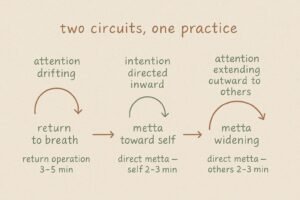
STEP 1: The return operation (3–5 minutes)
Direct attention to the breath — the sensation at the nostrils, or the movement of the abdomen. Choose one point and stay with it.
When attention drifts — and it will — confirm the fact of the drift without evaluating its content or frequency.
Attention moved. Returning now.
The content of the drift does not matter. The number of times it happens does not matter. Each return is the training unit.
STEP 2: Direct Mettā toward yourself (2–3 minutes)
From the position of settled attention, bring intention inward.
May I be at ease.
May I meet this moment without resistance.
If the phrases feel unfamiliar or flat, that is not a problem. The operation is directing attention in a specific direction — the feeling follows the repetition, not the other way around.
STEP 3: Direct Mettā toward others (2–3 minutes)
Extend from the self outward — toward someone close, someone neutral, someone difficult.
May you be at ease.
May what is difficult for you find some relief.
The amygdala’s tendency to register others as potential threats is what this practice works against — not through effort or persuasion, but through the repetition of directing attention differently.
Session 3: Five Findings That Map the Circuits
Where the training unit is located
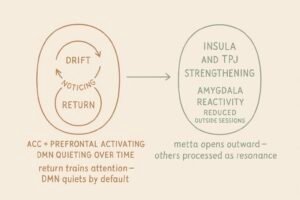
Wendy Hasenkamp and colleagues’ research, published in NeuroImage (2012), identified the neural structure of the training unit in concentration practice. Using real-time fMRI tracking during meditation, Hasenkamp’s team mapped four phases of the attention cycle: mind-wandering, the moment of noticing the drift, the act of redirecting attention, and sustained focus. Each phase showed a distinct neural signature. The noticing moment activated the anterior insula and inferior frontal gyrus; the redirecting operation activated the anterior cingulate cortex and dorsolateral prefrontal cortex. What subjectively registers as correcting a lapse is, at the neural level, a direct loading of the attention control circuit. The training does not happen during the periods of sustained focus. It happens at the moment of return.
How functional training becomes structural change
Sara Lazar and colleagues’ structural neuroimaging study, published in NeuroReport (2005), showed that this functional training produces measurable structural change over time. Comparing experienced meditators with non-meditators, Lazar’s team found greater cortical thickness in the prefrontal cortex and right anterior insula among practitioners — regions corresponding precisely to those Hasenkamp identified as activated during the return operation. A further finding concerns aging: cortical thickness in the prefrontal cortex typically decreases with age, but in long-term practitioners this thinning was attenuated. Hasenkamp’s functional observations and Lazar’s structural findings map the same training effect at two different timescales — one measured in sessions, the other in years.
What the strengthened circuit produces by default
Judson Brewer and colleagues’ research, published in PNAS (2011), extends the account beyond improved focus to what the strengthened attention control circuit produces by default. Brewer’s team found that experienced meditators showed significantly reduced activity in the default mode network — the circuit that processes self-referential thought, rumination, and mind-wandering — both during meditation and during resting state. The resting-state finding is significant: the reduction was not confined to meditation sessions but reflected a shift in the brain’s default operation. The quieting of chronic self-referential processing is both a wellbeing outcome in itself and the neural condition under which Mettā practice’s outward orientation becomes more available.
What Mettā practice opens from that quieter ground
From that quieter ground, Olga Klimecki and colleagues’ compassion training research, published in Cerebral Cortex (2013), describes what Mettā practice opens. Klimecki’s research showed that compassion training strengthens the insula and temporoparietal junction — the circuits involved in resonating with others’ emotional states and in perspective-taking. Where concentration practice works in the direction of quieting self-referential processing, Mettā practice works in the direction of opening attention toward others. These are not opposed directions. They are complementary: the first creates the conditions the second requires.
What Mettā practice does to the amygdala
Gaëlle Desbordes and colleagues’ research, published in Frontiers in Human Neuroscience (2012), documents what Mettā practice does to the amygdala — the region central to processing others as potential threats. After eight weeks of Mettā meditation training, participants showed reduced amygdala reactivity to emotionally evocative images — and this reduction was measured outside of meditation, in ordinary waking states. The reduction in reactivity is not the suppression of emotional response. It reflects a shift in how others are processed: less as sources of threat, more as objects of potential resonance. What Theravāda Buddhism described as Sati — the quality of attention that notices where the mind has gone and returns it deliberately — arrived at the same operational description Hasenkamp’s research mapped: the noticing, the return, and the repetition that gradually changes what the attention system does by default.
Conclusion: The Drift Was Always the Training

The noticing-and-returning operation was strengthening the attention control circuit. That strengthened circuit was quieting the default rumination. And from that quieter state, Mettā practice was opening the circuit oriented toward others. The drift was never the failure. It was the condition that made the return possible — and the return was always the training.
Concentration practice and Mettā practice do not converge on the same outcome. One quiets the circuit that loops inward; the other opens the circuit that reaches outward. What connects them is sequence — and the return operation is where that sequence begins.
The distraction was never the failure. It was the repetition that built the circuit.
KEY TERMS
Attention Control Training
Wendy Hasenkamp and colleagues’ finding, from NeuroImage (2012), that the noticing-and-returning operation in concentration practice activates the anterior insula, anterior cingulate cortex, and dorsolateral prefrontal cortex in a specific sequence. The training unit is not the period of sustained focus but the moment of return — each return loads the attention control circuit. Reframes drifting as the condition that makes training possible rather than as a failure to be minimized.
Cortical Thickness Changes
Sara Lazar and colleagues’ finding, from NeuroReport (2005), that long-term meditators show greater cortical thickness in the prefrontal cortex and right anterior insula — regions activated during the return operation Hasenkamp identified — and that age-related cortical thinning in the prefrontal cortex is attenuated in practitioners. Provides the structural evidence that the functional training effect Hasenkamp documented accumulates as lasting anatomical change.
DMN Suppression
Judson Brewer and colleagues’ finding, from PNAS (2011), that experienced meditators show reduced default mode network activity both during meditation and in resting state — reflecting a shift in the brain’s default operation rather than a meditation-only effect. The quieting of chronic self-referential processing is both a wellbeing outcome and the neural condition under which Mettā practice’s outward orientation becomes more accessible.
Mettā Practice and the Affiliative System
Olga Klimecki and colleagues’ finding, from Cerebral Cortex (2013), that compassion training strengthens the insula and temporoparietal junction — circuits involved in emotional resonance and perspective-taking. Where concentration practice quiets self-referential processing, Mettā practice opens attention toward others — the two practices are complementary rather than parallel, with concentration practice creating the conditions Mettā practice requires.
Amygdala Reactivity and Mettā
Gaëlle Desbordes and colleagues’ finding, from Frontiers in Human Neuroscience (2012), that eight weeks of Mettā meditation training reduced amygdala reactivity to emotional stimuli in ordinary waking states — outside of meditation sessions. The reduction reflects a shift in how others are processed: less as potential threats, more as objects of resonance. Connects to Sati’s functional role as the attentional operation that makes both circuits trainable.