
Introduction: It Was Never Inconsistency

Getting closer to someone and suddenly wanting to pull back.
Lonely when alone, drained when together.
Developing feelings for someone and finding, without warning, that it’s frightening.
Many people interpret these experiences as evidence of emotional instability — that they are bad at relationships, unable to attach, inconsistent in ways they should be ashamed of.
But this is not inconsistency. It is the neurologically explainable state of having a genuine desire for connection and a genuine fear of connection present simultaneously. And the oscillation between them — the moving toward and moving away — follows a pattern that is specific to each person and, once recognized, entirely consistent.
This article explains the structure. Why the brain generates both I want to get closer and this is dangerous toward the same person. Why the direction of the oscillation differs across individuals. And whether the pattern can change.
Session 1: The Oscillation Has a Structure

The experience of getting close and then pulling back — or pulling back and then missing someone — tends to feel random. Looked at more carefully, it moves in a direction.
One pattern is approaching too far and then being pushed away. When someone tries to be intimate, anxiety rises and distance follows. But when that person withdraws, urgency appears. People with this pattern tend to experience every relationship as either too close or too far, never quite landing at a workable distance.
The other pattern is withdrawing too far and then arriving at loneliness. As intimacy approaches, something internal activates to protect, and the person pulls back. But after pulling back, loneliness remains. People with this pattern tend to want deep connection and find that something interferes every time they get close.
Neither pattern is evidence of a broken self. Each has an explicable structure — an internal working model of self and other, shaped by early attachment experiences, that sets a default for how closeness is processed. And that working model can be updated.
Session 2: Noticing the Pattern and Inserting a Pause
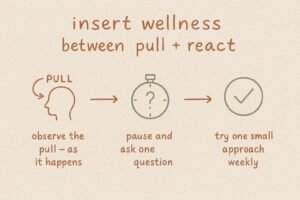
STEP 1: Observe the pull as it happens (as occasions arise)
When something shifts in a relationship — a pull toward distance, or a rise in anxiety — at the moment of noticing, ask:
Am I feeling too close right now? Or have I pulled too far?
No judgment yet. No correction. Just observation.
There is a pull to withdraw right now. The anxiety is rising.
This noticing alone delays the automatic response. The pattern operates most powerfully when it goes unobserved.
STEP 2: Pause before reacting, and ask one question (as occasions arise)
Once the sensation has been noticed, before responding, ask:
Is this a reaction to what is actually happening — or is the old pattern running?
Complete certainty is not required. Asking the question is enough to interrupt the automatic chain.
When the pull to withdraw is present: is there a way to stay just a little longer? When anxiety is rising: is there a way to step back just slightly and observe rather than react?
Both moves are small. The aim is not to eliminate the pattern but to introduce a small degree of choice within it. This pattern was once trying to protect you. Right now, a slightly different response is available.
STEP 3: Try one small, safe approach (once a week)
Within a relationship where the pattern has been noticed, choose one action that moves very slightly toward connection.
The measure: something that feels a little uncomfortable for me, carries no real risk of harm, and is entirely reversible.
Send a message. Ask how someone is doing. Say something true that hasn’t been said before.
No large shift is needed. Small repeated experiences of safe approach accumulate into an update of the brain’s predictions about what closeness does. This is the beginning of what attachment research calls earned security.
Session 3: Four Findings That Explain the Pattern
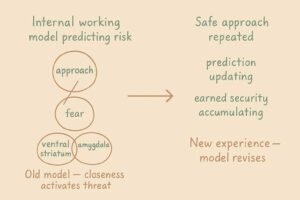
Where the oscillation originates
John Bowlby’s account, from Attachment and Loss, Volume I (Hogarth Press, 1969), establishes where the oscillation originates. Bowlby showed that early experiences with caregivers generate an internal working model — a cognitive and affective schema representing the self and others — that functions as an initial answer to the questions am I worth being loved? and can others be trusted? This model becomes the template through which all subsequent intimate relationships are processed. When closeness activates the threat system — because the internal working model learned that closeness preceded harm, abandonment, or conditional acceptance — the approach and the fear arrive simultaneously. The oscillation is not between loving and not loving. It is between the drive to connect and the model’s standing prediction that connection carries risk.
Why the oscillation takes different forms
Kim Bartholomew and Leonard Horowitz’s four-category model of adult attachment, published in the Journal of Personality and Social Psychology (1991), extends Bowlby’s framework and reveals why the oscillation takes different forms for different people. Organizing attachment along two dimensions — self-image and image of others — Bartholomew and Horowitz identified four distinct styles: secure, preoccupied, fearful-avoidant, and dismissing-avoidant. Preoccupied individuals approach intensely while rejection anxiety operates continuously in the background. Fearful-avoidant individuals experience the strongest conflict — every move toward closeness simultaneously triggers the move away. Dismissing-avoidant individuals minimize dependency and often underrecognize the loneliness that follows withdrawal. What these patterns share is not inconsistency but a consistent internal logic, running according to predictions formed long before the current relationship existed.
The neural circuit underneath
Robin Aupperle and Martin Paulus’s review, published in Dialogues in Clinical Neuroscience (2010), explains the neural structure that makes wanting to get closer and finding it frightening possible simultaneously. Aupperle and Paulus showed that approach and avoidance behaviors are generated by distinct neural circuits: the ventral striatum produces approach motivation in response to reward and connection; the amygdala and insula generate avoidance motivation in response to threat. These opposing signals are integrated by the prefrontal cortex — but when attachment-related threat is high, amygdala activation exceeds the prefrontal cortex’s capacity to regulate it. The experience of developing feelings for someone and suddenly finding it frightening is, at the neural level, a genuine conflict between two systems — not a sign of emotional instability or weakness.
The evidence that the pattern can change
R. Chris Fraley and Glenn Roisman’s review of longitudinal research, published in Current Opinion in Psychology (2019), provides the evidence that attachment patterns are not fixed. Fraley and Roisman showed that while attachment styles originate in early caregiving experiences, those early experiences do not determine adult outcomes — the associations between early caregiving and adult attachment are weaker and less consistent than attachment theory originally proposed. Repeated experiences of safety within a relationship — being approached and not harmed, being vulnerable and not rejected — accumulate into a revision of the internal working model. This is earned security: security that was not given early but built through experience.
Conclusion

The oscillation between closeness and distance was never inconsistency. It was an internal working model running its predictions — an approach-avoidance circuit doing what it was calibrated to do, based on what it learned before the current relationship existed.
Noticing the pull, inserting a pause, making one small safe approach: these are not fixes. They are the conditions under which the pattern begins to learn something new.
The pattern was never inconsistency. It was the same fear, running on schedule.
KEY TERMS
Internal Working Model
John Bowlby’s account, from Attachment and Loss, Volume I (Hogarth Press, 1969), that early caregiving experiences generate cognitive and affective schemas of self and other that template subsequent intimate relationships. When the internal working model learned that closeness preceded harm or abandonment, the approach drive and the threat response arrive simultaneously — producing the oscillation between wanting connection and finding it frightening.
Four Attachment Styles and Oscillation Patterns
Kim Bartholomew and Leonard Horowitz’s four-category model, published in the Journal of Personality and Social Psychology (1991), organizing adult attachment along self-image and other-image dimensions into secure, preoccupied, fearful-avoidant, and dismissing-avoidant styles. Each style produces a characteristic oscillation pattern — reframing apparent inconsistency as a consistent internal logic running according to predictions formed long before the current relationship existed.
Neural Circuit of Approach-Avoidance Conflict
Robin Aupperle and Martin Paulus’s finding, from Dialogues in Clinical Neuroscience (2010), that approach motivation is generated by the ventral striatum and avoidance motivation by the amygdala and insula, with the prefrontal cortex integrating both signals. When attachment-related threat is high, amygdala activation exceeds prefrontal regulation. Explains the experience of simultaneous desire for and fear of closeness as a circuit conflict rather than emotional instability.
Earned Security
R. Chris Fraley and Glenn Roisman’s finding, from Current Opinion in Psychology (2019), that attachment styles are not determined by early experience but continuously updated by subsequent relationship experiences throughout the lifespan. Repeated experiences of safe approach — being vulnerable and not rejected — accumulate into a revision of the internal working model. Security that was not given early can be built through experience.