
Introduction: The Criticism Arrives Before the Looking Is Done

Standing in front of a mirror. Catching a photograph. A glance down at a hand, a stomach, a face. What arrives is not observation. It is judgment.
Too much. Too old. Why does it look like this.
This voice is not a character flaw. It is a circuit — one built through years of taking in an external evaluator’s perspective and running it as if it were your own.
Understanding where that circuit comes from, and where the judgment lands when it arrives, is what makes Mettā directed at the body something other than consolation.
Session 1: The Critical Eye Was Borrowed

The critical gaze toward the body was not originally an interior one.
Society treats the body as an object of evaluation. Media, advertising, and social platforms continuously present images of the “ideal body” and reinforce the perspective from which one’s own body is measured against that standard. The result of internalizing that perspective over years is that the external evaluator’s view begins to activate automatically — as a circuit running inside, rather than a voice coming from outside.
When the criticism arrives, it is not your perspective operating. It is a borrowed perspective that has made itself at home.
That perspective can be returned.
Session 2: From Evaluation Frame to Sensation Frame
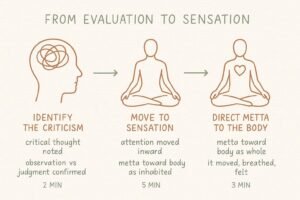
STEP 1: Identify when the criticism arrived today (2 minutes)
Bring to mind a moment today when a critical thought about the body appeared.
When the there it is again evaluation came — was it observation or judgment? Observation sees what is there. Judgment sees what should not be there.
Confirm the difference between the two.
STEP 2: Move attention to sensation (5 minutes)
Bring attention to somewhere in the body right now.
The contact of feet with the floor. The temperature of the hands. The movement of breath through the chest or abdomen.
Receive the body from the inside rather than evaluate it from the outside.
Toward the body that is being sensed, direct quiet intention:
May I inhabit this body with some kindness.
May I meet what I find here with care rather than judgment.
STEP 3: Direct Mettā toward the body as a whole (3 minutes)
From the position of inhabiting rather than evaluating, direct intention toward this body.
It moved today. It breathed. It felt. Toward those facts:
May this body be received as it is, not as it is measured.
Session 3: Objectification Theory and Body Capital, Anchoring, Interoception, and Where the Judgment Lands
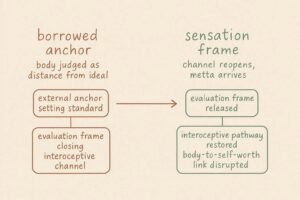
The critical eye has a biography. Social psychology traces where it comes from; behavioral economics explains why it carries such force; neuroscience describes what it costs while it runs.
Barbara Fredrickson and Tomi-Ann Roberts’s objectification theory, presented in Psychology of Women Quarterly (1997), describes the social origin of the critical gaze. Their observation was that women are socialized to view their own bodies from the perspective of an external observer — and that when this self-objectification becomes chronic, the body-surveillance circuit activates automatically. The sociological depth behind this observation comes from Pierre Bourdieu’s account of the body as a bearer of social and cultural capital — developed in The Logic of Practice (1990). The critical eye is not a personal failing — it is a circuit designed and maintained by social structure. Understanding this is the precondition for treating that perspective as something borrowed rather than something intrinsic.
Why the socially established evaluation standard carries such force is where behavioral economics’ anchoring effect provides an explanation. In Thinking, Fast and Slow (2011), Kahneman showed that the first piece of information presented functions as a reference point — an anchor — that pulls subsequent judgments toward it. The “ideal body” images repeatedly presented by media and social platforms become anchored standards for body evaluation: the circuit that forms processes one’s own body as a deviation from that anchor. Kahneman and Amos Tversky’s prospect theory — originally published in Econometrica (1979) — adds a further layer: losses register more strongly than equivalent gains. When deviation from the ideal body is processed as loss, its emotional weight exceeds the weight of any corresponding gain. Dan Ariely, in Predictably Irrational (2008), showed that comparative judgment of this kind is largely automatic and resistant to deliberate correction. Body evaluation is not objective self-assessment. It is the automatic measurement of distance from an externally set anchor — and the anchor was never neutral.
What the evaluation frame does to cognition and to the body’s own sensing is where Fredrickson and colleagues’ experimental findings connect with neuroscientist Anil Seth’s work on interoception. In experimental research published in Journal of Personality and Social Psychology (1998), Fredrickson and colleagues showed that self-objectification states reduce cognitive performance — the working memory capacity consumed by appearance-focused self-surveillance is capacity unavailable for other cognitive functions. Seth, in Being You (2021), showed that the visual evaluation of the body from the outside and the processing of sensation from the inside — interoception — use different neural circuits, with the insula as the primary processing structure for interoceptive signals. When the evaluation frame is running, access to interoceptive sensation is constrained. The critical gaze does not only consume cognitive resources. It closes the channel through which the body’s own signals arrive. The shift from evaluation frame to sensation frame is not a spiritual exercise — it is the restoration of a neural pathway that the evaluation circuit has been occupying.
The destination of the judgment — where it lands after it leaves the mirror — is what Thomas Cash’s body image research describes. Cash, in The Body Image Workbook (1997), showed that body image functions as a core dimension of the self-concept — meaning that evaluations of the body propagate into self-worth as a whole. The conversion of I look wrong into I am therefore inadequate is not a logical leap. It is an automatic processing outcome produced by the connection that has been established between body image and self-worth. Directing warmth toward the body interrupts the evaluation frame that Fredrickson described, reopens the interoceptive pathway that Seth identified, and disrupts the body-to-self-worth conversion that Cash documented. Directing Mettā toward the body is the operation of releasing the externally borrowed anchor and receiving the body as sensation rather than as a score.
Conclusion: Where the Judgment Had Been Landing

The critical eye came from outside — built into the social structure, anchored by repeated external standards, running on a borrowed circuit.
It landed on the body. From there it moved to the self.
The body was never the problem. It was the place where the judgment chose to land.
KEY TERMS
Objectification Theory
Fredrickson and Roberts’s framework, from Psychology of Women Quarterly (1997), describing the socialization of women to view their own bodies from an external observer’s perspective — a self-objectification that, when chronic, becomes an automatic surveillance circuit. Combined with Bourdieu’s account of the body as social and cultural capital from The Logic of Practice (1990), the framework shows the critical eye as a social-structural design rather than a personal disposition.
Anchoring and Body Evaluation
The application of Kahneman’s anchoring effect, from Thinking, Fast and Slow (2011), to body evaluation: media and social platforms establish “ideal body” images as anchors, causing one’s own body to be processed as deviation from those anchors. Combined with Kahneman and Tversky’s prospect theory — originally in Econometrica (1979) — loss asymmetry means body evaluation becomes emotionally weighted toward deficit. Ariely’s work in Predictably Irrational (2008) on automatic comparative judgment shows that this processing is largely resistant to deliberate correction — the anchor operates before evaluation begins.
Interoception and Cognitive Cost
The connection between Fredrickson and colleagues’ experimental finding — self-objectification reduces cognitive performance by consuming working memory — and Seth’s account of interoception in Being You (2021): the evaluation frame not only consumes cognitive resources but constrains access to insula-processed interoceptive sensation. The shift from evaluation frame to sensation frame restores a neural pathway the evaluation circuit has been occupying.
Body Image and Self-Worth Connection
Thomas Cash’s finding, from The Body Image Workbook (1997), that body image functions as a core self-concept dimension, causing body evaluations to propagate into self-worth as a whole. The automatic conversion of body observation into self-attack runs through this established connection. Directing Mettā toward the body becomes an intervention at this conversion point — disrupting the evaluation frame and the self-worth cascade simultaneously.