
Introduction: The Practice That Was Already Scheduled
Brushing teeth while running through tomorrow’s meeting. Washing dishes while replaying a conversation from earlier. Showering while rehearsing what should have been said.
The daily rituals are already happening. The question is whether anything is actually present for them.
The feeling of not having time to meditate is honest. But the two minutes of teeth-brushing, the ten minutes at the sink, the five minutes in the shower — these are already in the day. What’s needed is not more time. It’s a different relationship to the time that is already there.
Session 1: What Autopilot Is Quietly Taking

Repeated actions get handed off. Once teeth-brushing is learned, the brain runs it without supervision — and while it does, attention moves to the next task, the unfinished conversation, what didn’t go well yesterday. This is not weakness. It is efficiency.
But the cost is quiet. Attention spent planning tomorrow while standing at the sink is not available for recovery. The action proceeds; the presence doesn’t. By the end of a day full of activity, there is a specific kind of fatigue — the feeling of having been somewhere without ever quite arriving — and it accumulates across dozens of these small moments when presence was available and not taken.
Each return to the physical sensation of what the hands are doing is a moment of that drift interrupted. Brief, ordinary, sufficient.
Session 2: Three Everyday Practices
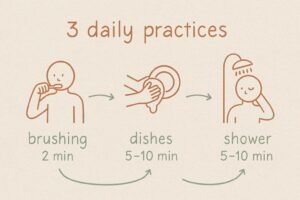
STEP 1: Teeth-brushing (2 minutes)
Phone down. Bring full attention to what is actually happening.
The pressure of the brush against the gums. The texture of the bristles. The sharp scent of mint. The quiet sound of the scrape.
This is what teeth-brushing feels like — right now, not while something else is running.
When a thought arrives — and it will —
There’s a thought. Returning to the brush.
Once a day, two minutes. The attention control circuit loads. That is enough.
STEP 2: Dish-washing (5–10 minutes)
The warmth of the water. Soap moving across a surface. The weight of a plate. Something becoming clean.
The hands are doing something. The attention can stay with what the hands are doing.
When the urge to finish arrives —
There’s the urge to rush. Returning to the water.
This is not an attempt to make dish-washing enjoyable. It is using the time that was already passing for something other than drift.
STEP 3: Shower (5–10 minutes)
Each drop of water landing on skin. The temperature across the shoulders. The sound — steady, white, simply there.
The body is somewhere specific. The attention can be where the body is.
Let sensation be where attention rests, rather than today’s unresolved material.
Session 3: The Gap Autopilot Creates, and What the Body Fills It With
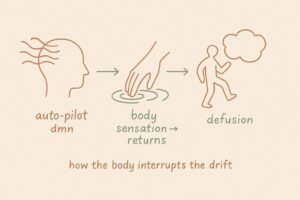
Neuroscientist Marcus Raichle and colleagues’ research established the existence of a brain circuit that activates automatically in the absence of a focused task — the default mode network — continuously processing past events, future scenarios, and unresolved social tensions. Repeated everyday actions like teeth-brushing, dish-washing, and showering provide this circuit with ideal activation conditions: the behavior is sufficiently practiced that it requires no attention, and the resulting gap is filled automatically. Thinking about tomorrow while brushing teeth is not a concentration failure. It is a brain designed for efficiency doing precisely what it was built to do.
What interrupts this is not willpower. Britta Holzel and colleagues’ research, published in NeuroImage (2011), showed that eight weeks of mindfulness practice produced measurable increases in gray matter density in the insula and several other brain regions. The insula is the circuit through which bodily sensation becomes felt experience — the reason the warmth of dishwater registers as more than temperature data. Deliberately directing attention to physical sensation during everyday activity is a direct activation of this circuit. It does not merely redirect attention away from the DMN; it engages a competing processing mode that structurally displaces the default network’s operation. One session of teeth-brushing produces a small number of these activations. The accumulation across daily repetition is where the structural effect Holzel measured becomes possible.
When Step 2 catches the thought I just want to be done with this and steps back from it, a further change is taking place. Steven Hayes and colleagues identified this as defusion — the shift from being fused with a thought, in which thought and thinker feel identical, to observing it as a passing mental event. The thought that arrives during dish-washing — I should have handled that differently — does not need to be resolved or dismissed. It needs only to be noticed as a thought, and attention returned to the water. The thought remains; its claim on the next action loosens. Theravāda Buddhism described this two-layered operation as Sati and Sampajañña — awareness, and clear comprehension: knowing what is arising, and knowing what one is doing while it arises. Brushing teeth and knowing that teeth are being brushed. That quiet clarity is what fills the gap the autopilot left open.
Conclusion

The practice does not require more time. It requires a different relationship to the time that is already there.
Teeth-brushing happens every morning. Dishes happen most evenings. The shower is already built into the day. Each one is a recurring window — brief, bodily, ordinary — in which attention can drift or return.
Thinking about tomorrow while brushing teeth was never a failure of attention. It was the brain running exactly as designed.
The body always knew where to return.
KEY TERMS
Default Mode Network (DMN)
The brain circuit that activates automatically in the absence of a focused task — continuously redirecting processing toward past events, future scenarios, and unresolved social tensions. Raichle and colleagues’ research established this circuit’s existence and its automatic engagement during familiar, repeated actions. The everyday rituals of teeth-brushing, dish-washing, and showering provide the exact conditions under which it runs unchecked.
Insula
A region of the cerebral cortex that integrates bodily sensation with emotional awareness — the circuit through which physical experience becomes felt presence. Holzel and colleagues’ research (NeuroImage, 2011) showed measurable increases in insula gray matter density following eight weeks of mindfulness practice. Directly activated by deliberate attention to physical sensation, it engages a processing mode that structurally displaces the default mode network’s automatic operation.
Defusion
A core concept in Acceptance and Commitment Therapy (ACT), developed by Steven Hayes and colleagues. The shift from being fused with a thought — experiencing it as reality — to observing it as a passing mental event. In everyday practice: noting there’s the urge to rush rather than acting from it. The thought remains present; its claim on the next action loosens.
Sati
Pāli for “awareness.” The quality of attention that notices what is arising — a thought, a drift, an urge — without being carried away by it. In Theravāda practice, Sati is not reserved for formal meditation. It is a trainable quality available in any moment, including the two minutes at the bathroom sink each morning.
Sampajañña
Pāli for “clear comprehension.” The paired quality to Sati: not only noticing what is arising, but knowing what one is doing while it arises. Brushing teeth and knowing that teeth are being brushed. Washing dishes and knowing that dishes are being washed. The quiet layer of clarity that keeps the action and the awareness connected.